Tibetan MP Candidates Call for Active Campaigning, Public Debates Ahead of 2026 Elections
By Tenzin Chokyi
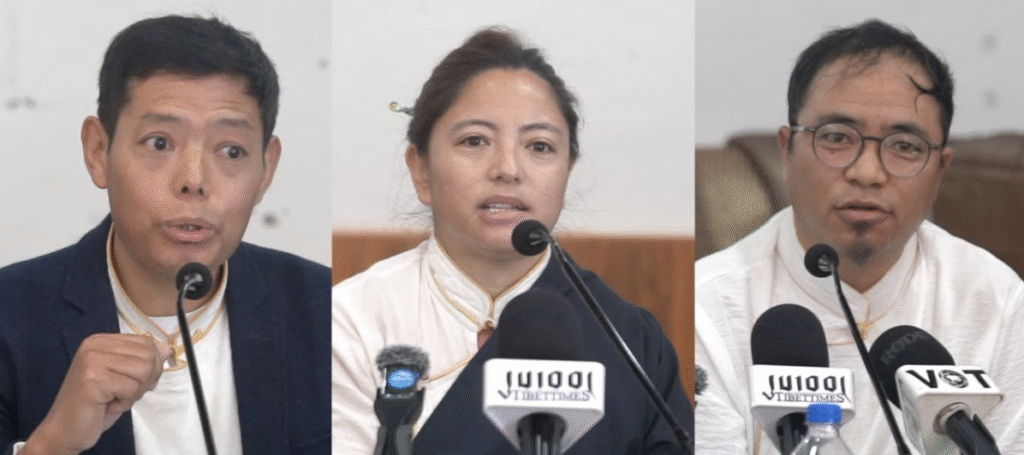
DHARAMSALA, 3 Dec: Three candidates for the 18th Tibetan Parliament-in-Exile (TPIE) held a press conference today at the Dharamsala Tibetan Settlement Office Hall in McLeod Ganj, aiming to stimulate discourse within the Tibetan democratic polity. The candidates expressed serious concern that the exile community has remained largely indifferent and silent since the official start of the election process two months ago.
The Tibetan MP candidates stated that the press conference was an effort to bring together all new MP candidates based in Dharamsala this year and to create a platform for meaningful discourse—one that draws attention to the election and allows candidates to present their visions so that voters have real choices before them.
They stated that although invitations were extended to seven or eight new MP candidates in the 2026 Tibetan general election residing in Dharamsala, others did not attend.
U-Tsang MP candidates Tsering Tharchin and Dr Sonam Topgyal, along with Do-tod MP candidate Gyaltsen Choekyi, who all coincidentally come from research backgrounds, unanimously argued that public debates among candidates—and genuine efforts to present themselves and their visions to the public, rather than merely campaigning online from home – are essential in a democratic society.
“If candidates make little effort to present their case to the public and maintain a certain distance from voters, relying solely on posters and recorded videos on social media, then once elected, they can avoid accountability. It gives them the room to claim that they never personally reached out to people to ask for their votes in exchange for a promise—or even a vision,” said Tharchin, an independent China analyst, who is running for the office for the first time.
Candidates’ minimal engagement in active campaigning within the exile Tibetan polity is often defended as a commitment to upholding ethical standards and to steering clear of the harsher tactics typical in politics. However, today’s discourse among the candidates, the media, and the public pointed instead to the growing concentration of power among established political figures and the trend of blind voting in the diaspora, where an individual’s choice is heavily influenced—if not determined—by the group or organisation they belong to.
Dr Sonam Topgyal, a researcher at Tibet Watch, a research organisation that monitors and reports on developments inside occupied Tibet, stated that the Tibetan struggle must be carried forward across generations in resistance to China’s colonial occupation of Tibet, which seeks to erase Tibetan identity. He therefore argued that a new generation of Tibetans in exile—those with fresh ideas and the opportunity to pursue higher education—must be given political space and opportunity.
“Democracy requires change, and that is the very essence of holding elections. If everything decided by the older generation is treated as absolute, then what is the point of democracy?”, added Dr Topgyal.
He noted that the greater risk of internal politics and the resulting power struggles among established political figures is their significant contribution to Tibetan youth becoming detached from and disillusioned with Tibetan politics and the broader freedom struggle.
The three argued that internal struggles have led to a diminished focus on advocating for the Tibetan freedom struggle, both within the diaspora and on the global stage, as the legislative body of the exile government remains primarily occupied with the welfare of the exile community rather than addressing the dire situation of Tibetans inside Tibet.
MP candidate Gyaltsen Choekyi, who was born and raised in occupied Tibet and later fled into exile in 2009, stated, “Though MPs may have different ideological orientations and varying ways of delivering in the house, it is important to set aside personal egos and affiliations, as the ultimate goal is to contribute to the Tibetan freedom struggle.”
The importance of open public debates, especially given the lack of such platforms, has been emphasised by the candidates today, as well as recently by Sikyong candidate Kaydor Aukatsang during his press conference. Yet, the rise of self-proclaimed Tibetan political commentators across social media amid heightened political polarisation, combined with the lack of a reliable and authentic database for voters who genuinely want to understand their candidates, presents a significant dilemma for the Tibetan democratic polity today.
In response, Dr Topgyal noted that it is indeed difficult for a single candidate to campaign across all settlements, and even more challenging to organise public platforms with multiple candidates. He therefore recommended that NGOs take the lead in organising such platforms. More importantly, he noted that back-channel campaigning must also be monitored and checked.
The Preliminary Election of the Central Tibetan Administration, commonly referred to as the Tibetan Government-in-Exile, for the next Sikyong (President) and members of the 18th TPIE, will take place on 1st February 2026, followed by the Final Election on 26th April 2026.
The TPIE consists of 45 members: ten members each from U-Tsang, Do-tod, and Do-med, the three traditional provinces of Tibet; two members each from the four schools of Tibetan Buddhism and the traditional Bon faith; two members each from Europe and North America; and a member representing Tibetans in Asia and Australasia (excluding India, Nepal, and Bhutan).