Re-elected Sikyong Penpa Tsering Pledges Unity and Strategic Advocacy
By Tenzin Chokyi
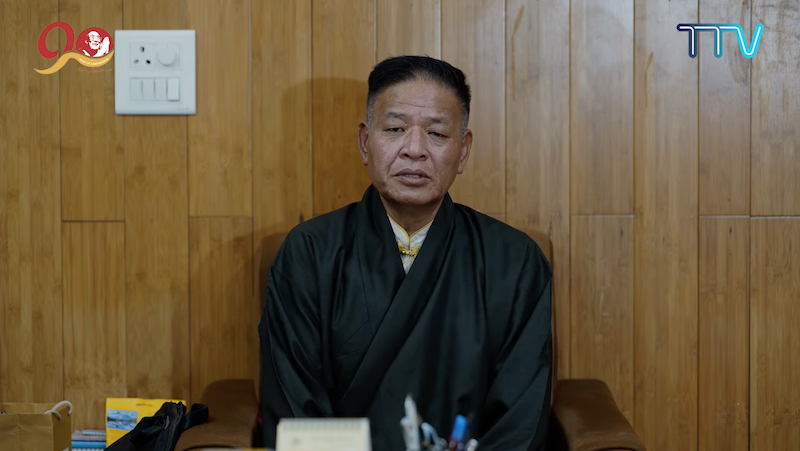
DHARAMSALA, 26 Feb: Eleven days after the Election Commission (EC) declared him elected on 13 February, Central Tibetan Administration’s (CTA) Sikyong (President) Penpa Tsering released a post-election address on Tuesday via CTA-run broadcaster Tibet TV, acknowledging his first round victory with over 60 percent of the vote, crossing the threshold required to avoid a final round.
“Due to the public’s love and support, I received over 60 percent of the vote. I have not responded to any media since then because I feel there is no need for any special celebration. At the same time, there is nothing to be sad about, even if I am looked down upon,” stated Sikyong Tsering, invoking the Buddhist practice of equanimity and expressing his gratitude to the people for entrusting him with another five-year term.
The re-elected Sikyong, who had earlier declined to engage with the media or participate in public debates during the election in order to avoid fuelling internal discord within the Tibetan community, stated that he could proudly assert that he did not contribute to any internal division throughout the electoral process.
He affirmed that his administration will continue to be guided by the principles of “equitable justice, cooperative effort, and moving forward” — first articulated during his 2021 campaign and later formalized in the vision document Securing Tibet’s Future, published under the 16th Kashag(Cabinet) of the CTA in 2023.
Unity, a recurring theme in Tibetan politics, must extend beyond rhetoric to genuine practice, he emphasised. True unity, he said, requires equality paired with strategic leadership and a guided vision oriented towards long-term goals – an approach he believes his administration has upheld.
Tsering also reiterated his commitment to the Middle Way Policy as the framework for resolving the issue of China’s colonial occupation of Tibet, but called for strategic changes to the policy in order to garner international acceptance between the two extremes presented by the policy.
Sikyong presented the US legislation “Promoting a Resolution to the Tibet-China Dispute Act,” signed by President Biden on 12 July 2024 and the recent reference to the CTA as the Tibetan Government-in-Exile in the explanatory notes to the US 2026 Appropriation Bill, as some of the key international developments.
The Promoting a Resolution to the Tibet‑China Dispute Act represents a shift in US policy by explicitly acknowledging that the dispute between Tibet and China remains unresolved, allowing the historical and political narrative of the issue to be weighed alongside human‑rights concerns.
These developments are widely seen as the fruits of the Kashag’s strategic advocacy to bolster international support for Tibet’s historical independence, as articulated under the Middle Way Policy, even as formal dialogue with China remains a distant prospect.
In addition to implementing the vision paper, Sikyong said he will work to institutionalise relations with various actors across the global community. The aim, he noted, is to ensure that the level of international support and dignity currently accorded to the Sikyong and the CTA under the blessings of the Dalai Lama is sustained in the years ahead, including during an interim period in the future when the Dalai Lama is no longer present.
Noting the importance of laying a firm foundation for the exile community’s democratic polity, the Sikyong emphasised the need for harmonious coexistence among the different provinces and religious sects within the Tibetan community. He argued that Tibetans must adopt a broader perspective in light of the major changes taking place at the international level and find their way forward amidst these shifts, even though many Tibetans naturally feel that the fate of Tibet is the most important issue in the world.
“Regardless of whether one belongs to the lay or monastic community, everyone should strive to think from a broader perspective,” he said, “which will allow us to recognise how small our internal conflicts are in the larger context.” He particularly noted that those in the monastic community—who study Buddhist doctrine and understand its vast teachings—should be especially well-placed to appreciate the relative triviality of minor social issues, reflecting the widely held belief that a deep understanding of Buddhism can equip one with an understanding of social and political issues.
However, recent events have shown that familiarity with Buddhist doctrine or institutions alone does not necessarily translate into clarity on social and political matters.
The controversy surrounding the Nechung Oracle, where the translator was issued a warning by the EC over the perceived misinterpretation, revealed how religious authority, interpretation, and institutional jurisdiction can easily become entangled. The episode also raised questions about whether the matter itself fell within the scope of the EC, underscoring that religious knowledge does not automatically confer an understanding of constitutional limits, institutional roles, or democratic procedure.