Tibetan MPs Question Future of Middle Way Policy Amid China’s New Ethnic Unity Law
By Tenzin Chokyi
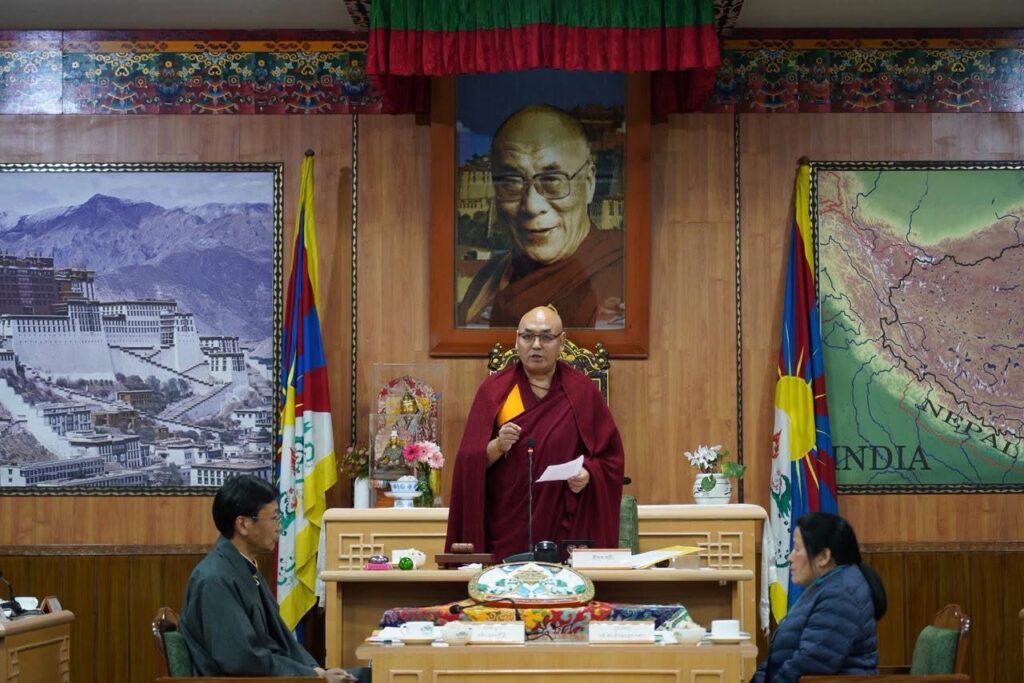
DHARAMSALA, 24 March: The Tibetan Parliament-in-Exile on Monday unanimously passed a resolution condemning China’s new law on “Promoting Ethnic Unity and Progress,” adopted on 12 March during the Chinese Communist Party’s 14th National People’s Congress.
The resolution states that the law represents a further tightening of state control over what China designates as its “ethnic minorities” and advances a vision of national unity that prioritises a singular identity over the recognition of distinct cultures. It warns that the law further restricts the already limited space for genuine autonomy nominally provided for under China’s Constitution.
The Kashag’s (Cabinet) resolution, tabled by the Central Tibetan Administration (CTA) President Penpa Tsering and unanimously adopted by the House on the seventh day of the Parliament session, calls on China to revoke the legislation and urges it to pursue peaceful means of negotiations to address the Tibetan issue. It reaffirms that Tibet remains an occupied country and maintains that Tibetans, with their distinct identity, civilisation, and history, cannot be subsumed within a singular Chinese identity.
Placing the new law in historical context, the resolution recalls the 17-Point Agreement of 1951, signed under duress, which promised regional autonomy for Tibet under the People’s Republic of China and protection for the Tibetan people’s religious and cultural freedoms. It traces the subsequent breakdown of that agreement, the mass exodus of Tibetan refugees into India in 1959, and the Dalai Lama’s formal repudiation of the agreement following his arrival in exile that same year.
The resolution argues that the new law, set to take effect on 1 July 2026, reverses the framework of meaningful autonomy established through China’s constitutional and legal system in the early 1980s. Under that framework, communities designated as “ethnic minorities” are, in theory, granted limited rights to self-governance, including the use and preservation of their own languages, cultural and religious practices, as well as a degree of administrative and economic autonomy—rights that are not always consistently upheld in practice.
The resolution further states that, by emphasising a unified national consciousness and reinforcing standardised language and identity, China is effectively redefining national unity not as coexistence among distinct groups, but as convergence into a single, state-defined identity.
Against this backdrop, the members of the House deliberated on how Tibetans and their leadership can mobilise and advance in responding to systemic injustice and aggression. Members of Parliament strongly advocated for the preservation of the Tibetan language and identity in exile, as well as for sustained international advocacy against the unlawful and unjust actions carried out by the Chinese government inside occupied Tibet.
Several MPs noted that the new law renders the promise of genuine autonomy within the Chinese Constitution largely hollow, raising deeper questions about how the Middle Way Policy should be interpreted and on what basis meaningful autonomy can be pursued within an increasingly centralised and homogenising system. Some members contended that it is high time to review the viability of the 2008 Memorandum on Genuine Autonomy for the Tibetan people in light of prevailing current realities on the ground.
Other MPs, however, maintained that legislative changes in China do not, in themselves, invalidate the Middle Way Policy altogether. They emphasised that, should a shift in approach be deemed necessary, it must be formally introduced through a resolution by the concerned Members, thereby enabling a structured deliberation on whether the Middle Way Policy can continue to be pursued and, if not, what alternative course of action the CTA should adopt.