
80 Tibetans Detained, 7 Disappeared After Protesting Gold Mining in Kham Zachuka
By Tenzin Chokyi
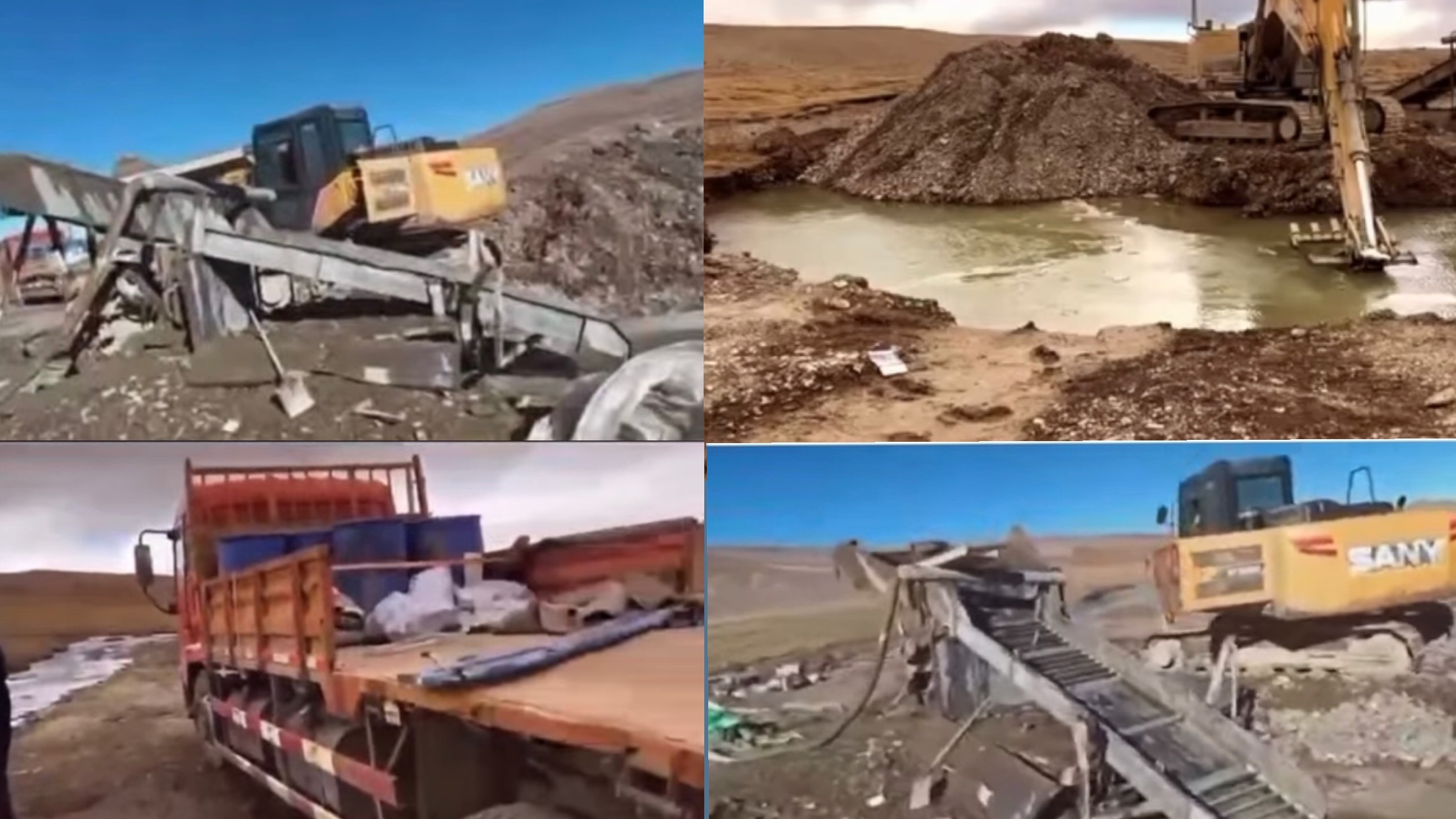
DHARAMSALA, 16 Dec: Chinese authorities reportedly detained around 80 Tibetans in Kashi Nomadic Village, located in the Zachuka in the traditional Tibetan province of Kham in occupied Tibet, on 6 November, following a protest by the local Tibetans against a gold mining project. The project, led by a Chinese business group, had reportedly begun operations without the knowledge or consent of the local Tibetan community.
According to the latest updates, the region is under heavy surveillance with military personnel deployed throughout the area to prevent further protests and restrict the flow of information. Of the approximately 80 Tibetans detained during door-to-door raids, seven have reportedly disappeared, while others were later released after being forced to sign documents pledging not to protest against the mining project or share information with the outside world.
Most of those released are reported to be in poor health, with access to medical facilities cut off. Sources further report that detainees were subjected to inhumane and degrading treatment while in custody.
They were reportedly denied the ability to urinate or defecate, deprived of sleep, and provided only cold water mixed with barley for sustenance. The interrogations were so violent that several detainees have reportedly suffered broken ribs, kidney-related illnesses and relapse of Tuberculosis.
In a press release issued today, the Tibetan government-in-exile urged the international community to pressure China to uphold its environmental protection policies, respect the local Tibetan community’s rights and voice regarding land use, and ensure the safety and whereabouts of the seven Tibetans who remain disappeared.
The arbitrary detentions and subsequent violence followed an attempt by the Kashi Tibetan community to halt mining activities at a site known locally as Serkhok (Gold Valley) on 5 November 2025, after discovering that mining operations were already underway. Tibetan residents reportedly approached local authorities the same day to raise their concerns. However, authorities allegedly refused to intervene, stating that local Tibetans had no rights to the land and that ownership rested solely with the Chinese Communist Party.
“They said we have no right to interfere and that complete ownership of the land belongs to the government. They told us they would investigate and decide what would happen to the land and warned us that protesting was a mistake,” a source from the Kashi Nomadic Village has told, an exiled Tibetan who also hails from the region whose name is being withheld for security reasons.
According to sources, strong objections from some Tibetans to the Chinese mining in Tibet on 5 November 2025 led to a brief confrontation with local Chinese authorities. The following day, at around 6:50 p.m. local time, Chinese authorities began detaining Tibetans one by one in a coordinated door-to-door raid. Those detained were reportedly taken into custody in Serchul County.
Shortly after the arrests began, Chinese authorities, including the United Front Work Department, Public Security Bureau, Armed Police, and township officials, sealed off the entire region to restrict information from leaving the area.
Sources further report that a meeting was held in which authorities warned local Tibetans to remain silent about the incident. They allegedly stated that any disclosure of information would be treated as a serious criminal offence.
The strong objection by the local community in occupied Tibet, despite pervasive repression by Chinese authorities, is widely viewed as a defiant act against China’s policies aimed at expropriating land from nomadic Tibetan communities for economic interests at the cost of environmental protection. More significantly, these policies seek to dismantle Tibetan nomadic life, which lies at the core of Tibetan cultural identity.
According to various reports, since 2016, at least one million Tibetan pastoralists from rural and pastoral areas in occupied Tibet have been resettled and relocated into concrete urban and semi-urban settlement towns in the name of modernisation and better opportunities for Tibetans in rural areas.
Sources stated that the Serkhok in Kashi Nomadic Village, the mining site at the centre of this case, serves as a crucial summer pasture for the nomadic community of Kashi village, providing grazing land for their livestock.
Such attempts to dismantle nomadic life in the name of development, while simultaneously portraying nomadic societies as backward or in need of modernisation, are widely seen as a classic colonial tool.
This approach constructs a division between the “self” and the “other,” reinforcing hierarchies of superiority and inferiority in what Tibetan anthropologist Huatse Gyal has described as the “political production of human inferiority” in his article, “Our Indigenous Land is Not a Wasteland.”
Meanwhile, China’s ill-advised developmental projects, thirst for mineral resources, and desire to exploit the rich deposits under the Tibetan plateau have led to numerous protests by the Tibetans, who consider the hills and lakes sacred as they believe them to be the abode of gods who have protected the community and the land from time immemorial.
However, Chinese authorities have reacted to these protests by beating, arresting, and also firing live ammunition at Tibetan protesters, resulting in the spread of environmental pollution and for local Tibetans whose ancestors have lived there for thousands of years.
Activists and rights groups alike have long criticised such malpractices as they threaten the Yellow, Yangtze, Ganges, and other rivers that hundreds of millions of people depend on.
In line with these concerns, scientists and experts in China have warned that the Three Gorges Dam, located on the Yangtze River and the world’s largest hydropower project, may be causing giant landslides in China, having cost $59 billion and taken 12 years to build.
In addition to disregarding these concerns and with total disregard for the fragile ecology of the Tibetan Plateau, China pushed forward its Kamtok (Chinese: Gangtuo) hydropower dam project in Kham Derge on the Drichu River, sparking mass arrests in February 2024.
Additionally, China officially flagged off its biggest dam in Tibet on 19 July 2025, when Chinese Premier Li Qiang inaugurated the construction of the world’s largest hydropower dam on the Yarlung Tsangpo River in southeastern Tibet at a groundbreaking ceremony in Nyingchi.