China Attempts to Silence Tibetan Representative at UN Minority Forum
By Tenzin Chokyi
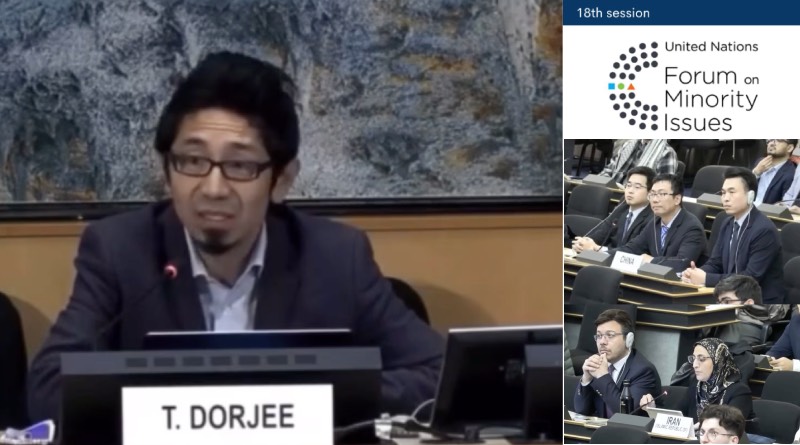
China Attempts to Silence Tibetan Representative at UN Minority Forum, Iran Seconds China.
DHARAMSALA, 1 Dec: The Chinese delegation at the United Nations (UN) 18th Forum on Minority Issues, held from 27-28 November, sought to suppress the statement of the exiled Tibetan representative. The representative addressed the realities of China’s colonial residential school system in occupied Tibet and its broader campaign to assimilate Tibetans, Uyghurs, Mongolians, and their histories into the dominant Han-Chinese narrative.
Dr Tenzin Dorjee, Senior Researcher and Strategist at the Tibet Action Institute, speaking on behalf of the Tibetan delegation, was repeatedly interrupted by the Chinese representatives as he shed light on the estimated 800,000–900,000 Tibetan children aged 6 to 18 who are forcibly separated from their families and placed in state-run residential schools designed to erode their language, culture, and identity.
During the session, the Chinese delegation interrupted twice, requesting that the Chair immediately halt Dr Dorjee’s statement. They rejected his characterisation of China’s boarding school system as a classic colonial tool and claimed that his remarks violated China’s sovereignty, territorial integrity, the UN Charter, and the forum’s rules of procedure.
Along with China, Iran also opposed Dr Dorjee, supporting China’s point of order over his remarks. However, aside from China and Iran, none of the more than 26 countries present at the forum objected to the Tibetan representative’s statement.
As Dr Dorjee continued, he contextualised the atrocities faced by the Tibetan people and other occupied regions under China within Beijing’s hardline, top-down approach to enforcing unity through the forced imposition of cultural homogeneity—an approach that, he argued, fuels secession, radicalisation, and even terrorism.
“So every state should remember this: if you have one terrorist in your country, you have a problem. If you have a million terrorists in your country, then perhaps you are the problem,” Dr Dorjee stated, receiving wide applause from the audience.
He added that in Inner Mongolia, Beijing has banned the use of the Mongolian language in schools and in public and social life, resulting, he noted, in nearly 30% of Mongolians in the PRC no longer being able to speak their mother tongue. He further said that over a million Uyghurs have been placed in detention camps.
The senior researcher also addressed the global rise of exclusive nationalism and internal colonialism, “where powerful but insecure states are disempowering and disenfranchising minorities,” he said, adding that China is where some of the world’s most severe persecution of minorities takes place.
He argued that minorities neither drain a state’s resources nor threaten societal stability. On the contrary, minorities contribute immensely to society—and indeed to humanity—citing their contributions to cuisine, infrastructure, and technology. However, he stated that the most important contribution of minorities is their perspective.
“Minorities offer a new way to see the world. A window as well as a mirror through which a society can simultaneously see the world and see itself,” he added.
Quoting renowned scholar Mahmood Mamdani of Columbia University, the father of New York City’s newly elected first Muslim mayor, he emphasised, “The minority is uniquely positioned to see the true nature of society, all of its flaws and all of its promises. That is the superpower of the minority: to be able to see society in its most naked form, and therefore to give us our most accurate diagnosis.”
In his concluding remarks, he recommended that states allow national minorities to exercise their right to maintain and develop their own language and cultural practices. He also urged the PRC to close its colonial residential schools and reopen local schools so that children are no longer separated from their families.