Sikyong Addresses US Funding Cuts, Assures CTA Remains Stable
By Tenzin Chokyi
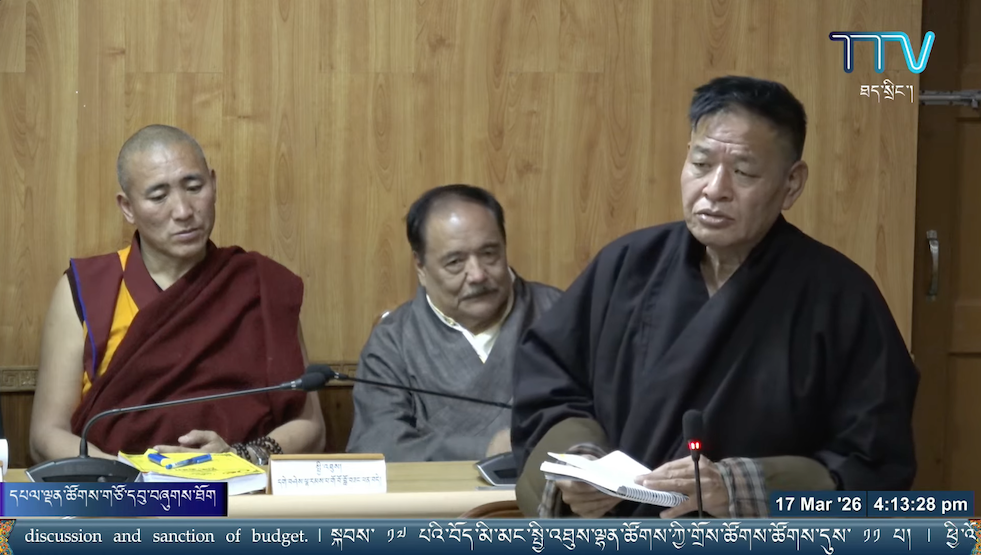
DHARAMSALA, 17 March: The second day of the budget session of the 17th Tibetan Parliament in Exile saw Central Tibetan Administration (CTA) President (Sikyong) Penpa Tsering, who also serves as the Finance Minister, respond to questions raised by MPs on the first day regarding foreign aid, expenditure patterns, and financial stability.
Members had expressed concerns over the status of US funding—its suspension, partial restoration, and share in the CTA’s overall expenditure—along with the disparity between social welfare and political allocations, the need for greater financial self-reliance, and a recent US budget bill referring to the CTA as the “Tibetan government-in-exile.”
Addressing the US funding cuts and their partial restoration, President Tsering explained that of the $12 million approved in the US funds, $5.2 million was restored to the CTA in July 2025, following cuts implemented on 1 January 2026. These restored funds are allocated to key departments of the CTA, including Education, Home, Finance, and Health.
However, about $5 million remains unrecovered, impacting initiatives like the CTA’s Capacity Building Program ($3 million) and the Digital Library Project under the Religion Department ($2 million).
Despite the reductions, Sikyong emphasised that the CTA has continued its programs without major disruption and reassured the house that the administration remains stable and fully functional. US funding accounts for about 29% of total CTA expenditure; while the cuts are significant, he said, they do not render the administration nonfunctional. He added that the CTA has identified alternative funding sources, which he offered to discuss privately with MPs due to the potential risks of Chinese interference.
Responding to MPs’ concerns about higher allocations to social welfare for Tibetans in exile as compared to political activities, Sikyong explained that foreign aid typically targets time-bound programs—mostly social welfare, with less allocated for political work. He also stressed that such investments are essential, as the exile community plays a crucial role in sustaining and advancing the Tibetan movement.
Acknowledging the growing trend of Tibetan youth leaving settlements for better opportunities abroad, he underscored the need to strengthen development initiatives within these settlements to retain the younger generations. He noted that the majority of the budget for infrastructure development is directed toward public infrastructure, while also providing shelter for Tibetans in exile who have fled Tibet, along with other essential welfare programs.
He argued that infrastructure projects should be viewed as largely one-time investments, aside from periodic renovations. Once completed, he said, the CTA can shift its greater focus toward political activities, with meaningful change expected to occur gradually through established procedures and due process. He added that fostering stronger mutual support within the Tibetan community, beyond government efforts, can open pathways toward greater self-reliance, although complete self-sufficiency cannot be guaranteed.
Regarding the question on whether the CTA should change its name to “Tibetan Government-in-Exile” following the US budget legislation’s reference to it as such, Sikyong clearly stated that the administration has no plans to do so. He explained that the current name ensures legal compliance with the host country, safeguarding the administration’s long-term sustainability.
However, he noted that the new US reference could enable direct funding to the CTA from the US—bypassing intermediaries like the Tibet Fund, which currently serves that role. That said, Sikyong added, the CTA lacks the human resources and mechanisms needed to align with US procedures at present. He said the administration is preparing a plan and will share details once it takes proper form.