TYC Launches Dharamsala–Delhi ‘Black Hat March’ Protesting China’s Ethnic Unity Law
By Tenzin Chokyi
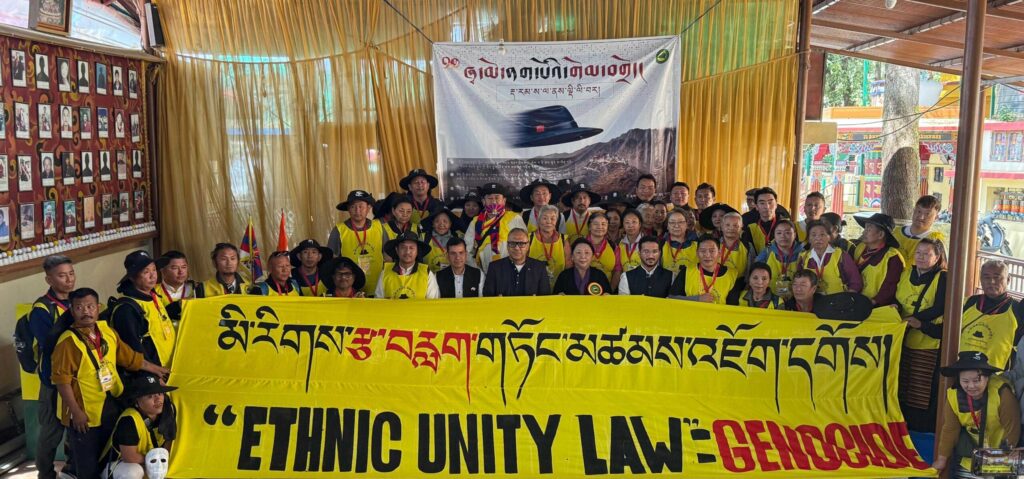
DHARAMSALA, 31 March: The Tibetan Youth Congress (TYC), one of the largest pro-independence Tibetan NGOs, today commenced its “Black Hat March” from McLeod Ganj, a journey that is scheduled to culminate at the United Nations office in Delhi on 25 April. The march primarily calls for the repeal of China’s recently enacted law on “Ethnic Unity and Progress”, which the organisation describes as a deliberate attempt to accelerate the sinicisation and erasure of Tibetan identity under the guise of promoting unity.
Around 65 participants from 20 regional chapters of the TYC, all wearing black hats, officially began the march from McLeod Ganj. The event was flagged off by Security Kalon (Minister) Gyari Dolma and Tibetan Parliamentarian Tenzin Jigme, and received a ceremonial send-off from Sikyong (President) Penpa Tsering of the Central Tibetan Administration (CTA) at Gangchen Kyishong, the headquarters of the Tibetan government-in-exile.
The colour black symbolises what organisers describe as China’s systematic suppression of the fundamental freedoms of Tibetans, imposed under the pretext of maintaining “social stability.”
Drawing from the Tibetan phrase “putting a black hat on a white person,” the march highlights how official narratives invert reality to justify restrictive measures against Tibetans inside Chinese-occupied Tibet.
“The new law provides a facade of legal cover for the Communist Party to trample on anyone who goes against the ‘Ethnic Unity Law,’” stated CTA President Penpa Tsering. He cautioned against the euphemistic use of the term “unity” in the legislation, arguing that it masks policies aimed at erasing the cultures and identities of ‘ethnic minorities,’ including Tibetans, Uyghurs, and Mongolians, in an effort to homogenise them into a single Chinese identity.
TYC President Tsering Choephel, speaking at the opening ceremony at Lhayal Ri near the Dalai Lama Temple, asserted that Tibetans are not merely a minority within China, but a nation with a distinct identity and culture. He reaffirmed that Tibet remains under China’s colonial occupation, with policies such as the new law designed to undermine and ultimately erase Tibetan identity.
Echoing this perspective, the President of the Indo-Tibetan Friendship Association, Ajit Nehria, highlighted that India has historically shared its border with Tibet, not China. He argued that China’s occupation of Tibet has compelled India to allocate substantial resources to border security—funds that could have otherwise supported vital social welfare and development programmes.
The Tibetan exile community has unanimously condemned the law, as reflected in a resolution passed by the Tibetan Parliament-in-Exile, along with strong opposition from various NGOs. While the effectiveness of appeals to the United Nations and the international community remains uncertain, Kalon Gyari Dolma stressed the moral imperative to voice opposition, asserting that failing to do so would amount to shirking their responsibility as Tibetans.
In addition to calling for the repeal of China’s new law on “Ethnic Unity and Progress”, the march also demands the release of Tibetan political prisoners, including the 11th Panchen Lama, who has been missing since his abduction at the age of six in 1995, and an end to the ongoing environmental destruction in occupied Tibet, asserting that the region is not a resource colony.
These demands will be formally presented to the United Nations office in Delhi on the final day of the march. The march also serves to express gratitude to India and its people for their longstanding support of the Tibetan community.