Digital Democracy: Smartvote Tibet Opens for Second Election Cycle
By Tenzin Chokyi
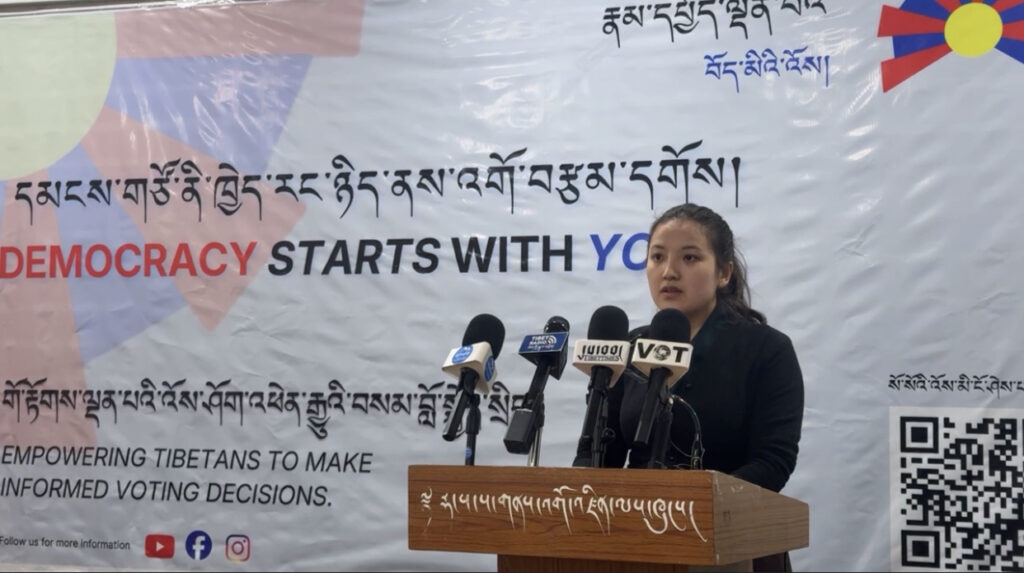
DHARAMSALA, 5 Jan: Smartvote Tibet, an online portal designed to help Tibetan voters identify their preferred Sikyong and Members of Parliament (MP) candidates for the 2026 Tibetan General Election, is now open to the public. The platform invites voters to respond to a series of questions and subsequently calculates a matching rate between voters and candidates based on the candidates’ responses to the same set of questions.
The questionnaire consists of 33 yes-or-no questions addressing key aspects of Tibetan democratic life, including Tibetan identity and culture, structural reforms, social welfare, and policies of the Central Tibetan Administration.
According to the Smartvote Tibet team, a total of 50 candidates—48 MP candidates and 2 Sikyong candidates—have responded to the questionnaire and presented their visions on the portal. This information was shared during the platform’s official press conference held today at the hall of the Tibetan Settlement Office, McLeod Ganj. Twelve candidates have declined to participate in the portal, though the Smartvote team stated that no explicit reasons were provided for their non-participation.
The 2026 initiative marks the platform’s second launch within the Tibetan diaspora, with the aim of promoting transparency and fostering direct democratic engagement among voters. During its first launch in the 2021 Tibetan General Election, the portal recorded 11,000 matches, according to official data shared by the team.
While the initiative is widely regarded as timely and much needed—particularly given the limited democratic understanding and engagement within the Tibetan diaspora, as well as the lack of active campaigning and an authentic, accessible database of candidates—the portal has also drawn criticism.
During the press conference, media representatives raised concerns that the questions reflect dominant narratives within Tibetan society. They noted that certain political and social issues are strictly framed in binary terms, such as whether a position is “harmful” or “not harmful” to Tibetan society.
Views that diverge from established policies of the Tibetan government-in-exile—most notably the Middle Way Policy—are often presented within this binary framework. Similarly, the portal frames alternative perspectives in terms of whether they are “harmful” or “not harmful” to Tibetan unity. It also includes questions on whether freedom of speech should exclude religious figures.
Such framing overlooks a fundamental premise of democracy: that it is a human society, not one composed of idealized or infallible beings devoid of flaws, self-interest, or disagreement. A democratic society allows differing, and often competing, viewpoints to coexist without automatically construing them as threats to social cohesion.
Questions concerning support for critical social issues—such as mental health, healthcare systems, addiction, and social support for children with special needs—are framed as trade-offs against traditional expenditures. This approach indirectly implies that development for one segment of the community comes at the expense of another, relegating these concerns to secondary importance.
The recurring disclaimer, “Remember, an increase in expenditures could result in a decrease for other areas,” accompanies all questions related to these sectors. The media argued that such framing is problematic, as these areas should be recognized as essential public services and basic facilities that the exile government is obligated to provide, rather than discretionary expenditures competing for legitimacy.
Responding to these concerns, Tenzin Sewo, a member of the Smartvote Tibet team, acknowledged the limitations of the questionnaire, stating that complex social issues cannot be adequately captured through simple yes-or-no responses and that the portal as a tool only allows such a framework. He noted that the portal allows both voters and candidates to add additional comments where necessary, enabling them to elaborate on their views beyond the scope of the questions.
Smartvote Tibet, as described by the team, is an initiative of the association Project Democracy, an independent, non-partisan, non-profit association founded by Tibetans with backgrounds in political science, history, communications, psychology, technology, and human rights.
The platform is reportedly an adapted version of smartvote, which was first developed in 2003 by Politools in Switzerland. The tool has been successfully implemented for regional and national elections in Switzerland, Australia and throughout Europe.