TWA Commemorates 30th Anniversary of Historic ‘Silent Protest’ in Beijing
By Tenzin Chokyi
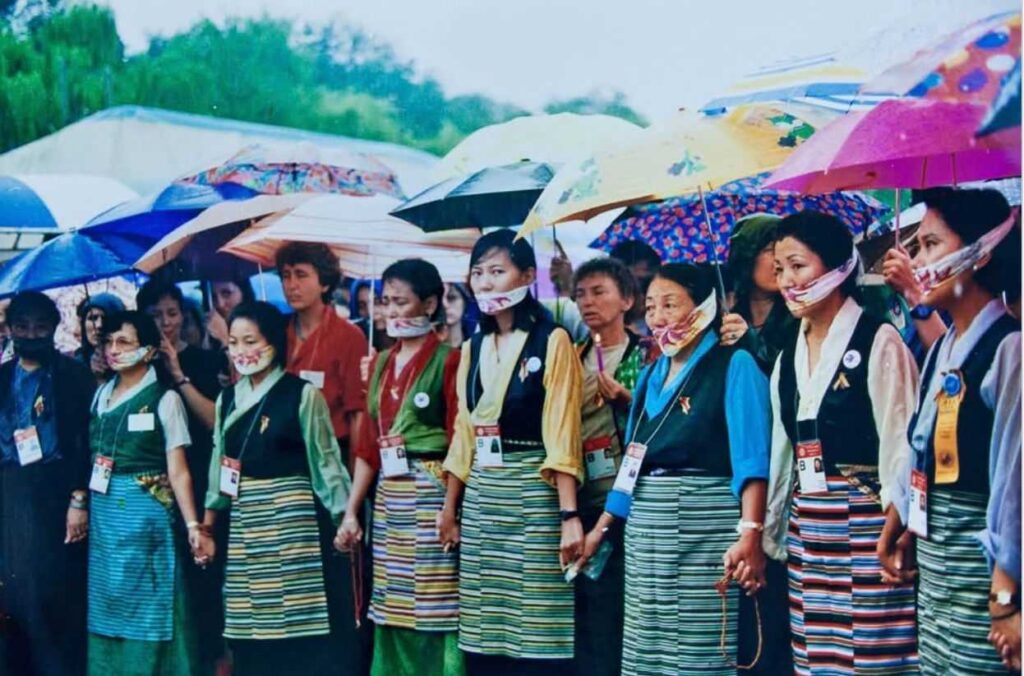
DHARAMSALA, 5 Dec: The Tibetan Women’s Association (TWA) today commemorated the 30th anniversary of the ‘Silent Protest’ staged in Beijing by a delegation of exiled Tibetan women during the United Nations Fourth World Conference on Women in 1995. The commemorative event was held at the Tibetan Settlement Hall in McLeod Ganj.
On the opening day of the 1995 Beijing conference, held over 4-15 September 1995—which brought together 40,000 women representatives from around the world—nine exiled Tibetan women wearing traditional Tibetan chupa covered their mouths with silk scarves distributed at the ceremony and marched in protest against China’s silencing of Tibetan women’s voices under its colonial rule in occupied Tibet.
Although the Tibetan delegates did not have an official seat at the conference, they were able to reach Beijing after years of negotiations and advocacy with NGOs that stood in solidarity with Tibetan women inside occupied Tibet and offered their own seats to the Tibetan delegation.
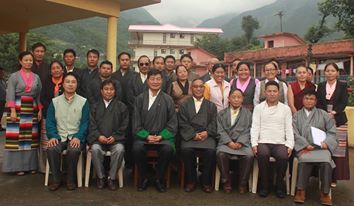
The delegation, consisting of Gyalthong Tsering Dolma, Kherol Seldup, Tenzin Dolkar Jinpa from Canada, Chime Dhonden, Youdon Dhonden and Phuntsok Dolma from America, Kalsang Wangmo, Dorje Dolma Kherol from Australia and Tsomo Namgyal from Norway, successfully lobbied for the adoption of two major resolutions on the rights of Tibetan women. These resolutions recognised that “women residing under foreign occupation experience serious and specific harm” and affirmed the “complete right and freedom of women to make autonomous decisions regarding their fertility.”
Sonam Sangmo, then the Secretary of the Fourth TWA, played a key organizing role but was unable to attend the Beijing conference due to restrictions imposed by China. She stated, “It was through years of negotiations—beginning in 1992 with various NGOs at international platforms—and careful strategic planning that TWA was able to secure seats for Tibetan women in 1995.”
She further commended the achievement, noting that “it is truly remarkable that our early efforts made it possible for exiled Tibetans to protest on the soil of our occupiers at a time when the organisation was only just beginning to participate in such global forums.”
Eva Harzer, mentor to the delegation and one of the six Westerners accompanying them for security purposes, wrote in her letter to today’s ceremony: “Fortunately, many groups expressed their solidarity by doing just that, including the International Lesbian Human Rights Commission, with whom I had close connections.”
Security and safety were another major concern for the exiled Tibetan women traveling to Beijing. Harzer explained that the TWA team therefore “took Tibetan women with citizenship in another country so as to assure diplomatic help in case of trouble.”
Out of around 63 women who applied to attend the conference, only nine ultimately made the trip to Beijing. Upon their arrival, they were reportedly placed under immediate surveillance. Chinese police and men with cameras followed them everywhere—sleeping just outside their hotel rooms—and even infiltrated the conference rooms with Chinese agents.
Reed Brody, a human rights lawyer who accompanied the Tibetan delegation, said in his video message that they had been monitored from the very first day and throughout the three weeks of the conference. “From the first day of the forum, the police were on us—they followed and they harassed us,” Brody recounted.
He described another incident during a crowded workshop at the conference, where a Chinese agent suddenly attempted—unsuccessfully—to run off with a cassette containing footage of Tibetan refugee women that the delegation was presenting.
“But people stopped him,” added Brody.
Brody, who personally witnessed the silent protest, explained that despite the restrictions and surveillance imposed on the delegation—and on women inside occupied Tibet—the Tibetan women’s protest was a powerful symbolic act of refusing to be silenced by the Chinese regime.
The protest drew significant international attention to the Tibetan issue at the time, receiving coverage from major news outlets including The Washington Post, The New York Times, BBC, CNN, and others. Today, the Tibetan Women’s Association remains one of the largest Tibetan NGOs in exile, with substantial engagement across communities.
However, in her conversation with Tibet Express, Sonam Sangmo noted that TWA must continue to expand its reach, both within the exile community and internationally. She emphasized that Tibet is now far more visible on the global stage, offering a fertile opportunity to connect the Tibetan struggle with the international community.