China Remains World’s Biggest Jailer of Journalists, RSF Says
By Tenzin Chokyi
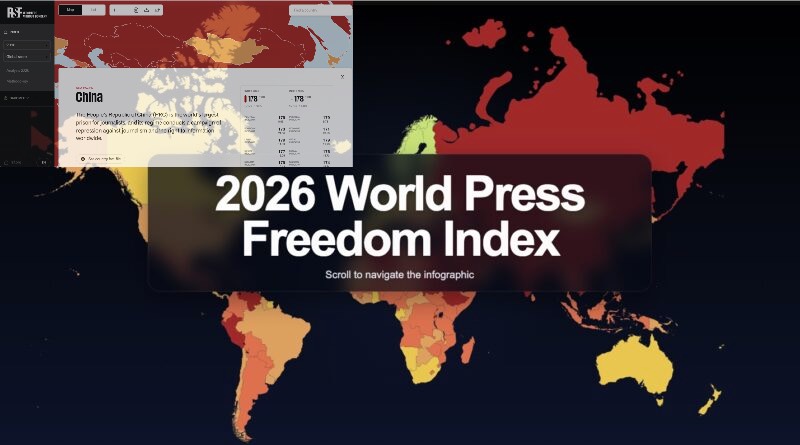
DHARAMSALA, 1 March: China remains the world’s largest jailer of journalists, with growing transnational repression targeting journalism and the global right to information, according to the 2026 Press Freedom Index released by Reporters Without Borders(RSF) on 30 April 2026.
China ranks 178th—third from the bottom out of 180 countries surveyed—just ahead of North Korea (179th) and Eritrea (180th). This marks a further drop of two places from its 176th ranking last year.
China’s near-bottom ranking is reflected across all key indicators used to assess press freedom. It ranks 179th in the political indicator (8.86) and legal indicator (11.03), 177th in the social indicator (15.25), and 173rd in the economic indicator (21.66), pointing to systemic constraints on journalism across governance, legal frameworks, societal conditions, and media sustainability.
Unlike countries where press freedom has deteriorated more recently due to political shifts, China’s restrictions are deeply institutionalised, reflecting a long-standing model of state control over the media rather than a sudden downturn. As the report notes, press freedom in some regimes has “hardly changed” because authoritarian systems keep it in a “deadlock,” a pattern seen in China (178th), North Korea (179th) and Eritrea (180th).
This pattern extends beyond mainland China, particularly in Hong Kong (140th), where press freedom has sharply declined in recent years as Beijing tightened political and legal control over the territory. Once considered a regional media hub, Hong Kong’s information space has contracted significantly, illustrating how China’s influence extends beyond its borders and contributes to a broader pattern of transnational repression affecting journalism and the flow of information.
Beyond these country-level cases, the 2026 index points to a broader global deterioration in press freedom. It records the lowest average score in a quarter of a century, with more than half of the world’s countries and territories (52.2%) now classified as having a “difficult” or “very serious” press freedom situation. At the same time, less than 1% of the world’s population lives in countries where press freedom is considered “good,” a steep decline from 20% in 2002. Over the same period, the share of countries in this top category has also fallen sharply, from 13.7% in 2002 to a small minority today.
By offering a retrospective of the past 25 years, RSF highlights the continuing pressures facing journalism today, alongside the systematic obstruction of reporters worldwide.
The report also highlights how threats to the right to information have become more varied and sophisticated. These include the criminalisation of journalism through the misuse of national security laws, the increasing use of Strategic Lawsuits Against Public Participation (SLAPPs), and broader efforts to obstruct those who investigate, expose, and hold power to account.
Within this context, RSF Editorial Director Anne Bocandé argues that inaction itself amounts to endorsement. She stresses that it is no longer enough to state principles without taking action, calling instead for effective and enforceable measures to protect journalists. This includes addressing the criminalisation of journalism and strengthening protections against legal and structural intimidation, especially as current safeguards remain insufficient and impunity remains widespread.
As she puts it, “the ball is in the court of democracies and their citizens,” shifting responsibility toward both political institutions and the public to resist the normalisation of press suppression. “It is up to them to stand in the way of those who seek to silence the press. The spread of authoritarianism is not inevitable,” writes Anne Bocandé