Eleven Years On, Niece’s Testimony Seeks Truth for Tenzin Delek Rinpoche
By Tenzin Chokyi
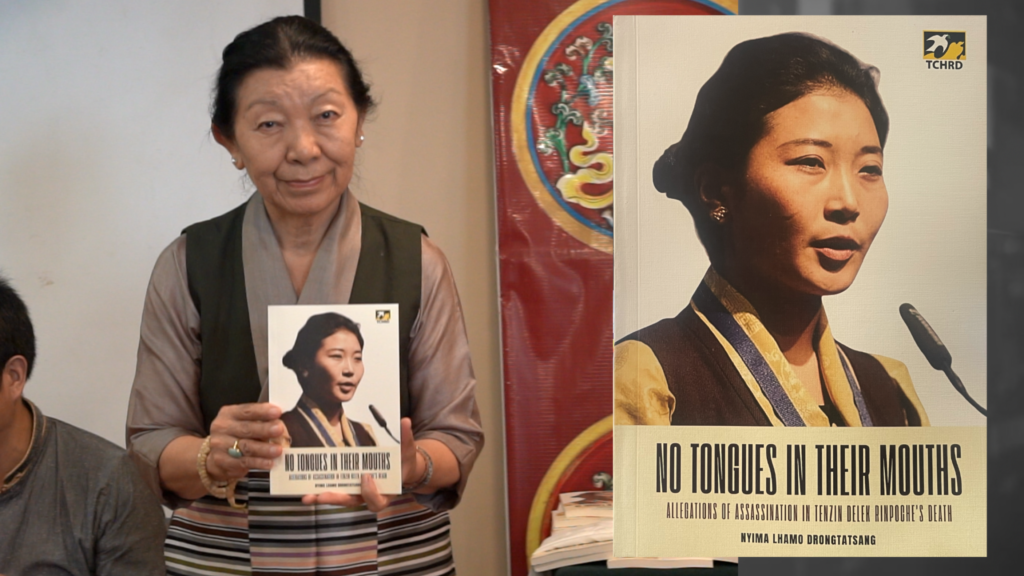
English Edition of Tenzin Delek Rinpoche’s Testimony Launched in Dharamsala on 11th Death Anniversary.
DHARAMSALA, 13 July: No Tongues in Their Mouths: Allegations of Assassination in Tenzin Delek Rinpoche’s Death, the English edition of the documented testimony of Nyima Lhamo, niece of the late Tibetan religious leader Tulku Tenzin Delek Rinpoche, was launched in Dharamsala on Monday, with Nyima Lhamo saying in a recorded video message that the publication seeks to bring her uncle’s story to an international audience while preserving his legacy for younger Tibetans.
The launch, held at Norbu House in McLeod Ganj, was jointly organised by the Tibetan Centre for Human Rights and Democracy (TCHRD) and the Tulku Tenzin Delek Service Association. Speaker of the Tibetan Parliament-in-Exile Dolma Tsering Teykhang attended as chief guest, alongside Geshe Tsering Dorjee, head of the Tulku Tenzin Delek Service Association, TCHRD Executive Secretary Tenzin Dawa, researcher Dorjee Rinchen, author and translator Bhuchung D. Sonam and Nyima Lhamo, who joined via a recorded message.
Nyima Lhamo fled Tibet into exile in 2016 after she and her mother were detained by Chinese authorities following Tulku Tenzin Delek Rinpoche’s death in custody. Researcher Dorjee Rinchen compiled the manuscript from her oral testimony, first published in Tibetan and later translated into Chinese. The English edition, translated by Bhuchung D. Sonam, aims to broaden its international reach, with translations into other languages also planned. In her message, Nyima Lhamo noted that the launch coincided with the 11th anniversary of her uncle’s death and expressed hope that the book would preserve his legacy for future generations.
Speaking at the launch, Tenzin Dawa said the English edition was intended not only to recount Tulku Tenzin Delek Rinpoche’s story but also to preserve the historical truth of his life and death while drawing renewed attention to the broader human rights situation in Tibet. “Accountability begins with memory, and memory must be served by truth,” Dawa said, adding that preserving the truth of Delek Rinpoche’s life and death is essential to preserving historical memory.
Calls for unity among Tibetans across the three traditional provinces of U-Tsang, Kham and Amdo and the five major schools of Tibetan Buddhism emerged as the central theme of the event. Recalling his final conversation with Tulku Tenzin Delek Rinpoche before leaving Tibet for India in 1998, Geshe Tsering Dorjee said the lama urged him never to contribute to divisions among Tibetans.
“He told me, ‘Do not indulge in any circumstance that contributes to division among the three provinces and the five religious sects,’ and asked me to promise this in the name of the Three Jewels,” Geshe Tsering Dorjee said. “Looking at the situation in the exile community today, it feels almost like a premonition.”
Speakers also linked the message to the final appeal of Tibetan Independence activist Lobga Rangzen, who self-immolated outside the United Nations headquarters in New York earlier this month after urging Tibetans to set aside regional and sectarian divisions and unite for Tibetan independence, a message they said echoed Tulku Tenzin Delek Rinpoche’s lifelong appeal for unity.
Dolma Tsering Teykhang recalled that Tulku Tenzin Delek Rinpoche secretly met the first Tibetan delegation from exile to visit Tibet in 1979 despite the considerable risks posed by the Chinese authorities, during which he helped document the destruction of monasteries in Lithang during the Cultural Revolution. She said he later campaigned against large-scale logging by local Chinese authorities, an effort that drew official attention and was among the factors that ultimately led to his persecution and arrest. Teykhang added that his decision to return to Tibet from India despite the risks reflected his unwavering commitment to the Tibetan people.
Tulku Tenzin Delek Rinpoche (1950–2015) was a prominent Tibetan Buddhist lama from Kham who was arrested by Chinese authorities in 2002 on bombing-related charges he denied. Following a trial widely criticised as unfair and politically motivated, he was sentenced to death with a two-year reprieve, later commuted to life imprisonment. He died in Chinese custody on 12 July 2015, after serving more than 13 years in prison. While Chinese authorities said he died of a heart attack, his family and rights groups called for an independent investigation into his death, which has yet to take place.