“Victory to Tibet, Victory to Tibetan Independence”: Tibetan Activist’s Final Video Message Before Self-Immolation Outside UN
By Tenzin Chokyi
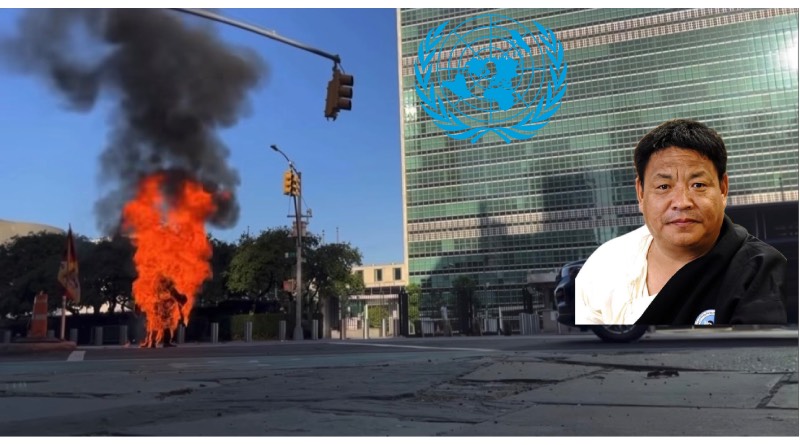
DHARAMSALA, 3 July: Veteran Tibetan activist Lobsang Palden, widely known as Lobga Rangzen and president of the New York & New Jersey chapter of the Tibetan National Congress (TNC), died after self-immolating outside the United Nations headquarters in New York on 2 July. He had left behind a final video message that was both a political testament and a plea for Tibetan unity and independence.
In a 6-minute-and-5-second video message shared on his Facebook account, Lobga Rangzen delivered what would become his final political testament before before carrying out the self-immolation outside UN headquarters.
He praised Tibetans inside occupied Tibet for preserving their language, culture and national identity under Chinese rule, but directed his most urgent appeal to Tibetans in exile. He urged them to rise above divisions rooted in traditional provinces and religious sects, saying such differences had weakened the Tibetan cause.
“China attacks all Tibetans, regardless of whether they come from U-Tsang, Dotoe or Doemey. We are all Tibetans,” he said. “Before anything else, we are Tibetans.”
Lobga Rangzen argued that Tibet’s present condition was the direct result of the loss of independence and said Tibetans worldwide should unite in the struggle for an independent Tibet. He further stated that he was not protesting because he lacked food, clothing or shelter, but because of the condition of the Tibetan nation and its people under Chinese rule, which he said is aimed at eradicating the Tibetan people.
By drawing this distinction, Lobga Rangzen framed his protest as a sacrifice for political freedom rather than a response to material hardship, suggesting that national and political freedom are indispensable, and that material comfort, on its own, can never suffice in their absence.
Speaking about how he wanted his protest to be remembered, he urged Tibetans not to scale back celebrations for the upcoming 91st birthday of the 14th Dalai Lama, but to mark the occasion “even bigger and grander,” with dances, cultural performances and public gatherings continuing as planned. He said the greatest tribute would be for Tibetans to continue the struggle for independence and carry forward the cause for which he died.
“ I don’t want you to mourn for me. I want you to continue the struggle for Tibetan independence because the lack of independence is the root of all our problems. Bhoe Gyalo, Bhoe Rangzen Gyalo”(Victory to Tibet, Victory to Tibetan Independence),” Rangzen said in the video message.
A livestream from the same Facebook account later showed him standing outside UN headquarters in traditional Tibetan dress, with the Tibetan national flag beside him. At around 5:49 p.m. New York time, he carried out the self-immolation. According to the New York Post, emergency responders took him to Bellevue Hospital, where he was later pronounced dead at age 42.
It also reported that police recovered several sheets of paper he had scattered before the protest, including one bearing the words, “CHINA OUT OF TIBET.”
The self-immolation is being described as the first by a Tibetan in a Western country since the wave of Tibetan self-immolation protests began in 1998. More than 160 Tibetans in occupied Tibet, Nepal and India have self-immolated in protest against China’s rule over Tibet.
Lobga Rangzen’s final appeal for Tibetan independence is likely to deepen the ongoing debate within the Tibetan exile community over the future direction of the Tibetan movement. The debate has intensified since China’s “Law on Promoting Ethnic Unity and Progress” was adopted in March and came into force on July 1, just a day before his self-immolation. Critics say the law further entrenches assimilation policies and leaves diminishing space for the meaningful exercise of the “Law on Regional National Autonomy” under China’s constitutional framework, which forms the basis for the Central Tibetan Administration’s Middle Way Approach.
Despite these concerns, the Central Tibetan Administration has maintained that the Middle Way Approach remains relevant to its long-standing policy objectives.
Commenting recently on the new law, both Sikyong Penpa Tsering and Speaker of the Tibetan Parliament-in-Exile Dolma Tsering Tenkyang have said there is no need to alter the policy, which continues to seek genuine autonomy for the Tibetan people within the framework of the People’s Republic of China rather than independence.