Tibetan Parliament-in-Exile’s Statement on the 91st Birthday Celebration of His Holiness the Dalai Lama
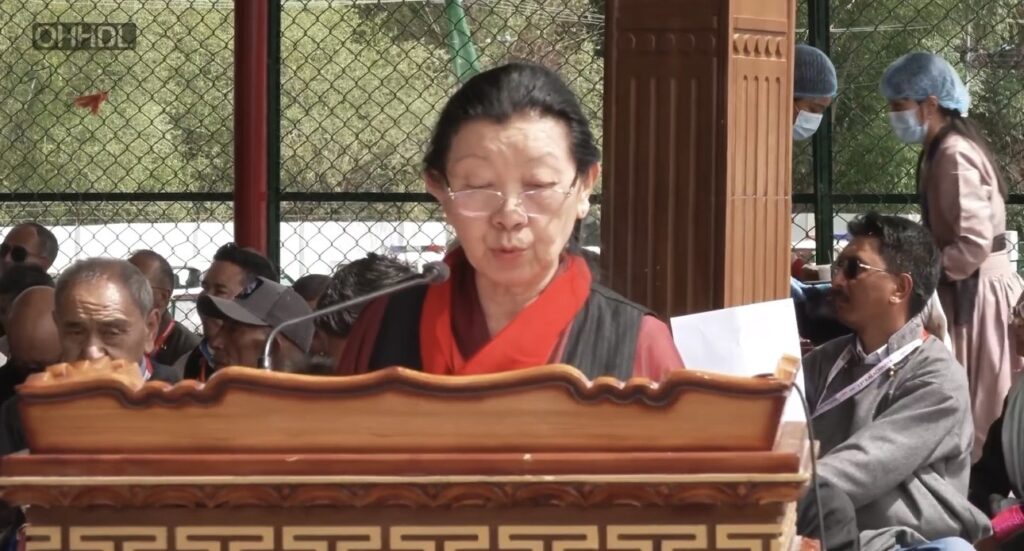
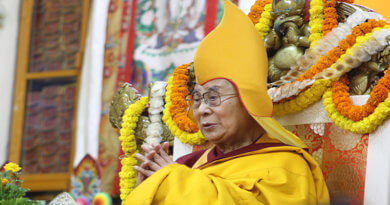
On behalf of all Tibetans in Tibet and in exile, the Tibetan Parliament-in-Exile wishes to express immense joy, devotion, and delight in offering heartfelt and sincere greetings and felicitations to His Holiness the Great 14th Dalai Lama, the very embodiment of universal compassion, a noble protector of the world, a supreme sovereign of the entire corpus of Buddhist teachings on this earth, and a great friend to all infinite beings despite the absence of any prior intimacy, on this very auspicious day of his attaining 91 years of age, holding in petal-formation our ten fingers to our hearts, and offering countless prostrations before him. Jetsun Jampel Ngawang Lobsang Yeshe Tenzin Gyatso Sisum Wanggyur Tsungpa Mepey-de Pel-Sangpo, to spell out his full name for the sake of the occasion, the crown jewel of the domains of celestial beings and the entire existence, took a preordained birth on the 5th day of the 5th month of the Wood-Swine Tibetan calendar year, corresponding to the 6th of July 1935, in the Dhomey region of the land of Tibet to parents of excellent noble lineage and illustrious descendance for his samsaric undertaking. Such then is the day today on which all across the world we engage in joyous and virtuous activities, accumulating merit and performing good deeds with great enthusiasm. For the boundless beings, but especially for we the destitute Tibetan people, there is no refuge, protector, or defender but Your Holiness, the sole refuge and hope, the true protector and patron. Therefore, we fervently pray that you, the supreme protector, may remain eternally steadfast in the nature of the unchanging Dharmadhatu (the realm of truth or totality of phenomena), the essence of Samantabhadra (the primordial Buddha of absolute awareness), and that your enlightened activities may thereby spread throughout the world. In the Dharma-endowed land of Tibet, a succession of Dalai Lamas — incarnations of canonically devout monks in saffron robes — have taken birth to guide all beings, with each generation perfectly attuned to the particular circumstances and inclinations of their time. The scope and extent of their wondrous and compassionate deeds naturally remain beyond the comprehension of ordinary beings like us and difficult to fully contemplate or enumerate. In particular, the life and deeds of the Great 14th Dalai Lama, the supreme guide for this world and the next, are boundless like an ocean. Still, to present but a mere token, drop-in-the-ocean, amount of gratitude owed for his extraordinary deeds, we offer these words of prayer:
In the field of the entirety of the noble works of all Victors, you alone,
Have shouldered responsibility encompassing the entire Buddhist teachings,
And have attained authority in upholding, preserving, and spreading it without any discrimination, We pray to you, the very embodiment of Manjushri.
As thus stated, it was in keeping with divine guidance of lamas and deities, and through meticulous and thorough investigation, that certainty was attained, and His Holiness was ushered to the high golden throne of the Potala Palace in heavenly Lhasa. It was a time when the political situation of Tibet hung on an existential crisis. Hence, though only 16 years of age, His Holiness, on being beseeched with great earnestness by the totality of both the monastic and lay communities, speaking with one voice, assumed the responsibilities of both temporal and spiritual leadership of the country. And he devoted himself with full commitment to work for the immediate as well as long term wellbeing of the Tibetan nation and its people. Immediately on taking the government responsibility, His Holiness, being concerned for the wellbeing of his subjects, ordered a thorough investigation of the corvee labour and other forms of taxes as well as travel permit system (authorising the requisition of corvee labour and transport animal), debts that had passed down through generations, and other burdens on the Tibetan citizenry. Following it, His Holiness granted complete remissions, reduced the burdens, and permanently abolished the travel permit system, among other momentous changes, and especially established a reform commission for the purpose of introducing further improvements in the country. However, it was a time when the severity of the repression of the Communist Chinese government, with the use of their military power, kept worsening drastically with each passing day. The growing tragedy of the ever worsening situation left His Holiness the Dalai Lama with no other option but to take a decision to set out in exile in the night of the 17th of March in 1959 for the holy land of India with his entourage. It was to be a temporary measure in order to be able to work for the restoration of the freedom of his country and its people, religion, and nationhood.
Immediately on setting foot on Indian soil, His Holiness initiated a campaign to take the issues concerning the wellbeing and situation of the Tibetan people before the United Nations by launching a series of petitions. In order to revive and otherwise preserve, as the case may be, the religious, cultural, linguistic and so forth aspects that define the identity of the Tibetan nation and its people, His Holiness initiated the establishment of community settlements, a Tibetan administrative setup, schools, monasteries, and monastic schools. Centres for the preservation of Tibetan culture such as the performing arts, archival libraries and so forth were also newly established. As a result, and thanks to the opportunities graciously provided for traditional and modern education to students, as well as for religious studies and so forth to monks, nuns, and tantric practitioners, the younger generation of Tibetans have been able to inherit and perpetuate the knowledge and customary traditions and practices of their elders. The Tibetan people thereby became an outstanding exemplar of success among all the refugee communities across the world both collectively and at different individual levels. For all these achievements, we owe utmost gratitude to none but His Holiness the Dalai Lama. On the 3rd of February in 1960, representatives from all the three provinces and the different religious schools of Tibet, while making a long-life ceremonial offering to him at Buddhism’s most sacred site of Bodh Gaya, submitted a grand solemn pledge of unqualified undertaking to scrupulously follow whatever edifying advices may be provided by His Holiness. At that time, His Holiness responded with profound words of wisdom on the basis of which the first Tibetan parliament in exile was established. The members elected to the parliament were duly granted their appointment under the signature of His Holiness the Dalai Lama and took their oath of office on the 2nd of September in 1960, marking the founding, for the first time, of Tibetan democracy. Then in 1961, His Holiness announced the salient features of a future democratic constitution of Tibet, which was followed, in 1963, by his promulgation of a constitution of Tibet. In 1991, His Holiness empowered the Tibetan parliament in exile as a true lawmaking body. On the 28th of June in1991, His Holiness gave his assent to the Charter of Tibetans in Exile after it was passed by the 11th Tibetan parliament in exile. From that day on, the nature of the Tibetan political institutions and the systems within the Tibetan community came under the rubric of full-fledged democracy. In every effort in the campaign for the just cause of Tibet and in all undertakings of the Tibetan government, His Holiness ensured that they scrupulously adhered to non-violent means. Besides, in a great endeavour that recognized the equality and sought to ensure the coexistence of the Tibetan and Chinese peoples, His Holiness initiated a mutually beneficial middle way approach in an effort towards the resolution of the Sino-Tibetan dispute. Meanwhile in the year 2001, the Kalon Tripa, the head of the executive branch of the Central Tibetan Administration, was given appointment by him after being directly elected by the Tibetan electorate. Then, in the year 2011, His Holiness made an irrevocable transfer to leaders directly elected by the Tibetan people the entirety of the government powers vested until then for nearly four hundred years in the Gaden Phodrang institution of the successive Dalai Lamas. He thereby ensured that the offices held by the elected leaders became meaningful representatives of the Tibetan people in Tibet and in exile, with the task to work towards the fulfilment of the government responsibilities for their wellbeing. Such then is the nature of the 18th Tibetan Parliament in Exile and the 17th Kashag, both of which began functioning from June this year.
His Holiness has ensured the preservation and sustenance of the excellent cultural heritage of the Tibetan land of Dharma, which has its origin in the immaculate expanse of the view and conduct of the peerless Buddha himself. Through this, he has striven to fulfil the innate desire of all beings, with their seeking of happiness and avoiding suffering, through efforts that are rooted in the foundation of noble conduct. And he has enhanced this foundation to promote environmental protection, religious harmony, peaceful resolution of wars and conflicts, and other immeasurable activities extending across time and space, thereby assuming universal responsibility with a view to contribute to global peace in an ongoing effort. Secular ethnics, which does not depend on people’s religious belief and principles, envisioned by His Holiness the Dalai Lama is being promoted today through the SEE Learning curricula in many schools at different levels with focus on social, emotional, and ethical concerns. Likewise, in 1987, His Holiness established the Mind and Life Institute for the purpose of exchange of ideas and making of collaborative inquiry between Buddhism and science, with the aim to bring happiness to humanity and solve problems. A total of 39 mind and life have been held conferences have been held so far.
In order to commemorate the 90th birthday of His Holiness the Dalai Lama, the Central Tibetan Administration is observing the yearlong period of the 6th of July 2025 to the 6th of Jul 2026 as the Year of Compassion worldwide. And it is not just the Tibetan people living in countries across the world, but also fraternal peoples across the Himalayas, as well as supporters and friends of Tibet in a number of countries who respect or are otherwise devotees of His Holiness the Dalai Lama, who have organized various events related to his vision and activities, in celebration of his compassion and kindness to mark the Year of Compassion in grand and solemn manners. The vision of His Holiness the Dalai Lama is vast and profound, with the result that the more he contributes to environmental protection and the welfare of all sentient beings, the more he is able to bring happiness to all and establish peace in the world. Hence, everyone should constantly study and strive to implement the four great commitments of His Holiness the Dalai Lama – namely, creating equal happiness for all humanity; promoting interfaith harmony; preserving, nurturing, and propagating Tibetan culture and religion; and reviving ancient Indian knowledge, spiritual traditions, and secular ethics through integration with modern education. We should thereby strive to serve others with compassion at all times as this will undoubtedly be a pleasing offering to His Holiness the Dalai Lama. We according urge everyone to act accordingly.
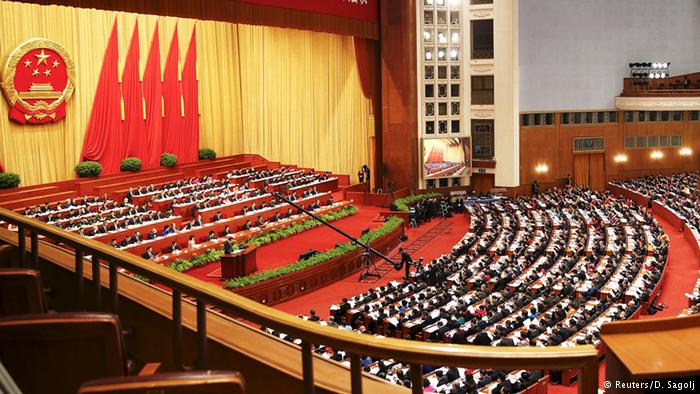
On the 12th of March this year, the Communist Chinese government enacted a Law on Promoting Ethnic Unity and Progress, which took effect on the 1st of July. Besides, China has been carrying out in Tibet a policy of forced transfer of Tibetan children under the age of majority to boarding schools in a move that deprived them of the opportunity to preserve their own language and script, the very artery of Tibetan identity and culture. Needless to say the children have also been placed in a situation where they are also deprived of parental love and care. In connection with this situation, His Holiness the Dalai Lama gave a profound speech at the beginning of this year, saying we should be cognisant of the fact that the Tibetan language is the essence of Tibetan culture and we should pay special attention to it. All the Tibetan people residing in free countries therefore have a responsibility to make every effort to use our own language and script so as to be able to maintain and preserve the Tibetan culture that the younger generations should be able to inherit without any sort of decline in them. The Tibetan Parliament in Exile accordingly wishes to remind the youth to keep away from activities like any sort of betting and dissolute indulgence which will only harm themselves, their families, and the Tibetan society. They should, instead, strive to be relentless in devoting themselves to noble and virtuous pursuits.
On the day after the government of China began implementing on 1 July 2026 its so-called Law on Promoting Ethnic Unity and Progress, a patriotic Tibetan hero named Lobsang Palden, also known as Rangzen Loga, a resident of New York City, took a Tibetan national flag on the square in front of the United Nations Headquarters and planted it on a crossroad there. He also distributed placards with slogans such as “China Out of Tibet” written on them. He then set himself on fire in protest against the variety of policies being implemented by the Chinese government directed at the destruction of Tibet as we knew it. Sad reports soon emerged that he did not survive his fiery protest.
In a video message he posted before carrying out his protest self-immolation, the Tibetan martyr said, “The communist government of China has been continuing to carry out measures to implement various policies designed to bring about the destruction of Tibet and it’s people.” He also said, “we need to be sincere in expressing our views. Nothing can be achieved from doing nothing at the fundamental level when it comes to struggling to pursue the cause of a people. Hence, I wish to make it clear that we the Tibetan people living in exile need to work harder.” He further said, “We need to work for the cause of the Tibetan nation. We need to work for the cause of the people of the Tibetan nation. Currently, we are all devoid of any human rights. We have no freedom to express ourselves. We have no freedom to display portraits of His Holiness the Dalai Lama.” And he went on, “The question is, why do we remain deprived of all our freedoms. It is because we lost our independence that we remain deprived of all our freedoms. Because this is the fact, all of us – whether it is the Tibetan government, or the Tibetan Parliament-in-Exile, or the general masses of the Tibetan people – everyone should henceforth unite as one in working for the cause of the Tibetan nation and the Tibetan people. This is of utmost importance.” And he further continued, “We need to understand that it is all because we have lost our national independence. If we win our national independence, we will have everything we need. So, what do we need? Independence, of course! What do we need to do for the cause of independence? Everyone should work hard for it. So, I request every individual to be relentless in the struggle for it. This is what I wish to say.”
With these words, the late Rangzen Loga sacrificed his own precious life for the cause of Tibet and the people of Tibet. This is an enormously great deed that is bound to remain forever indelible in the history of the Tibetan nation. Besides, since the year 2009, well over a hundred and fifty Tibetan people in Tibet and in exile have carried out self-immolations in an unending series of protests. In the history of the world, this remains the longest campaign with the highest number of non-violent acts of self-immolations. We therefore request governments and parliaments across the world, the relevant sections of the United Nations, to legally review the so-called Law on Promoting Ethnic Unity and Progress of the People’s Republic of China with urgency. We request such a review with a plea that all available measures be employed to prevent the crime of ethnic genocide being committed. In particular, we call on the leaders of local and central governments of the People’s Republic of China to thoroughly review their stance to bring to an immediate end to their hardline policies of violent repression and relentless oppression being implemented in Tibet. We wish to reiterate that the government of China should, instead, initiate a prompt start to negotiations in an effort to resolve the Sino-Tibetan conflict in a meaningful way.
Over the past more than sixty years of living on foreign lands as exiles, we have received sincere and unwavering help and support for the fundamental cause of Tibet as well as in the fields of Tibetan culture, language, and so forth especially from our hosts – the people and government of India – as well as others that especially include the United States of America and Europe. To all these supporters of the Tibetan cause, the Tibetan Parliament-in-Exile wishes to express profound gratitude. And we wish to appeal to them to continue their steadfast support until the just cause of Tibet prevails.
In conclusion:
In this Land of Snows shrouded in darkness of misery,
The magnificent glow of your compassion,
Stands relentless in dispensing feelings of succour and well-being,
May you remain unwavering, steadfast thus, until the end of time.
As thus beseeched by the sage of the melody of truth, may Your Holiness sustain your living presence in your seven-fold posture of Vairocana for tens of thousands of aeons, with all your wishes being seen fulfilled with spontaneity and without exception, and with a definite rising of the sun of happiness of the reuniting of the Tibetans in Tibet and in exile, so that you will set your lotus feet on the Snowland of Tibet and bask in the joy of dwelling in the perfect world.
By the Tibetan Parliament-in-Exile
6 July 2026
. . . . . . . . . . . . . . . . . . . . . . . . . . . . . . . . . . . . . . . . . . . . . . . . . . . . . . . . . . . . . . . . . . . . . . . . . . . . . . . . . . . . . . . . . . . . . . . . . . . . .
* In case of any discrepancy between this English translation and its Tibetan original, the latter should be considered as authoritative and final for all purposes.