Chinese Authorities Demolish Eight Tibetan Homes, Three Compounds in Golok
By Tenzin Chokyi
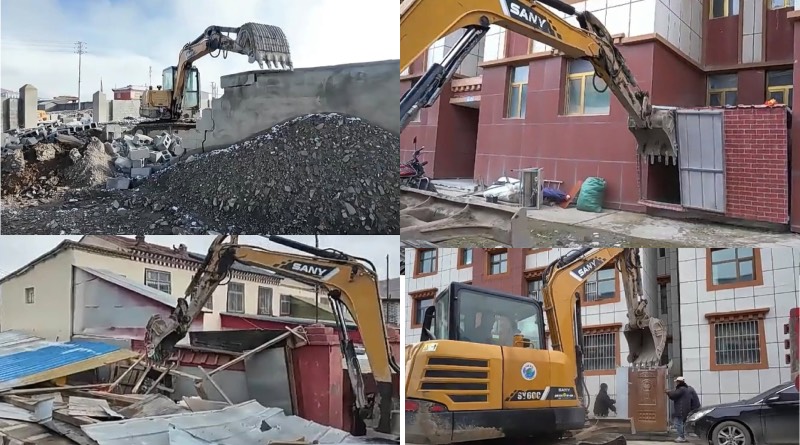
DHARAMSALA, 22 Oct: Eight Tibetan homes and three large residential compounds were forcibly demolished by Chinese authorities on 16 October in the Nyi-woe residential area of Darlag County, located in the Golok region of Amdo, eastern Tibet.
According to a report published by the Voice of Tibet (VOT) on Wednesday, the demolitions targeted Tibetan families who have lived in the area for three generations. The affected families received no financial compensation.
Sources cited by VOT noted that these families had never previously faced eviction or housing threats. Following the demolitions, some families have been forced to relocate to other regions, while the destruction of shared residential compounds, access roads, and stairways has left remaining residents concerned about structural safety.
The forced clearances stem from a land-use restriction imposed in May, when local authorities designated the sector as a government land reserve and prohibited residents from using or developing the property independently. Officials claimed the structures violated government land-use regulations and warned that any future unauthorised reconstruction would be penalised under the Constitution of the People’s Republic of China.
The report said the demolition drive was carried out under the pretext of following the “unified directives” issued jointly by the county administration and the Chinese Communist Party.
Significantly, while the Nyi-woe residential area is a mixed neighbourhood home to Han Chinese and Hui Muslim traders, all eight demolished homes belonged exclusively to Tibetan families.
This targeted repression reflects the escalating assimilationist policies implemented by Beijing in Amdo and across its occupied regions, which seek to enforce a homogenised national identity at the expense of the cultural and civilisational particularities of Tibetans and other occupied communities.
Between August and September 2026, Chinese authorities forcibly closed at least three privately run Tibetan schools in the Golok region alone, including the Golok Tadrak Orphan School, the Ra-Gya Jigme Gyaltsen Grassland Girls’ School, and a community-funded primary school.
Together, the forced closure of independent educational institutions and the physical displacement of Tibetan families reflect a deliberate strategy to dismantle autonomous Tibetan community spaces. By disrupting these local structures, authorities undermine the key environments where Tibetans can preserve, shape, and transmit their cultural traditions and worldview, leaving them increasingly vulnerable to systemic assimilation.