China’s United Front Work Department and the Tibetan Diaspora
By Khedroob Thondup Executive Summary. The United Front Work Department (UFWD) is a central organ of the Chinese Communist Party
Read moreBy Khedroob Thondup Executive Summary. The United Front Work Department (UFWD) is a central organ of the Chinese Communist Party
Read moreBy Khedroob Thondup
In the long arc of Tibetan history, the Chinese Communist Party has sought to erode the spiritual foundations of Tibetan identity. Yet, despite decades of repression, the Tibetan people’s devotion to His Holiness the Dalai Lama and their deep-rooted belief in religion remain unshaken. These are not fragile sentiments that can be legislated away; they are enduring strengths that continue to define Tibet’s resilience.
Read moreBy Khedroob Thondup
When Xi Jinping arrives in India for the BRICS summit, the choreography of diplomacy will mask a deeper negotiation. Behind the handshakes and communiqués lies a potential bargain of historic consequence: Beijing’s willingness to settle the long‑festering Sino‑Indian border dispute in exchange for New Delhi’s silence on the Dalai Lama’s reincarnation.
Read moreBy Khedroob Thondup
The Chinese Communist Party (CCP) has long seen religion not as a matter of conscience but as a potential rival to state authority. Its current campaign to rebrand Tibetan Buddhism as “Chinese Buddhism” is part of a broader project: the domestication of all faith traditions under the Party’s ideological umbrella.
By Karma L. Pangring
From the perspective of the Chinese leadership, losing control over Tibet would be of existential significance. On closer examination, it becomes clear that without Tibet, the People’s Republic would lose far more than just a region. It would lose a crucial pillar of its economic, strategic, and cultural stability.
By Khedroob Thondup
In 1979, Gyalo Thondup’s meeting with Deng Xiaoping in Beijing marked the beginning of a new chapter in Tibet’s modern history. Deng’s words were blunt: “Anything but Independence can be discussed.” With that statement, the parameters of dialogue were set, and Tibetans entered into a process that would span decades, yielding both moments of hope and deep disillusionment.
Read moreBy Khedroob Thondup
Chinese Communist Party (CCP) has long envisioned a future where the nation stands shoulder to shoulder with — or above — the United States as a global superpower. This ambition rests on two pillars: economic might and military strength. Yet, the trajectory is far from smooth. The CCP’s path is being tested by slowing growth, demographic decline, and intensifying confrontations abroad.
By Khedroob Thondup
The Tibetan struggle today is not only about sovereignty or autonomy—it is about survival. Communist China’s project of Sinicization is relentless: language policies that erode Tibetan in schools, religious restrictions that hollow out monasteries, demographic engineering that dilutes Tibetan presence in our own homeland. If Tibetans—inside Tibet and across the diaspora—do not act decisively, the distinctiveness of our culture risks being absorbed into a homogenised Chinese identity.
Read moreBy Khedroob Thondup
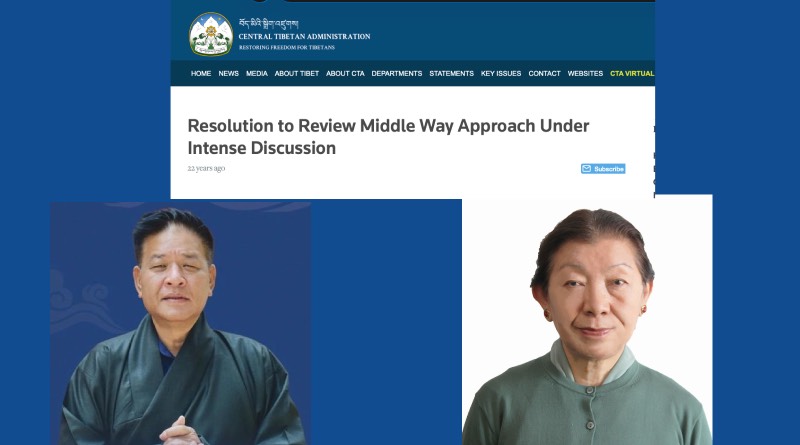
For more than four decades, the Tibetan leadership has held to a strategy that Beijing has consistently rejected. The reliance on a framework conceived in the 1980s—anchored in appeals for dialogue and autonomy—has not yielded meaningful negotiations. Instead, it has left Tibetans in a holding pattern, waiting for a door that Beijing has bolted shut. The time has come to recognize that persistence without adaptation is not resilience; it is stagnation.
Read more By Khedroob Thondup
China’s recent warnings to India not to interfere in the future reincarnation of the Dalai Lama are more than just diplomatic posturing. They strike at the heart of a centuries-old Tibetan spiritual tradition and the geopolitical contest over who gets to define its future. Beijing insists that the next Dalai Lama must be chosen under its authority, a claim rooted in its broader assertion of sovereignty over Tibet. Yet the Dalai Lama himself has repeatedly suggested that his reincarnation may well occur outside Tibet — most plausibly in India, where he has lived in exile since 1959.