Debate Over Debates: Kaydor Calls for Debates Between Sikyong Candidates Ahead of 2026 Election
By Tenzin Chokyi
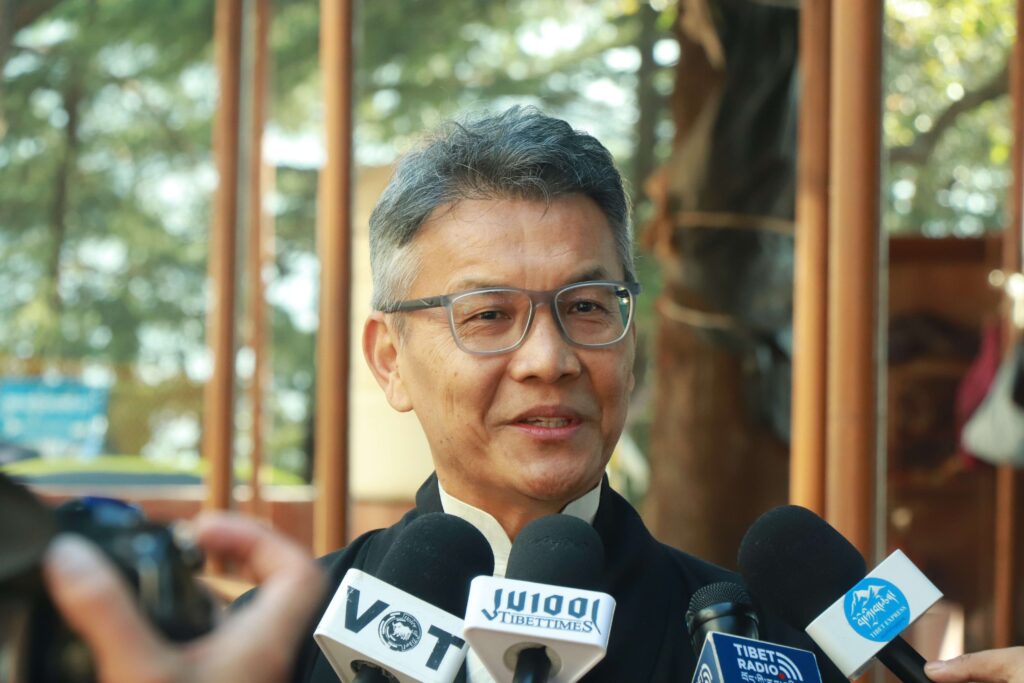
DHARAMSALA, 21 Nov: Sikyong Candidate Kelsang Dorjee Aukatsang(Kaydor) emphasised the importance of active and open debate among election candidates, highlighting the lack of such platforms within the Tibetan democratic system.
“There should be at least two debates before the Preliminary Election, one in Tibetan and one in English,” Kaydor said during a Meet the Press event held at Lhagyal Ri near McLeod Ganj today after announcing his run for the Sikyong 2026 election through a vidoe message on YouTube.
He added that debates between the final two candidates ahead of the General Election would further strengthen transparency and voter engagement.
His comments came in response to questions about the incumbent Sikyong, Penpa Tsering—who is also a Sikyong candidate in the 2026 election—and his stated decision not to campaign or take part in public debates, arguing that active campaigning, including travel and related expenses, risks creating further internal divisions within Tibetan society.
Kaydor expressed that he considers debate and open discourse as essential components of a democratic system. “ I believe all candidates should take part in debates organised by any credible group, and should answer questions from the public, the media, and other relevant stakeholders in a transparent manner. Interpreting this differently and choosing not to participate is, from my perspective, not a positive approach,” said Kaydor, asserting that he maintains this position and has previously addressed the issue both verbally and in writing.
Because the incumbent Sikyong has chosen to remain in office while announcing his candidacy for the 2026 election, the constitution prohibits him from conducting campaign activities during official working hours. However, a sitting Sikyong who is also a candidate may still participate in public debates outside office hours or by taking leave. Despite this, the Sikyong has stated that he will not take part in debates or public discussions organised by any group, including media outlets and NGOs.
Penpa Tsering, in his candidacy announcement on 11 October, explained his position by stating that the Tibetan community is still in need of unity, and that democratic processes naturally carry a risk of division as voters ultimately choose between two competing candidates in the end. He further argued that public appearances and campaigning offer no real benefit, asserting that people should evaluate his candidacy based on his performance over the past four and a half years.
While concerns exist that campaigning and public debates may at times deepen division within a community, avoiding them entirely risks overlooking their essential role in providing accurate information and fostering meaningful engagement between candidates and the public. Such platforms allow voters to hear diverse viewpoints directly, ask questions, and gain reliable information.
For the uninitiated, Tashi Wangdue, who dropped out of the 2021 Sikyong election, cited “the absence of a platform to hold extensive debates among the candidates” as one of the reasons that forced him to make the decision. Similarly, Kaydor himself also called on the Tibetan parliament to ensure at least two rounds of debates between the final Sikyong candidates when he conceded the Sikyong race in 2021.