Frank Aiken: Ireland’s Early Voice for Tibet at the United Nations
By Khedroob Thondup
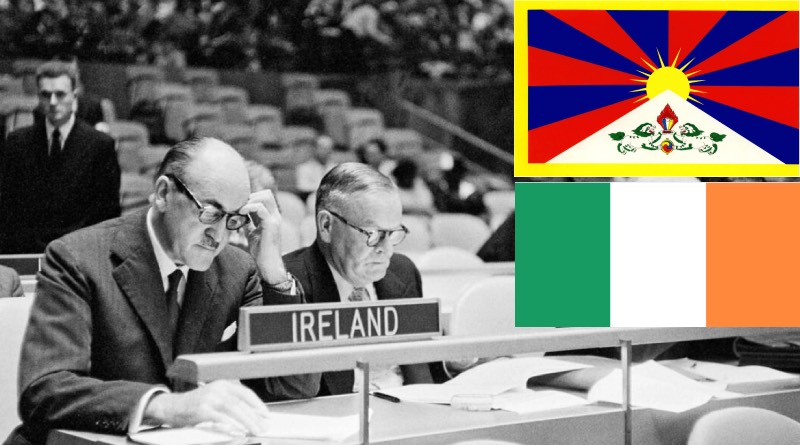
History often remembers great powers, but it is frequently smaller nations that first raise their voices when principle is at stake. In the case of Tibet, one of the earliest and most persistent international advocates was not a superpower but Ireland, led by its remarkable Minister for External Affairs, Frank Aiken.
At a time when much of the world was reluctant to challenge Beijing over Tibet, Aiken emerged as a courageous and consistent defender of the Tibetan people. Serving as Ireland’s Minister for External Affairs from 1951 to 1954 and again from 1957 to 1969, he transformed Ireland’s role at the United Nations into that of a principled champion of small nations, self-determination, and human rights. Under his leadership, Ireland became one of the strongest voices drawing international attention to Tibet following China’s military intervention and the subsequent Tibetan uprising of March 1959.
Aiken’s support for Tibet was rooted in more than diplomatic calculation. As an Irish nationalist who understood the experience of a small nation seeking control of its own destiny, he viewed the Tibetan struggle through the lens of freedom and self-government. Ireland’s foreign policy under his stewardship sought to ensure that international law and moral principles applied not only to major powers but also to vulnerable peoples whose voices were at risk of being drowned out by geopolitics.
The aftermath of the 1959 Tibetan uprising provided a critical test of that conviction. While many governments hesitated to confront the issue directly, Ireland joined with other nations to bring Tibet before the United Nations. In October 1959, Aiken appealed publicly for a peaceful settlement between Beijing and the Dalai Lama and affirmed what he called “the right of the small Tibetan people to control their own destiny.” Ireland, together with Malaya, sponsored a resolution calling for respect for the fundamental human rights of the Tibetan people and for the protection of their distinctive cultural and religious life.
What made Aiken exceptional was his willingness to frame Tibet not merely as a humanitarian concern but as a question of national freedom and historical identity. During United Nations debates in the 1960s, he argued that Tibet had governed its own affairs and maintained its distinct existence for centuries, asserting that it had been “as free and in control of its own affairs as any nation in this Assembly.” He condemned the suppression of Tibetan culture and religion and challenged the international community to recognize the gravity of what was occurring. His speeches stood out because they combined moral clarity with an insistence that the rights of small peoples mattered as much as those of powerful states.
Ireland’s advocacy was not symbolic. It contributed to a broader international effort that produced United Nations General Assembly resolutions expressing concern over conditions in Tibet and calling for respect for the fundamental rights of the Tibetan people. At a time when geopolitical tensions often overshadowed questions of justice, Ireland helped ensure that Tibet remained on the international agenda. Aiken repeatedly denounced what he viewed as the oppression of the Tibetan people and the continued presence of Chinese forces in Tibet, arguing that the United Nations had a moral responsibility to speak for those unable to defend themselves on the world stage.
Today, when discussions about Tibet often focus on contemporary human rights concerns, it is worth remembering those who first sounded the alarm. Long before Tibet became a familiar international issue, Frank Aiken recognized that silence in the face of injustice carries its own consequences. His advocacy demonstrated that a small country could exercise moral leadership far beyond its size.
Ireland’s advocacy for Tibet during the 1950s and 1960s remains one of the most principled episodes in its diplomatic history. At its centre stood Frank Aiken, a statesman who understood that sovereignty, cultural identity, and human dignity are not privileges granted by powerful nations but rights that belong equally to all peoples. His legacy reminds us that international leadership is measured not by military strength or economic power, but by the willingness to stand up for those whose freedom is under threat.
Khedroob Thondup is a former Tibetan diplomat and parliamentarian and nephew of the 14th Dalai Lama. He is also the editor of the book, ‘Dalai Lama, My Son and Tibet in Turmoil.’
The views expressed in this article are those of the author and should not be attributed to Tibet Express.