Hunger Strike at UN: Tibetans Demand Repeal of China’s Ethnic Unity Law
By Tenzin Chokyi
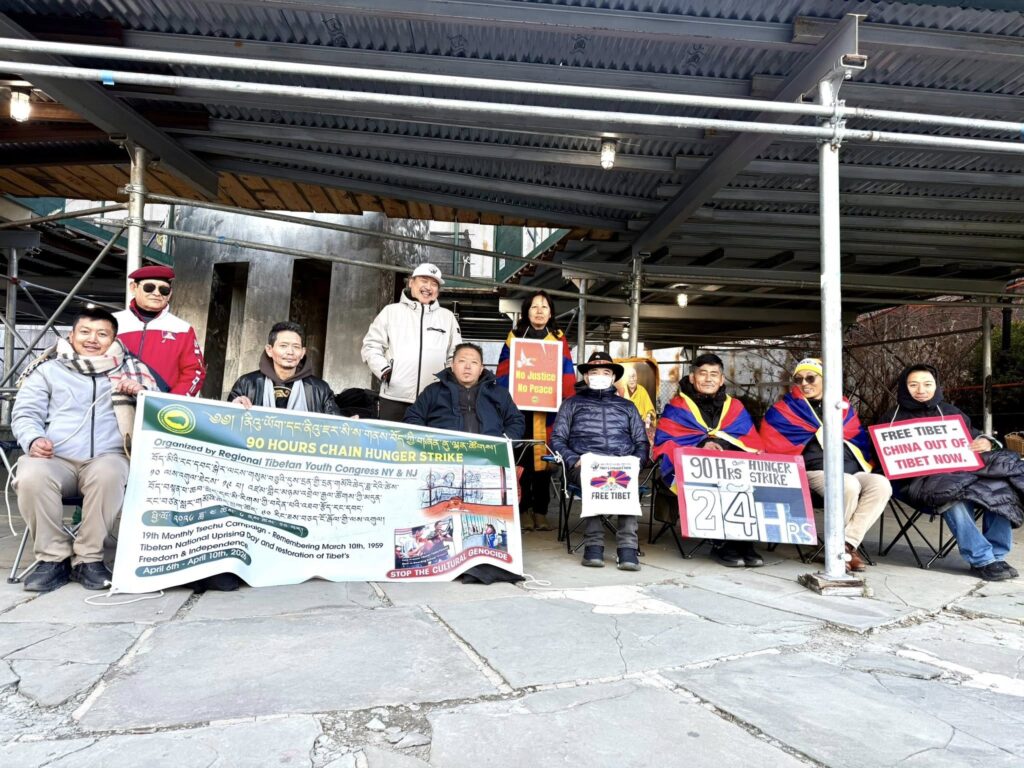
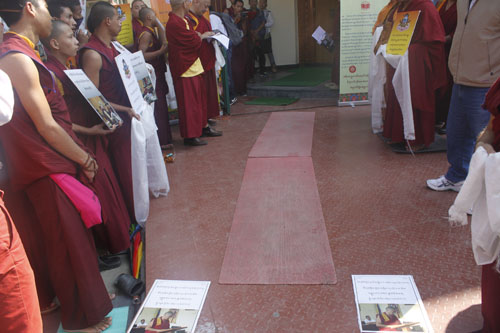
DHARAMSALA, 8 April: Tibetans in New York and New Jersey are staging a 90-hour chain hunger strike in front of the United Nations(UN) headquarters, calling for an end to China’s systematic eradication of Tibetan identity. The protest comes in response to China’s latest “ethnic unity” law, which critics warn is an attempt to assimilate marginalised and occupied groups into a single, homogenised Chinese identity.
Organised by the New York and New Jersey Regional Tibetan Youth Congress (RTYC NYNJ), the protest marks the 19th edition of the “Monthly 10th Day Campaign” — held on the 10th of every month to advocate for the restoration of Tibet’s freedom and independence, and to highlight China’s restrictions on Tibetan language, culture, religion, and forced assimilation through state-run education systems in occupied Tibet. It began at 6:00 PM on 6 April and will continue until 12:00 PM on 10 April 2026, totalling 90 hours. As of the latest update, 26 hours of the hunger strike have been completed, with participants temporarily off-site due to restrictions on overnight stays.
The protesters have outlined a series of urgent demands, chief among them the immediate repeal of the recently enacted Law on ‘Ethnic Unity and Progress,’ which they warn is a dangerous policy designed to forcibly assimilate Tibetans and other marginalised groups into a homogenized Chinese identity under the guise of promoting unity. They also call for the immediate and unconditional release of all Tibetan political prisoners, including Gedhun Choekyi Nyima, the 11th Panchen Lama, who was detained at just six years old on 17 May 1995 and has been missing for 31 years, along with his parents and attendants.
Other demands include an end to colonial-style boarding schools that aim to erase Tibetan religion, culture, and language — which organisers describe as a violation of the fundamental human right to preserve one’s own culture and language — the protection of Tibetans’ fundamental human rights; and a halt to environmental destruction on the Tibetan Plateau caused by deforestation, mining, and dam projects that threaten both regional and global ecological security. Protesters also insist that the recognition of His Holiness the Dalai Lama’s reincarnation must remain free from Chinese government interference and be determined solely by the Dalai Lama and the Gaden Phodrang Trust.
Additionally, they call for an end to China’s transnational repression targeting Tibetan families both inside Tibet and in exile and urge the UN and international community to intensify support for Tibet’s struggle for truth and freedom through pressure on China to engage in unconditional dialogue.
The demonstration is part of a broader, coordinated movement. In India, the Central Tibetan Youth Congress is simultaneously leading the month-long “Black Hat March” from Dharamsala to Delhi, also opposing the new Ethnic Unity Law. Taken together, these actions reflect the serious alarm among Tibetans globally, as the new law formalizes longstanding discriminatory and colonial policies, raising the stakes for their culture, religion, and identity like never before.
.