40 Years on, 1987–1989 uprising in Tibet Remembered as Turning Point for Tibetan Movement
By Tenzin Chokyi
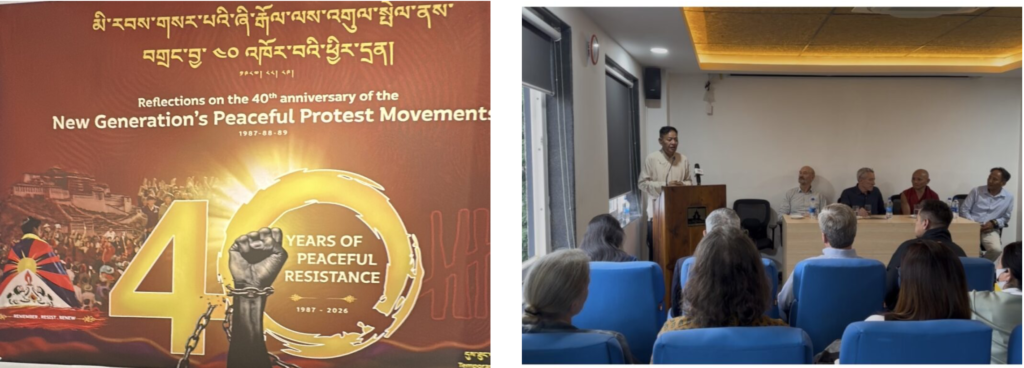
DHARAMSALA, 14 Sept: What began with monks taking to the streets of Lhasa in 1987 would soon become more than a series of protests, as photographs, medical records and eyewitness accounts carried the events beyond occupied Tibet. Forty years later, the Tibet Museum of the Department of Information and International Relations (DIIR), Central Tibetan Administration (CTA), brought together some of those who witnessed and participated in the uprising to reflect on its legacy.
The museum organised the exhibition and accompanying programme, titled “Reflections on the 40th Anniversary of the New Generation’s Peaceful Protest Movement, 1987-88-89,” bringing together archival material and firsthand accounts of the protests. American photographer John Ackerly and physician Dr Blake Kerr, who were in Lhasa during the protests, shared their experiences alongside Ngawang Woebar, a former Drepung monk who participated in the initial demonstrations and was later imprisoned for more than four months. Professor Tsangdhup Top of Sarah College and CTA Sikyong (President) Penpa Tsering were also among the speakers.
For Woebar, the protests began with clear political demands. The slogans included “Bhoe Rangzen” (Tibetan independence), “China out of Tibet” and “Return of the Dalai Lama to Tibet.” What followed was a widening cycle of protests and repression. Woebar said that 152 protests and campaigns were organised between 1987 and 1989, with figures he cited recording 469 deaths, 759 injuries, 2,750 imprisonments and 394 disappearances.
It was during this crackdown that Ackerly and Kerr found themselves documenting events that would later reach audiences far beyond Lhasa. Ackerly photographed the demonstrations, while Kerr, a physician, found himself treating wounded protesters as security forces confronted demonstrators with firearms.
With little medical equipment available, Kerr began recording the accounts of those who came to him wounded. What began as an attempt to document the experiences of his patients eventually became part of his testimony in international efforts to investigate alleged crimes against humanity in occupied Tibet.
He later testified before a Spanish court, and in 2014 international arrest warrants were issued for former Chinese leaders, including Jiang Zemin and Li Peng, in connection with the Tibet case.
For Sikyong Penpa Tsering, this spread of information beyond Tibet was one of the uprising’s lasting consequences. The photographs, media reports and firsthand testimony, he said, helped bring international attention to the Tibetan issue and contributed to the emergence of Tibet-support groups around the world. During this period, he said, accounts from foreign witnesses such as Ackerley and Kerr also played an important role in making events in occupied Tibet visible internationally.
But the legacy of 1987, speakers at the event suggested, is not confined to what happened on the streets. Woebar said Tibetan resistance later developed into a more intellectual form after 1997, and before the 2008 uprising. Ackerly placed that evolution in a broader understanding of resistance, one that includes learning the Tibetan language and maintaining religious and cultural practices.
Ackerly, however, cautioned against the dominant narrative that portrays Tibet as being on the brink of extinction. He said he did not think that characterisation was accurate, while acknowledging that the Tibetan movement still had a long way to go. In that continuing struggle, he said, the Tibetan exile government, its elected leadership and the wider exile community have an important role to play in preserving Tibetan identity and continuing to inspire resistance.