First-Ever Conference on Women’s Empowerment in Tibetan Buddhism Held in Dharamsala
By Tenzin Chokyi
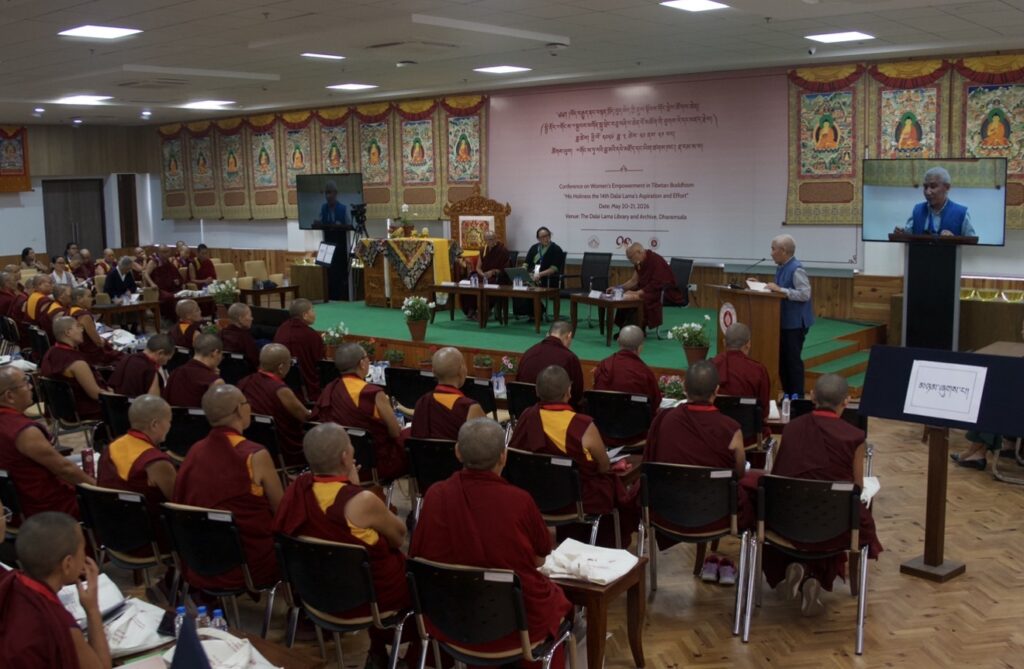
DHARAMSALA, 22 MAY: An inaugural two-day conference on women’s empowerment in Tibetan Buddhism was held at the auditorium of the Dalai Lama Library and Archives in Dharamsala from 20 to 21 May, with the participation of over 80 nuns from 13 nunneries across India and Nepal.
Jointly organised by the Department of Religion under the Central Tibetan Administration (CTA), in collaboration with the Dalai Lama Trust and with support from the Tibetan Nuns Project and the Tibetan Women’s Association, the conference featured panel discussions on key issues concerning nuns in Tibetan Buddhism. These included the institutionalisation of the Geshema degree—the highest academic qualification, first conferred in 2016 and historically reserved for male monks as the Geshe degree—as well as the continued absence of full Bhikshuni (Gelongma) ordination in the Tibetan Mulasarvastivada Vinaya tradition.
Discussions also addressed the role of Geshemas in leadership, nunnery curricula, international recognition and collaboration, as well as the historical and contemporary challenges faced by nuns, including the personal journeys involved in obtaining the Geshema degree.
Geshema Gelek Wangmo of Dolmaling Nunnery, Dharamsala, among the first cohort to pursue the Geshema degree, spoke about the challenges her batch faced due to the absence of an established curriculum. She explained that after completing the study of a single text, they were often left uncertain about what to study next and, at times, had to travel to other monasteries to continue their studies in subjects not offered at their nunnery. However, she noted that such challenges are often borne by the first generation in order to pave the way for those who follow.
Similarly, Geshema Namdol Phunstok of Khachoe Ghakhyil Nunnery, Nepal, highlighted a range of structural challenges faced by nuns, including the requirement to be accompanied when leaving the monastery, which can be financially and logistically burdensome. She also spoke of the difficulties she faced during her Geshema studies, when she was at one stage the only student remaining in her class, noting that Buddhist studies rely heavily on dialectical debate, making solitary study particularly challenging
She further expressed concern over what she described as a declining sense of responsibility and engagement among younger nuns, as well as the language barriers they face in studying texts. With many monasteries now comprising students from non-Tibetan Himalayan communities, she noted that limited proficiency in Tibetan poses a significant challenge to the study of Tibetan Buddhist texts.
“I always encourage, and at times request, plead, and even cry, asking my students to speak in Tibetan, not to assert linguistic superiority, but because a proper understanding of Tibetan Buddhism requires knowledge of the language,” she said, adding that nuns must also learn other languages and fields of knowledge in order to engage with the modern world.
Addressing the issue of gender-based discrimination in the Tibetan Buddhist tradition, Geshe Thupten Jinpa, translator to the 14th Dalai Lama, said the issue should be examined from both a philosophical perspective—what is stated in the scriptures—and the socio-cultural context in which those texts were produced. He argued that many forms of gender-based discrimination stem more from historical customs and traditions than from core Buddhist philosophy.
He further emphasised the importance of critically examining the context and reasoning behind such distinctions in the scriptures, in dialogue with Western and other feminist studies and theological frameworks. He encouraged Tibetan Buddhist nuns to engage in such research and to speak about these issues on broader platforms.