Wang Huning’s Tibet Visit: Law, Unity, and the Sinicization of Faith
By Khedroob Thondup
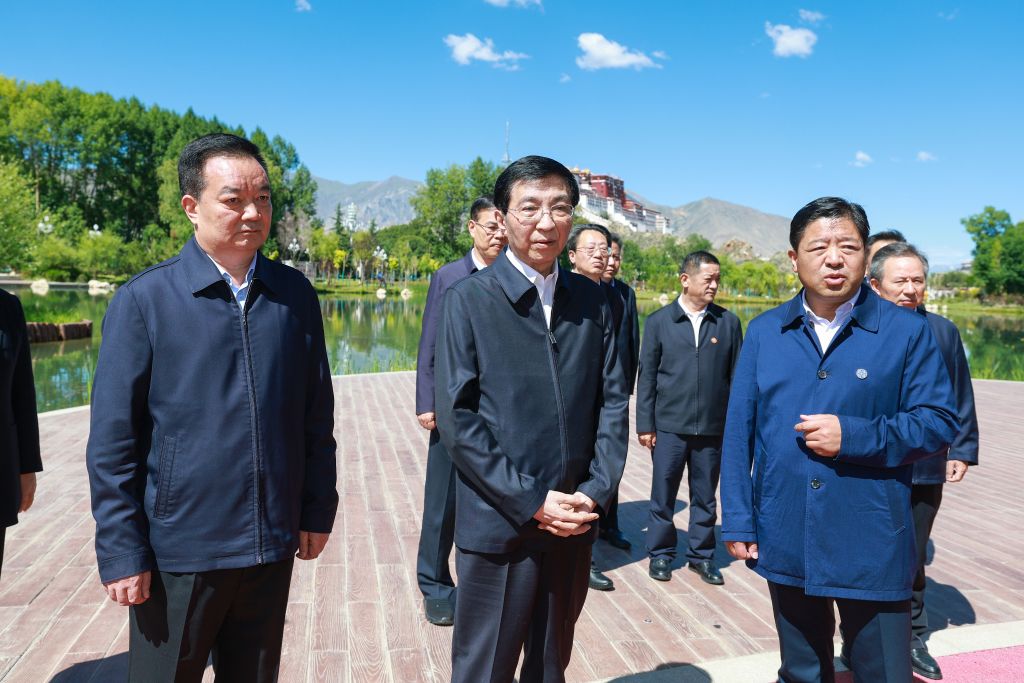
China’s fourth-ranking leader, Wang Huning, pictured at a Park in Lhasa, Tibet’s capital, during his four day visit to Tibet from 19 – 22 July, described as “a research tour“ by state media. Image: Xinhua/Liu Bin.
When Wang Huning, a senior member of the Politburo Standing Committee, traveled to Tibet, his words carried the weight of Beijing’s long-term vision for the region. His call for the implementation of the Law on Promoting Ethnic Unity and Progress was not a passing remark but a reaffirmation of the Party’s central strategy: to bind Tibet’s development inseparably to the project of national integration.
The Legal Framework of Unity. Wang’s emphasis on raising the capacity for administering ethnic affairs according to law signals a shift from ad hoc governance to codified, institutionalized management. The law is meant to function as both shield and sword: protecting the state’s vision of unity while disciplining any deviation from it. In Tibet, this translates into embedding ethnic unity into every layer of development—economic, cultural, and social. Infrastructure projects, education reforms, and poverty alleviation programs are all framed as vehicles for strengthening cohesion.
Development as Political Integration. The insistence that “all development be imbued with the significance of ethnic unity and progress” reveals the Party’s conviction that growth is not neutral. Roads, schools, and industries are not merely about prosperity; they are instruments of political consolidation. Tibet’s modernization is thus cast as inseparable from its assimilation into the broader Chinese identity. Development becomes a narrative of belonging, where material progress is equated with loyalty to the state.
Religion Under Socialist Guidance. Perhaps the most sensitive dimension of Wang’s remarks lies in the sphere of religion. In line with the broader policy of systematically advancing the sinicization of religion in China, Tibetan Buddhism is to be “continuously guided to adapt to socialist society.” This is not simply about regulation; it is about reshaping the spiritual landscape to align with state ideology. Monasteries, teachings, and rituals are expected to harmonize with socialist values, ensuring that faith does not become a locus of resistance but a channel for unity.
Law-Based Governance of Religious Affairs. The strengthening of law-based governance of religious affairs underscores the Party’s determination to manage belief as rigorously as it manages economics. By codifying oversight, the state seeks to prevent religion from drifting into what it perceives as separatism. The protection Wang mentions is therefore double-edged: it promises preservation of Tibetan Buddhism as a cultural heritage, but only within the boundaries set by socialist legality.
The Broader Implications. Wang’s Tibet visit illustrates the Party’s evolving toolkit: law, development, and religion are not separate domains but interwoven threads in the tapestry of national unity. The message is clear—ethnic policy is no longer about tolerance or coexistence; it is about integration under a single political and ideological framework. For Tibet, this means that its future will be scripted not only in terms of economic growth but in the language of ethnic unity and socialist adaptation.
Khedroob Thondup is a former Tibetan diplomat and parliamentarian, and nephew of the Dalai Lama. He is also the editor of the books Dalai Lama, My Son and Tibet in Turmoil.

The views expressed in this article are those of the author and should not be attributed to Tibet Express.