TCHRD Annual Reports Warn of Deepening Institutionalised State Control in occupied Tibet
By Tenzin Chokyi
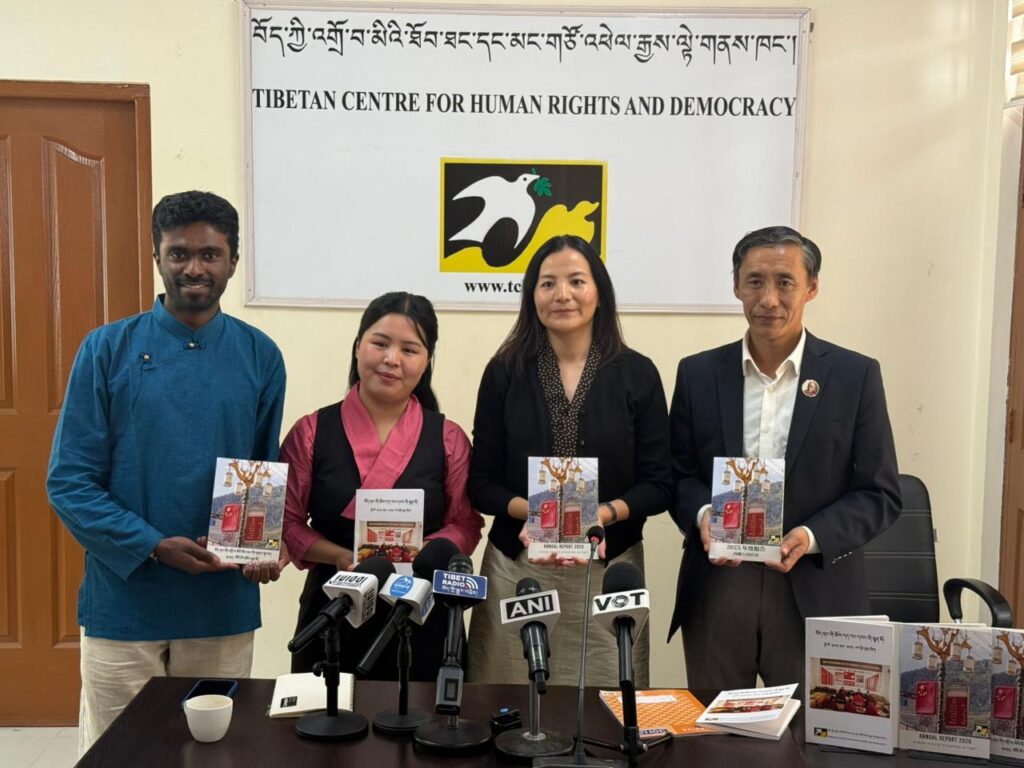
DHARAMSALA, 4 June: The Tibetan Centre for Human Rights and Democracy (TCHRD) released its Annual Human Rights Report 2025 and Religious Freedom Report 2012-2025 today, warning that Chinese authorities are increasingly exercising control over occupied Tibet through institutionalised legal and administrative mechanisms that affect religion, education, language rights and civic freedoms.
Presenting the findings at a press conference held at TCHRD’s office in Dharamsala, the organisation said Beijing’s governance of occupied Tibet is increasingly characterised by the integration of political control into state institutions and regulatory frameworks, moving beyond overt political suppression while continuing to restrict fundamental freedoms.
The Annual Human Rights Report examines five key areas: freedom of religion and belief, arbitrary detention and torture, education and language rights, the right to peaceful assembly, and transnational repression.
According to the report, restrictions on religious freedom remained among the most pressing concerns during the reporting period. TCHRD highlighted the implementation of the revised Measures for the Administration of Tibetan Buddhist Temples, which were issued in December 2024 and came into effect on 1 January 2025. The organisation argued that the measures further strengthened state oversight of religious practice by requiring Tibetan Buddhist institutions and monastic personnel to adhere to Chinese Communist Party leadership, promote “core socialist values,” and support the Sinicization of religion.
The report further raises concerns over the continued erosion of Tibetan language rights, stating that policies promoting Mandarin Chinese as the primary language of instruction have further narrowed opportunities for Tibetan-medium education. TCHRD argues that recent educational reforms, including China’s first Preschool Education Law, which seeks to expand the use of Putonghua in early childhood education, have accelerated efforts to assimilate Tibetan children into the state’s preferred linguistic and cultural framework.
In its assessment of civil and political rights, the report documents cases of arbitrary detention, torture and enforced disappearances, which it describes as continuing features of China’s governance in occupied Tibet. The organisation said Tibetans accused of activities deemed threatening to state security, as well as individuals engaged in peaceful cultural, religious and community activities, remain vulnerable to detention and punishment.
The report also highlights restrictions on the right to peaceful assembly, documenting cases in which Tibetans protesting mining projects and other local grievances faced surveillance, intimidation, detention and other forms of retaliation by authorities.
Beyond Tibet’s borders, TCHRD raised concerns about what it described as growing instances of transnational repression targeting Tibetans abroad. Among the cases highlighted was the death of Tibetan religious leader Tulku Hungkar Dorje in Vietnam following his detention in an operation reportedly involving Chinese and Vietnamese authorities. The organisation said the case underscored concerns over the reach of Chinese state actions beyond its borders and their implications for Tibetans living outside Tibet.
During the press conference, reporters questioned the effectiveness of appealing to international bodies such as the United Nations, given China’s influence within the organisation as a major global power and one of its largest contributors.
Responding to the question, TCHRD Executive Director Tenzin Dawa acknowledged the limitations of international mechanisms and the challenges posed by the influence of powerful states within multilateral institutions.
“It certainly presents a challenge,” she said, while noting the need for structural reforms within the international system. However, she maintained that the United Nations remains an indispensable multilateral platform through which communities such as Tibetans can document human rights violations, raise concerns and bring international attention to developments inside Tibet.
Addressing the impact of TCHRD’s advocacy efforts, Dawa said it is difficult to measure the direct and immediate impact of reports and appeals on the human rights situation inside occupied Tibet. Nevertheless, she maintained that documenting abuses and engaging in international advocacy remain essential for sustaining global attention on Tibet, even if tangible outcomes may appear limited in the face of broader systemic challenges.
She cited cases in which TCHRD’s interventions had helped family members of political prisoners address specific challenges, including instances where children were reportedly allowed to return to school following advocacy efforts.