Penpa Tsering Sworn In for Second Term as Sikyong of Tibetan Government-in-Exile
By Tenzin Chokyi
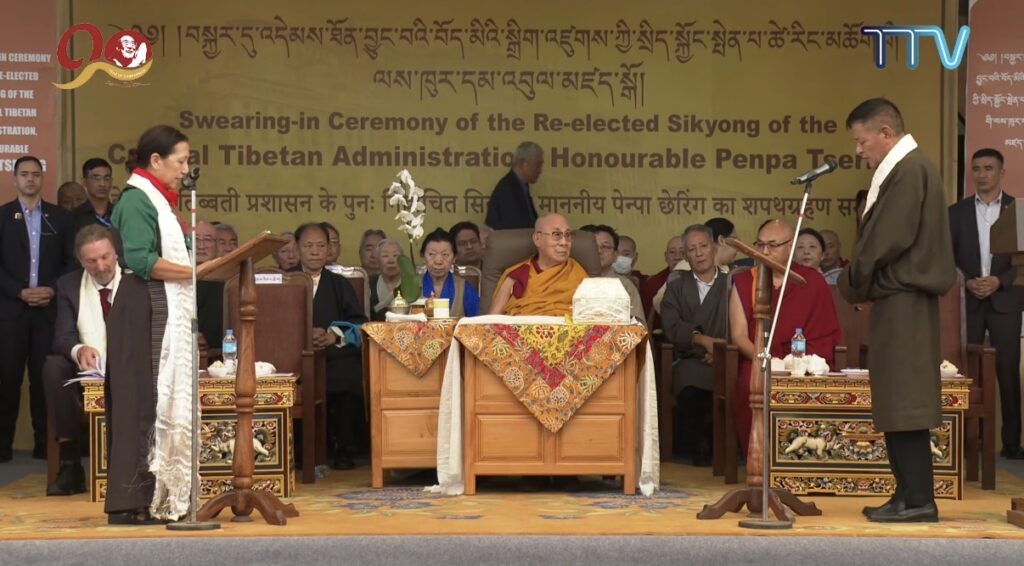
DHARAMSALA, 27 May: Sikyong Penpa Tsering, the re-elected political head of the Central Tibetan Administration (CTA), also known as the Tibetan government-in-exile, was officially sworn in today as the Sikyong of the 17th Kashag (Cabinet), marking the beginning of his second five-year term in office.
At the oath-taking ceremony held today at the Tsuklakhang Temple in McLeod Ganj, Sikyong Penpa Tsering took the oath of office before CTA Chief Justice Commissioner Yeshi Wangmo, in the presence of the Tibetan spiritual leader, the 14th Dalai Lama of Tibet.
The ceremony, regarded as one of the most significant political events in the Tibetan exile democratic polity, was attended by parliamentarians and representatives from several sovereign countries, including host nation India, longtime Tibet supporter El Salvador, Chile, the United Kingdom, and Scotland.
In his inaugural address, Sikyong Tsering reiterated that his administration would continue advocating for the Middle Way Policy envisioned by the Tibetan spiritual leader as the guiding framework for resolving the Sino-Tibet issue, although he acknowledged the limited space for such negotiations given China’s current policy direction towards nationalities.
He further reaffirmed that his administration remains committed to countering disinformation and misleading narratives propagated by the Chinese government through the dissemination of factual information aimed at strengthening global support for the Tibetan cause, particularly on issues concerning the reincarnation of the 14th Dalai Lama and Tibet’s historical status as a sovereign state.
Alongside its political advocacy on the Tibet issue, Sikyong stated that his administration would continue prioritising social welfare policies aimed at strengthening the long-term sustainability and self-reliance of the Tibetan exile community until a resolution to the Sino-Tibet issue is achieved.
He also emphasised the need for a well-organised and efficient administration to advance the Tibetan cause and improve public service delivery for the exile community. Building on e-governance initiatives introduced during the 16th Kashag, he said the 17th Kashag would further strengthen administrative capacity through improvements in personnel, technology, infrastructure, and institutional systems, while expanding digital governance through enhanced data management and database systems.
According to the Sikyong, the administration will increasingly utilise information technology and artificial intelligence to strengthen advocacy efforts, improve administrative efficiency, and enhance communication with Tibetans living in exile across the world.
Highlighting social welfare as a key responsibility of the administration, Penpa Tsering said the Kashag would continue initiatives focused on youth skill development, healthcare and preventive services, public infrastructure, and support for vulnerable groups, including the elderly, the sick, and economically disadvantaged members of the community.