Ahead of Implementation, Sikyong Slams China’s Ethnic Unity Law as Escalation of Assimilation Policy
By Tenzin Chokyi
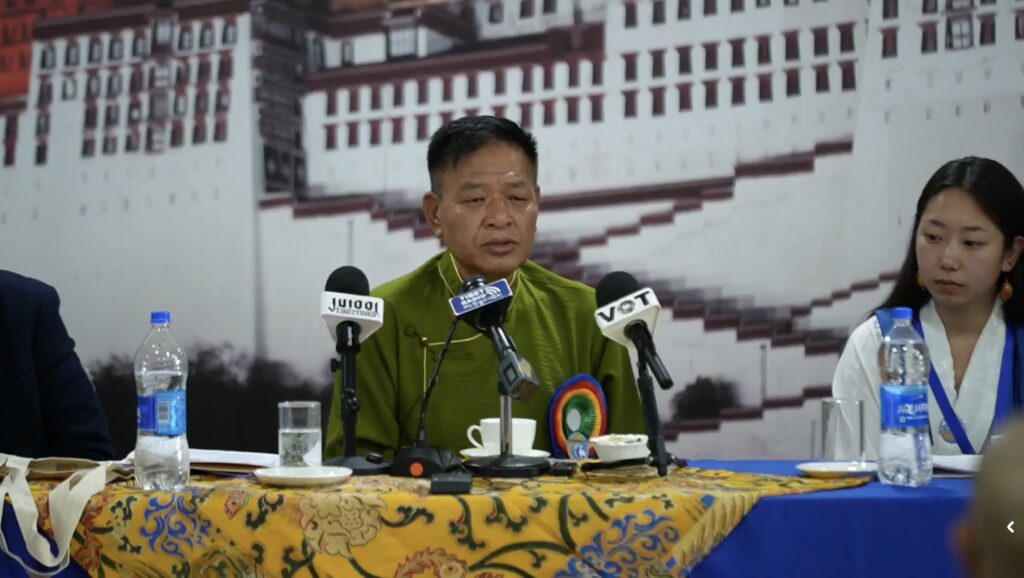
DHARAMSALA, 30 June: With China’s “Law on Promoting Ethnic Unity and Progress” set to take effect on 1 July, Sikyong (President) Penpa Tsering of the Central Tibetan Administration (CTA) on Monday rejected the legislation as a significant legal escalation of Beijing’s longstanding assimilation policies in Tibet, arguing that it formally codifies genocidal practices the Tibetans have opposed for decades.
Speaking at a press conference following a four-day International Conference on Sino-Tibetan Relations organised by the Centre for Middle Way Initiative, Penpa Tsering said the Tibetans not only reject but oppose the law, arguing that it violates both China’s Constitution and international law and amounts to a policy aimed at eradicating an entire people. “It can never be accepted,” he said.
Tsering argued the mechanisms underpinning Beijing’s assimilation policies toward Tibet have existed since the complete occupation of Tibet in 1959. What distinguishes the new legislation, he argued, is that those measures have now been codified into law, giving them explicit legal authority.
His criticism focused on what he described as contradictions within China’s own legal system. He argued that the new law conflicts with the Law on Regional National Autonomy, which guarantees certain rights to China’s “national minorities,” including the use of their own languages, religious freedom and regional autonomy. The result, he argued, is two mutually exclusive laws operating under the same constitution.
The apparent contradiction between the new legislation and China’s Law on Regional National Autonomy also prompted repeated questions about the future of the Middle Way Approach. Sikyong maintained that the CTA’s immediate response should not be to revise its established policy in reaction to a single development in China, but to examine the law, its contradictions, implementation and legal implications.
He said the administration’s priority is to present those findings to governments and the international community, placing the legislation in the broader context of China’s expanding role in global governance, international security and the global economy. In doing so, he argued, the administration hopes to help the international community better understand the wider implications of the law beyond Tibet.
While maintaining that the legislation does not warrant an immediate change to the Middle Way Policy, Tsering said it does necessitate a reassessment of the legal foundations of the 2008 Memorandum on Genuine Autonomy for the Tibetan People, which relies heavily on China’s Law on Regional National Autonomy. Such a reassessment, he said, would require time, resources and broad consultation.
Tsering said he has not yet had the opportunity to hold a full discussion on the issue with his newly constituted cabinet, noting that ministers have spent only about four hours together since taking office because of official engagements.
Even so, he said the administration has already begun engaging embassies, the Offices of Tibet and governments ahead of the law’s implementation, encouraging them to respond within their respective capacities. He added that he had raised the issue during recent overseas engagements and called on Tibetan non-governmental organisations and individual Tibetans to help bring greater international attention to the legislation.
China adopted the “Law on Promoting Ethnic Unity and Progress” on 12 March and it is scheduled to come into force on 1 July. Chinese authorities say the legislation is intended to strengthen “ethnic unity” and “national cohesion”, while Tibetan groups and human rights organisations argue it further institutionalises policies of cultural assimilation and strengthens state control over minority identities.