Tibetans Bid Final farewell to Lhasang Tsering, a Voice of Conviction in Tibet’s Freedom Struggle
By Tenzin Chokyi
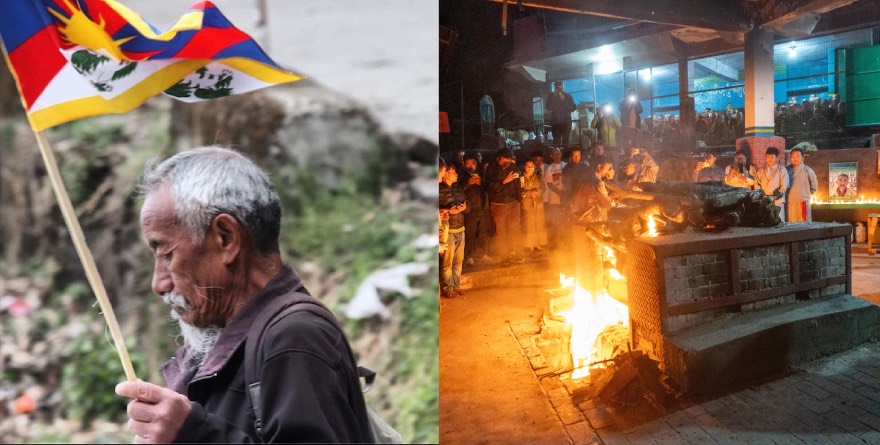
DHARAMSALA, 15 June: As friends, admirers, and fellow Tibetans gathered to bid him a final farewell, veteran Tibetan independence activist, writer, and poet Lhasang Tsering was cremated on Monday at the crematorium located half kilometre to Mcleod Ganj. He passed away on June 11 at the age of 74, leaving behind a life story etched into the history of the Tibetan freedom movement through sacrifice, conviction, intellectual honesty, and an unwavering commitment to his cause.
Born in 1952 in Ngari, western Tibet, Lhasang Tsering’s life was shaped by the upheavals that transformed modern Tibetan history. His family was on pilgrimage in India when Tibet was fully occupied by China in 1959, forcing them into exile. Like many Tibetans of his generation, his earliest years were marked by displacement, loss, and the difficult task of rebuilding life and, in many ways, the nation itself in a foreign land.
After completing his schooling in India, he turned down an opportunity to study medicine abroad in 1972 and instead joined the Tibetan resistance movement in Mustang, Nepal. The decision would become emblematic of a life defined by commitment to the Tibetan cause. Even as the resistance movement faced collapse amid shifting international politics and dwindling support, he remained steadfast in his belief that Tibetans should continue their struggle for a sovereign Tibet.
Central to Lhasang Tsering’s legacy was a fierce intellectual independence that often set him apart. Over the course of his life, he served as Principal of the Tibetan Children’s Village School in Upper Dharamshala at the age of 24, later worked in the Central Tibetan Administration, helped pioneer the establishment of Narthang Press, led the Tibetan Youth Congress as its president, co-founded the Amnye Machen Institute, and devoted his later years to writing and scholarship. Yet despite his contributions to some of the exile community’s most important institutions, he remained unafraid to challenge prevailing assumptions within the Tibetan movement. His unwavering advocacy for Tibetan independence and criticism of the Middle Way Approach made him one of the movement’s most distinctive and, at times, controversial voices.
For many who knew him, the Tibetan freedom struggle was not merely the central cause of his life but also one of its deepest burdens. The hopes, sacrifices, disappointments, and unresolved questions that accompanied the Tibetan movement were never abstract political concerns for him; they were deeply personal realities that shaped the course of his life.
In recent years, some observers felt that a figure who had once stood at the forefront of Tibetan political and intellectual life had come to occupy a quieter place in public discourse. Yet his writings, poetry, and reflections continued to offer a rare and uncompromising perspective on Tibet’s past, present, and future.
News of his passing has prompted tributes from across the Tibetan world. While manyremembered him as a resistance fighter, writer, and advocate for Tibetan independence, others reflected on what his death represents: the gradual passing of a generation whose lives embodied the aspirations, hardships, and contradictions of the Tibetan struggle in exile.
In mourning Lhasang Tsering, many Tibetans are mourning more than an individual. They are mourning a voice that refused to bend to political winds, a generation shaped by exile and resistance, and a chapter of Tibetan history that is steadily passing into memory.