TPiE Votes 23–15 Against Private Member’s Bill on Continuation of Tibetan Independence Struggle
By Tenzin Chokyi
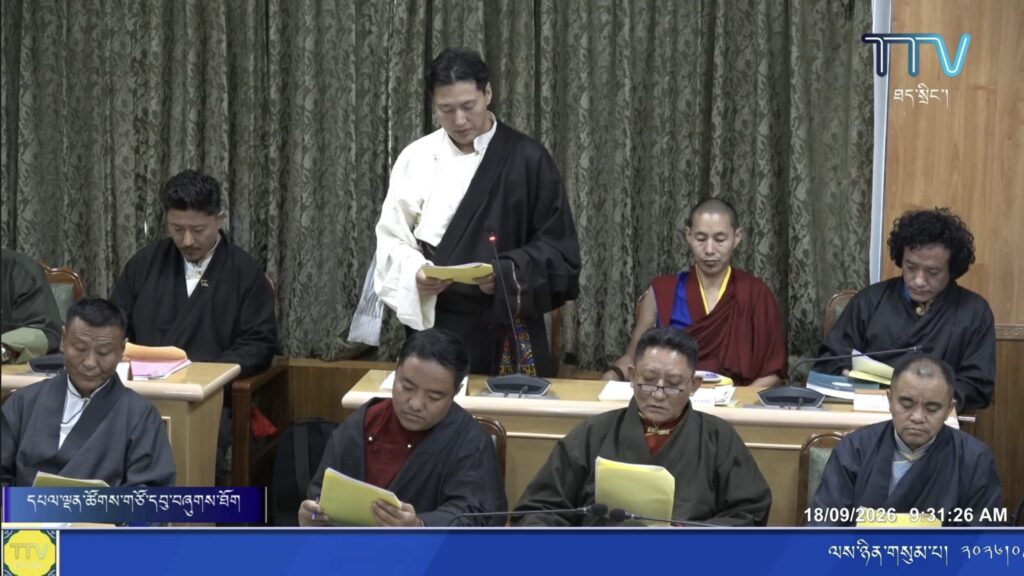
DHARAMSALA, 18 Sept: A private member’s Bill calling for the continuation of the Tibetan independence struggle prompted heated debate in the Tibetan Parliament-in-Exile (TPiE) on Friday over the constitutional and procedural basis for bringing the proposal before the House, before members voted 23-15 against admitting it to the discussion agenda.
The Bill was introduced by Parliamentarian Sangay Dorjee and supported by Parliamentarian Gagya Gyaltsen Choekyi on the third day of the second session of the 18th TPiE. Submitted as a private member’s Bill- an established avenue for individual parliamentarians to bring proposals before the House- it was rejected by 23 votes to 15 at the admission stage, preventing it from proceeding to substantive discussion.
Drawing on historical records documenting Tibet’s past independence, the worsening situation inside occupied Tibet, and statements by the Dalai Lama that the Tibetan people should ultimately determine their political future through democratic means, the proposal argues that the time has come to bring about a change in the Tibetan administration’s political policy. It calls for the continuation of the Tibetan independence struggle, as well as the restoration of Tibet’s territory and sovereignty.
Several parliamentarians, including Karma Gelek, immediately objected, arguing that the resolution lacked a constitutional basis. He maintained that a fundamental policy change should follow the mechanism under Article 56 of the Charter of Tibetans-in-Exile, which covers important policy matters affecting Tibet’s or Tibetans’ fundamental interests. He further maintained that there was no need to alter the existing policy and expressed his strong opposition to the proposal.
The Speaker, however, clarified that since the proposal had been submitted through the established Private Member’s Bill mechanism, the House would first vote on whether to admit it for further discussion.
Sikyong Penpa Tsering subsequently raised a point of order, arguing that the content of the proposal was directly connected to the official political policy of the CTA. While acknowledging that it had been submitted as a Private Member’s Bill, he questioned whether a proposal concerning such a policy could be brought forward through that mechanism.
Referring to Article 56, the Sikyong questioned whether allowing an individual-member proposal to bring about a change in a fundamental political policy could bypass the higher threshold envisaged under the Charter. Article 56 provides for a popular referendum on important policy matters concerning the fundamental interests of Tibet or Tibetans under specified conditions, including when supported by at least two-thirds of the total strength of Parliament or three-fourths of the combined strength of the Kashag (Cabinet) and the Standing Committee of Parliament.
Following the Sikyong’s intervention, the Speaker set the proposal aside for examination by a committee, changing course from her earlier decision that the House would vote on whether to admit it for discussion.
The decision prompted further disagreement among parliamentarians. Some supported the referral, arguing that the constitutional and procedural questions should be examined before the matter proceeded.
Others maintained that the House should first vote on whether to admit the Private Member’s Bill, arguing that whether it would ultimately lead to a change in policy would arise only after the proposal was admitted and considered. Some also argued that Article 56 did not prohibit an individual parliamentarian from introducing bills related to an established policy.
After further deliberation, the Speaker maintained both rulings and proceeded first with the vote on whether it should enter the discussion agenda.
The House voted 15 in favour and 23 against, preventing the resolution from being admitted to the parliamentary agenda for further discussion. As a result, the committee review could not proceed.