When Beijing Tried to Silence My Voice
By Khedroob Thondup
For decades, Tibetans in exile have lived with the knowledge that the Chinese Communist Party (CCP) seeks not only to control our homeland but also to police our voices abroad. I have experienced this firsthand. In one of the more cynical manoeuvres, the Chinese government attempted to enlist His Holiness the Dalai Lama to rein in my public advocacy for Tibetan independence. Their request was not only misguided—it revealed the CCP’s fundamental misunderstanding of democracy and freedom of thought.
The Attempt to Control. The CCP’s logic was simple but flawed: if His Holiness could be persuaded to silence me, then the broader Tibetan movement could be weakened. They assumed that our community functions like their own authoritarian system, where one directive from the top can extinguish dissent. They failed to grasp that Tibetan democracy in exile is built on pluralism, debate, and individual conscience.
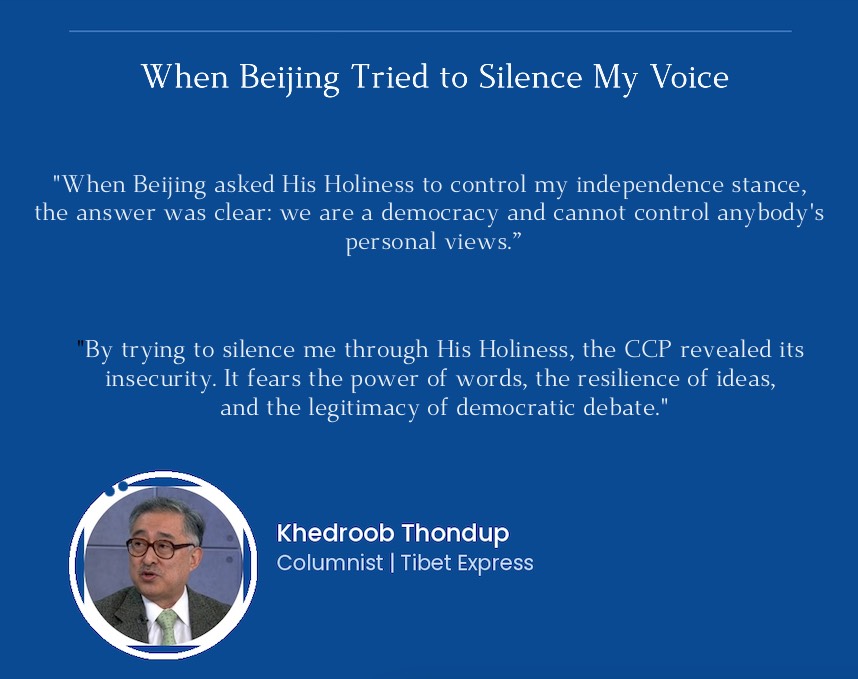
His Holiness’s Response. When Beijing asked His Holiness to control my independence stance, the answer was clear: we are a democracy and cannot control anybody’s personal views. That statement was more than a rebuke—it was a declaration of principle. Unlike the CCP, our institutions respect the right of individuals to speak their truth, even when it diverges from the majority or from leadership.
Why This Matters. The episode illustrates three critical points: Democracy in Exile: Our democratic system is not symbolic; it is lived. Tibetans abroad elect representatives, debate policies, and express diverse opinions. CCP’s Misunderstanding: Beijing cannot comprehend a system where leaders do not dictate every thought. Their request exposed their authoritarian reflex. Independence Advocacy: Calls for independence are not fringe—they are rooted in the lived experience of occupation and suppression.
The Broader Lesson. By trying to silence me through His Holiness, the CCP revealed its insecurity. It fears the power of words, the resilience of ideas, and the legitimacy of democratic debate. But Tibetans will not be silenced. Our democracy ensures that voices like mine—whether for independence, autonomy, or cultural preservation—remain part of the conversation.
Conclusion. I was trolled by the Chinese government, but their attempt backfired. Instead of isolating me, they highlighted the contrast between authoritarianism and democracy. In Tibet, voices are silenced. In exile, voices are free. And that freedom is precisely why the Tibetan cause endures.
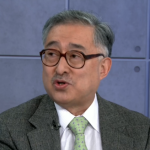
Khedroob Thondup is a former Tibetan diplomat and parliamentarian and nephew of the 14th Dalai Lama. He is also the editor of the book,’ Dalai Lama, My Son and Tibet in Turmoil.’
The views expressed in this article are those of the author and should not be attributed to Tibet Express.