
“Because You Lost” — Manila’s Defiance at Seoul
By Khedroob Thondup
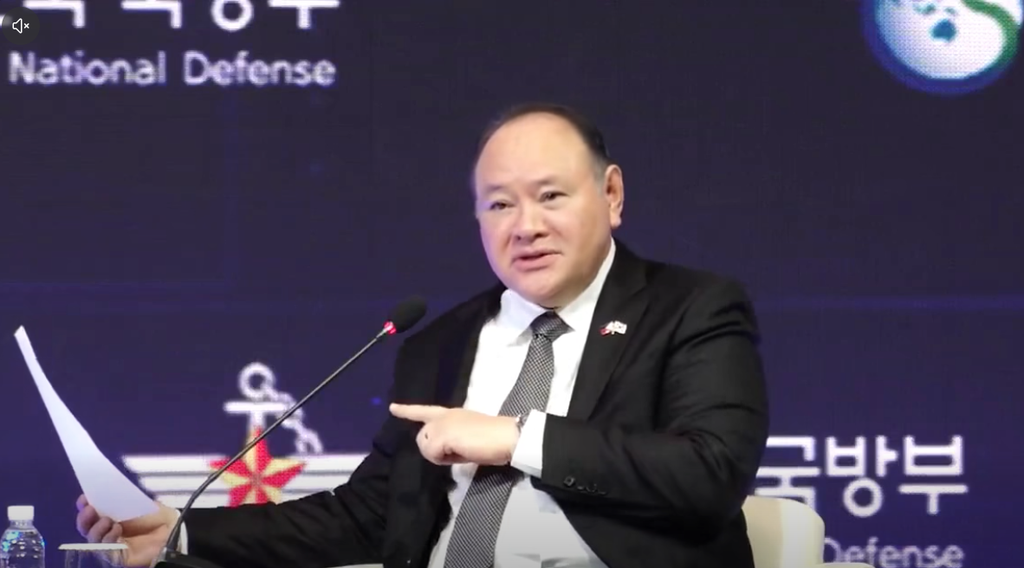
At the Seoul Defense Dialogue this Tuesday, Philippine Defense Secretary Gilberto Teodoro delivered a moment that will echo across Asia’s contested waters. Asked about gray-zone coercion, Teodoro did not retreat into diplomatic platitudes. Instead, he reached for a note handed to him by the Chinese delegation — a note that baldly declared the 2016 South China Sea arbitral award “illegal, null and void.”
His rebuttal was devastating in its brevity: “Because you lost.”
The Power of Two Words. In those two words, Teodoro distilled years of legal wrangling, diplomatic maneuvering, and maritime confrontation into a simple truth. The arbitral tribunal at The Hague ruled overwhelmingly in favor of the Philippines, invalidating Beijing’s expansive “nine-dash line” claims. China’s refusal to accept the ruling does not erase its legitimacy. By reminding the world that the award stands precisely because Beijing lost, Teodoro reframed the narrative: the arbitral decision is not a matter of opinion, but of law.
Naming Coercion for What It Is. Teodoro went further, calling the delivery of the note itself “coercion, bullying and aggression.” This was not mere rhetoric. Gray-zone tactics — the calibrated use of intimidation short of open warfare — are Beijing’s preferred weapon in the South China Sea. Whether through swarming fishing vessels, water cannon attacks, or diplomatic notes designed to delegitimize international rulings, the aim is the same: to wear down resistance without triggering outright conflict.
By labeling the note as aggression, Teodoro stripped away its veneer of diplomacy. He exposed it as part of the same continuum of coercion that plays out daily in the waters off Palawan and the Spratlys.
Why This Matters. The exchange in Seoul was more than a sharp retort. It was a reminder that words, when wielded with clarity, can puncture the fog of coercion. Teodoro’s response resonates because it is rooted in law, not bluster. It underscores that the Philippines is not merely a claimant state but a victor in a binding legal process.
For regional partners — from Japan to Vietnam — the moment offers a template: confront gray-zone tactics not only with ships and patrols, but with unflinching truth.
A Turning Point in Tone. The Philippines has often oscillated between accommodation and assertion in its China policy. Teodoro’s words mark a decisive tilt toward assertion. They signal that Manila will not allow Beijing to rewrite the outcome of 2016 through repetition or intimidation.
In the theater of geopolitics, sometimes the sharpest weapon is not a missile or a frigate, but a phrase. “Because you lost” may well become the rallying cry for smaller states facing larger powers who seek to bend law into submission.
Conclusion. At Seoul, Teodoro reminded the world that the arbitral award is not null and void — it is binding, and it is Beijing’s loss. By calling out coercion in real time, he demonstrated that resistance begins with refusing to accept the terms of intimidation.
The South China Sea remains a contested expanse, but on Tuesday, Manila showed that clarity and courage can cut through the haze of gray-zone coercion.

Khedroob Thondup is a former Tibetan diplomat and parliamentarian, and nephew of the 14th Dalai Lama. He is also the editor of the book: Dalai Lama, My Son and Tibet in Turmoil.
The views expressed in this article are those of the author and should not be attributed to Tibet Express.