California Arrest Brings Renewed Focus on China’s Transnational Repression
By Tenzin Chokyi
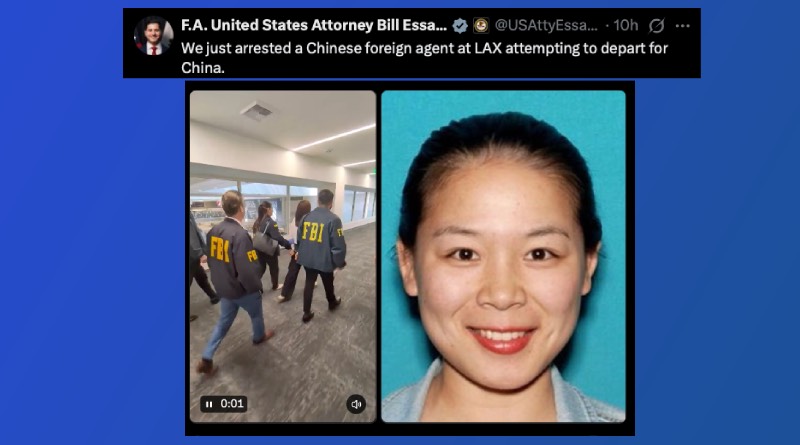
DHARAMSALA, 5 Oct: A California woman has been arrested while attempting to depart to China on charges of acting as an unregistered Chinese agent and spying on the son of Taiwan’s President Lai Ching-te. The case has renewed attention to Beijing’s documented efforts to extend its repressive reach beyond China’s borders and target Tibetans, Uyghurs and other exiled communities.
According to Reuters, Wanying Zhang, also known as Heather, 34, was arrested at Los Angeles International Airport on Sunday before her planned departure to China. Prosecutors allege that she travelled to Seattle in 2025 at the direction of Chinese officials and surveilled the son of Taiwanese President Lai Ching-te and his family, sending Chinese officials photographs, videos and licence-plate information. She has been charged with “acting as an unregistered foreign agent.”
Taiwan’s Presidential Office described the alleged operation as a “typical case of transnational repression,” a term used for attempts by governments to monitor, intimidate or pressure people beyond their own borders.
The issue has particular resonance among Tibetans living in exile, who have for years raised concerns over alleged Chinese surveillance and intimidation of Tibetan activists and communities outside China and its occupied regions.
A 2025 report by the US Commission on International Religious Freedom documented allegations of Chinese authorities using surveillance, blackmail and threats against relatives in China to pressure Tibetan and Uyghur diaspora communities. The report also documented efforts to suppress Tibetan and other activists during Chinese President Xi Jinping’s 2023 visit to San Francisco.
The concerns have gained another dimension this year following the introduction of China’s “Law on Promoting Ethnic Unity and Progress”, which came into force on 1 July. The law includes provisions concerning organisations and individuals outside China whose activities are deemed to undermine “ethnic unity and progress” or create “ethnic division”.
Rights groups have raised concerns that these provisions could be used to exert pressure on Tibetans, Uyghurs and other communities living in exile.
The latest US case comes amid growing international scrutiny of allegations that Chinese authorities seek to monitor and pressure critics and diaspora communities beyond China’s borders.
The allegations against Zhang have not been proven in court, and she is presumed innocent until proven guilty.