Sikyong Says Gandhi’s Non-Violence Remains Relevant to Tibetan Struggle
By Tenzin Chokyi
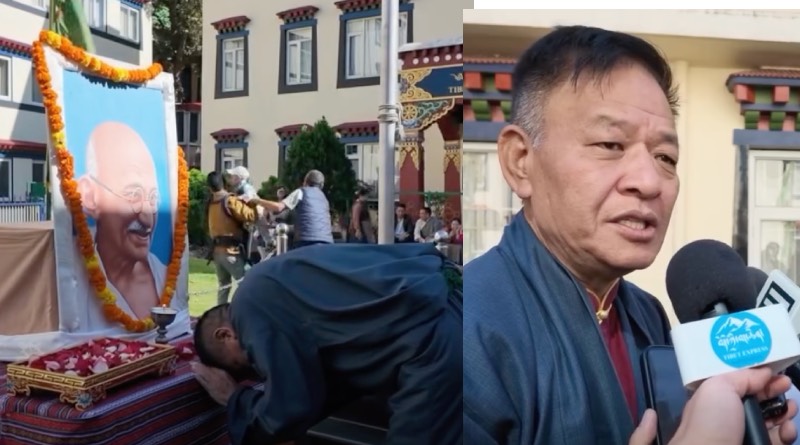
DHARAMSALA, 2 Oct: Sikyong (President) Penpa Tsering on Friday said Gandhi’s legacy of non-violence remains deeply relevant to the Tibetan struggle, describing him as a global example of resolving conflicts without violence.
Tsering made the remarks at a ceremony organised by the Central Tibetan Administration (CTA) in the compound in front of the Tibetan Parliament-in-Exile in Dharamsala to mark the 157th birth anniversary of Mohandas Karamchand Gandhi.
“Gandhiji is the apostle of peace. Gandhiji is one of the leaders in the world who used non-violence as a means to resolve conflict,” Tsering said, adding that Gandhi had set an example of how disputes could be resolved without violence and the loss of life.
He said the Tibetan freedom struggle is also based on non-violence and that Tibetans look to Gandhi as a leader who demonstrated the power of non-violent movements. He also noted the influence of Gandhi’s principles on leaders such as Martin Luther King Jr. and Nelson Mandela in their respective struggles for human freedom.
“Gandhiji is very much respected within the Tibetan community and all over the world,” Tsering said, noting that Gandhi Jayanti is observed every year in Dharamsala. He added that there are many Gandhians within the Tibetan community who follow Gandhi’s principles, including his concept of Hind Swaraj.
Referring to the 76th anniversary of the founding of the People’s Republic of China, which was observed on 1 October, a day before Gandhi Jayanti, Tsering said China could also learn from Gandhi’s principles of peace and non-violence.
“The world needs more peace, not violence,” he said, stressing that all human beings deserve dignity and freedom regardless of their colour or background.
Tsering said the responsibility of a government is to safeguard the welfare of its people and fulfil their aspirations. He criticised what he described as China’s “unidimensional” approach to viewing development as the solution to every problem, saying human beings also have spiritual and other aspirations.
Speaking specifically about Tibet, he said Tibetan civilization is ancient and has the potential to contribute to peace in the world. He stressed the need to preserve Tibet’s distinct identity, including its identity as a nation and civilization, as well as its language.