CTA Delegation Attends High-Level U.S. Independence Event in Delhi
By Tenzin Chokyi
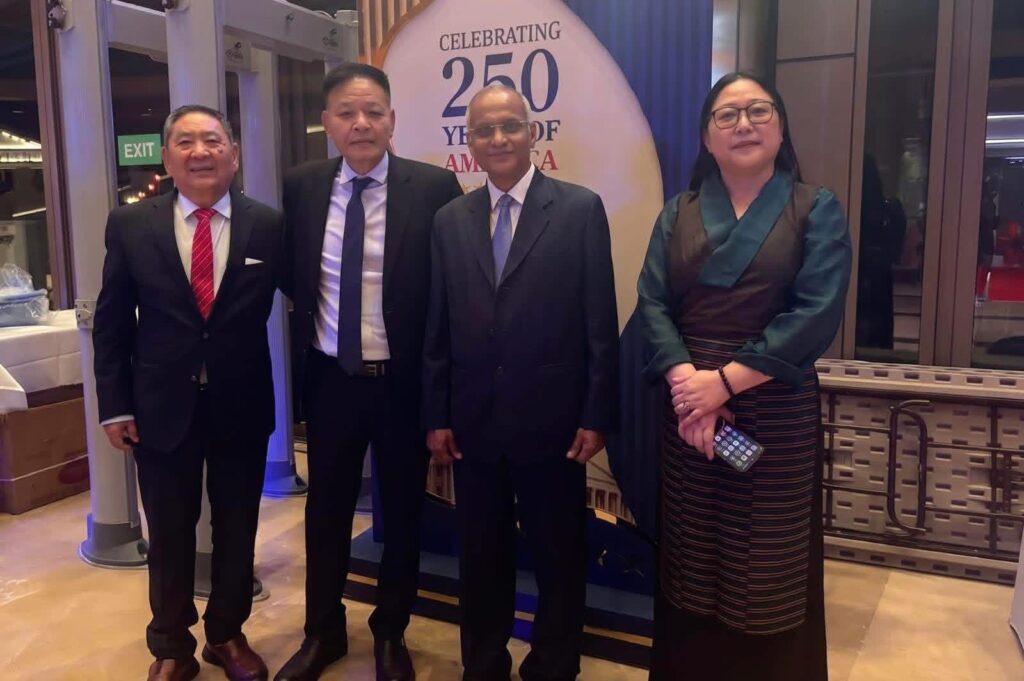
Image: Tibet.net.
DHARAMSALA 25 May: A high-level delegation of the Central Tibetan Administration (CTA), the Tibetan government-in-exile, led by its political head Sikyong Penpa Tsering, attended the Freedom 250: Independence Day Reception hosted by U.S. Ambassador to India Sergio Gor in New Delhi on 24 May, according to an update by Tibet.net.
The CTA delegation included Kalon Norzin Dolma of the Department of Information and International Relations (DIIR), along with Representative Jigme Jungney and Secretary Tashi Dekyi of the Bureau of His Holiness the Dalai Lama in Delhi. The reception formed part of the United States’ global lead-up to its 250th anniversary of independence, with commemorative events organised by U.S. embassies worldwide focusing on diplomatic ties and international partnerships.
Notably, U.S. Secretary of State Marco Rubio attended the reception in person, alongside India’s External Affairs Minister Subrahmanyam Jaishankar and Ambassador Sergio Gor. Their presence signalled the diplomatic weight of the gathering, with a clear emphasis on strengthening bilateral ties.
Rubio described the United States as a “beacon of hope not just around the world, but for individuals,” reflecting on his background as the son of Cuban immigrants. Emphasising global partnerships, he noted that “so much of what we’ve achieved in our history has been built in partnership with other countries,” singling out India as a key partner in the 21st century
Highlighting the strategic alignment between the two countries, Rubio noted that India and the United States are “perfectly positioned” to work together on major global challenges and opportunities, adding that their cooperation could contribute not only to the well-being of their own citizens but also to that of other countries.
While Rubio’s remarks focused on democratic partnership and shared strategic interests, the presence of the CTA delegation situates Tibet within a broader diplomatic framework. India, as host to the Tibetan government-in-exile, occupies a sensitive position—balancing its deepening partnership with the United States and its complex relationship with China.
Against this backdrop, the CTA’s participation in an event foregrounding U.S.–India cooperation and democratic values is seen within Tibetan political circles as part of an effort to maintain visibility within conversations shaped by shifting geopolitical alignments, where questions of human rights and political representation continue to intersect with strategic priorities.