
Eight Young Indian Scholars’ Conference on Tibetan Studies Opens in Dharamsala
By Tenzin Chokyi
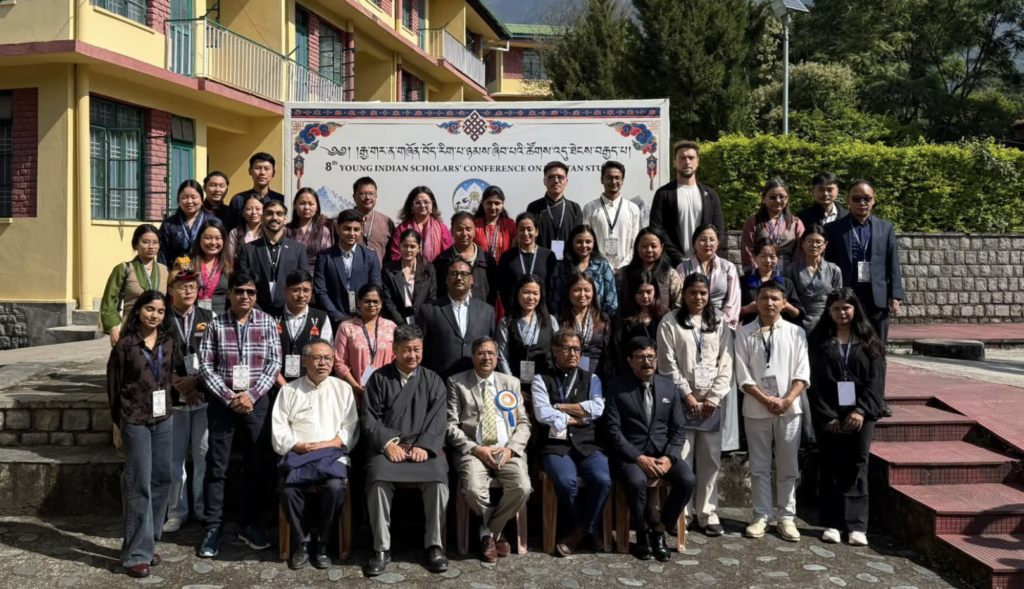
DHARAMSALA, 8 Oct: The 8th Young Indian Scholars’ Conference on Tibetan Studies officially opened in Dharamsala on Thursday, bringing together emerging researchers, university faculty, and academic experts from across the country to deepen Indian scholarship and understanding of Tibet.
Organised by the Tibet Policy Institute (TPI), the three-day gathering being held at the ATWS Hall in Khanyara, near here, aims to deepen academic engagement and foster a comprehensive, fact-based understanding of Tibetan studies among young Indian scholars.
Delivering the welcome address at the opening ceremony, TPI Director Tenzin Lekshay underlined the strategic necessity for India to cultivate its own scholarship on Tibet. While acknowledging the historical proximity and emotional sympathy that many Indians hold for Tibet, Lekshay pointed out that factual awareness of Tibet’s geopolitical reality often remains limited. He emphasised that this conference series, first established in 2009, is designed not merely to support the Tibetan cause, but primarily to serve India’s national interests and equip future generations to navigate complex Indo-Tibet dynamics.
In his keynote address, Chief Guest Dr Satya Prakash Bansal, Vice Chancellor of the Central University of Himachal Pradesh (CUHP), made a compelling plea for an interdisciplinary approach to Tibetan studies.
Urging young researchers to go beyond conventional academic boundaries, Dr Bansal stressed that the Himalayas should serve as a living laboratory where traditional knowledge interfaces with modern technologies such as artificial intelligence, digital humanities, climate science, and environmental studies.
He called on scholars not to examine Tibet solely through isolated lenses, such as viewing it only through geopolitics, Buddhism strictly through religion, or traditional knowledge merely as an artefact of the past, but to actively connect history with contemporary politics, culture with technology, traditional knowledge with sustainability, and scholarship with society.
Dr Bansal also highlighted CUHP’s ongoing initiatives, including its Centre for Tibetan Studies and Centre for Buddhist Studies, and announced that the university is working to organise an upcoming international convention on peace in Dharamsala, for which the Dalai Lama has given his acceptance. He proposed collaborations, diploma courses, and shared research projects between CUHP and the Tibet Policy Institute to build lasting networks among young scholars.
The inaugural session also featured Professor Siddique Wahid, former Vice Chancellor of the Islamic University of Science and Technology in Kashmir, who is mentoring participants over the three-day event, alongside Mr Passang Tsering, Principal of the College of Higher Tibetan Studies, Sarah.
Over the course of the conference, participants will engage across seven thematic panels covering critical areas such as border security, geopolitical strategy, digital influence operations, exile identity, and traditional knowledge systems. Participants will present their research and join interactive Q&A sessions, along with a special audience with the Dalai Lama and a visit to the Dalai Lama Library and Archives, both scheduled for the second day.