For Tibetan Activists, Tattoos Become a Permanent Declaration of Resistance
By Tenzin Chokyi
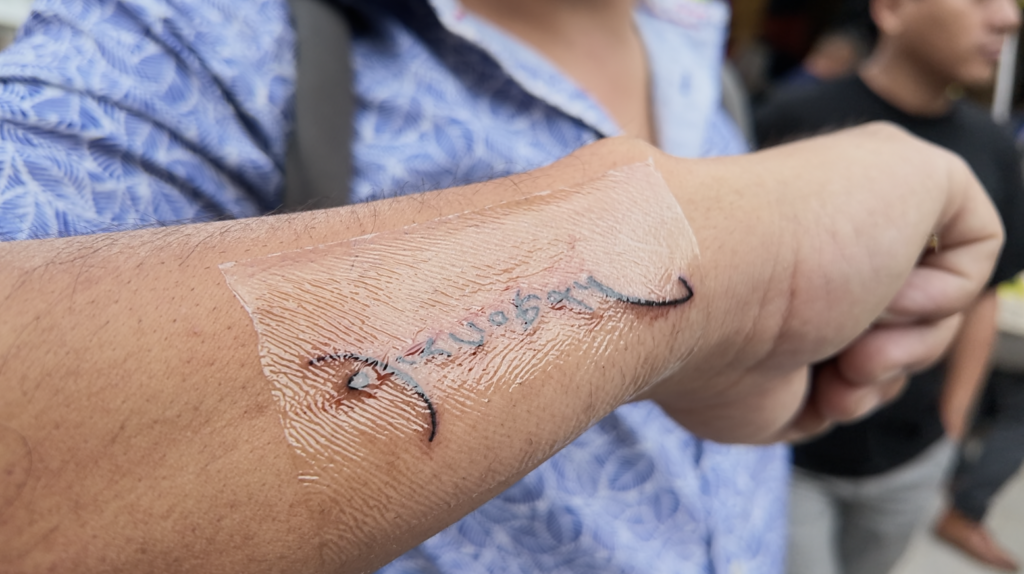
DHARAMSALA, 13 August: As exile becomes accustomed to a crushing sense of paralysis, where the geopolitical landscape can often feel unmoving, Tibetan refugees inscribe living shrines of their homeland onto their bodies through tattoos—transforming themselves into walking, breathing archives of Tibet.
At opposite corners of the hunger strike site, two young Tibetan tattoo artists, Sonam and Tenzin Kalsang, sit quietly with their equipment. Outside Tsuglagkhang, the Dalai Lama temple in McLeod Ganj, the Tibetan Youth Congress’ global hunger strike has entered its 42nd day in solidarity with Pawo (Martyr) Lobga Rangzen, the Tibetan independence activist who died after self-immolating outside the United Nations headquarters in New York on 2 July.
Amid solemn chants and fasting activists, the two artists lay out their needles, cleaning wipes and ink caps. Between them rests a shared lookbook filled with traditional Tibetan iconography, mantras and national symbols, rendered in strikingly diverse calligraphic styles—designs waiting to be permanently etched onto the skin of those who have gathered to commemorate Lobga Rangzen and carry forward his message.
Among those choosing to carry that message on their bodies are Rangzen Dhundup, president of the Regional Tibetan Youth Congress in Dharamsala, and Dr Sonam Tobgyal, a researcher at Tibet Watch. Both are outspoken advocates of Tibetan independence and familiar faces at campaigns and demonstrations in Dharamsala.
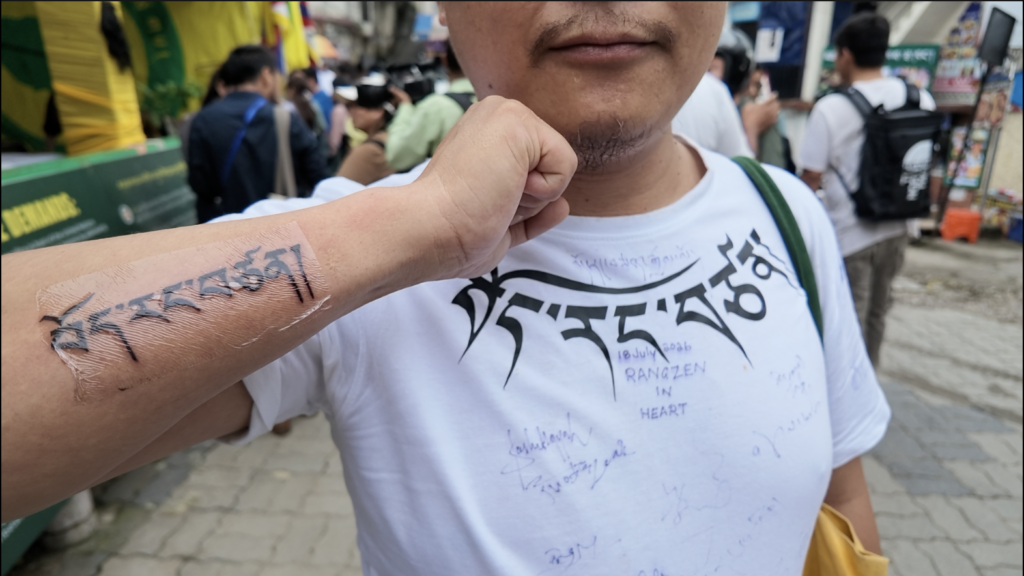
For Dhundup, the tattoo is less a statement for an audience than a promise to himself. The words he chose were བོད་རང་བཙན་(Tibetan Independence).
Dhundup said the tattoo was a way of uniting what the eye sees with what the heart holds—a commitment to Tibetan independence that he intends to carry for the rest of his life. “What the eye should see and what the heart should keep is independence,” said Rangzen Dhundup, his T-shirt and cap emblazoned with བོད་རང་བཙན་(Tibetan independence).
The inscription, he said, would remain on his body and in his heart until his death, a symbolic gesture of the promise he had made to himself to continue fighting for Tibetan independence until the end of his life.
For Dhundup, the permanence of ink mirrors the permanence of his political conviction. A cause that can feel distant in the political landscape can nevertheless be made physically present, carried beneath clothing, across borders and through the ordinary movements of life.
Tobgyal, too, chose the same inscription—བོད་རང་བཙན་(Tibetan independence)—but for him, the tattoo carries another layer of meaning.
He described it as an act of solidarity with what Lobga Rangzen gave his life for: Tibetan independence.
Independence, Tobgyal said, is not simply a matter of political preference or choice, but a historical right of the Tibetan people. More fundamentally, he said, the desire to live freely and without oppression is innate to people and has repeatedly driven them to struggle for freedom. His tattoo, therefore, is not only a remembrance of one man’s death. It is a declaration that the cause for which Lobga Rangzen died has not ended with him.
Tobgyal also argued that Tibetans must recognise China as an adversary in their struggle, describing Chinese rule in Tibet as a colonial system that, in his view, depends on the exclusion and erosion of the people it colonises. “Their colonial occupation thrives on the exclusion and eradication of the colonised—of us, the Tibetan people. A people cannot truly be free while living under the power of those who colonise them. It is therefore a matter of principle to recognise China for what it is and to struggle against it,” he said.
For Tobgyal, that struggle is now written onto his own body. What might otherwise remain an abstract political conviction has been made permanent in ink. The tattoo becomes more than an emblem. It becomes a way of making political memory physical.
At a hunger-strike site built around sacrifice, protest and the demand to be heard, the tattoos offer a quieter form of remembrance. There is no speech in the ink, no banner to raise and no slogan that needs to be shouted. The message simply remains, etched into the bodies of those who have chosen to carry it.