Dear Beijing, if Arunachal is ‘South Tibet’, let’s talk about Tibet
China has long weaponised maps, names and history against Bharat; Delhi is finally learning to return the favour.
By Utpal Kumar | Firstpost | 10 August 2026
Former Foreign Secretary Shyam Saran, in his book How China Sees India, recounts an extraordinary conversation between Chinese Premier Zhou Enlai and US Secretary of State Henry Kissinger in 1972.
“India is a highly suspicious country,” Zhou told Kissinger. “It is quite a big country; sometimes it puts on airs of a big country, but sometimes it has an inferiority complex.”
Kissinger had a ready explanation: “It has been governed by foreigners through most of its history.”
“Yes,” Zhou replied, “that might be one of the historical factors.”
Then came the most fascinating — and revealing — recollection. Zhou told Kissinger about a tea party the then Indian Prime Minister, Jawaharlal Nehru, had hosted in his garden. Among the guests were two Tibetan lamas. Then, suddenly, another figure appeared in Tibetan costume: a woman.
“Do you know who she was?” Zhou asked.
“Madame Binh?” Kissinger guessed.
“Madame Gandhi,” Zhou replied, provoking laughter.
It was Indira Gandhi, dressed entirely in a Tibetan attire.
“That was something that Nehru was capable of doing,” Zhou recalled. “I was speechless (when) confronted with such a situation. It was impossible for me to say anything.”
There, compressed into this seemingly innocuous episode, lies much of the tragedy of Bharat’s early engagement with China. Nehru apparently thought he was making a charming cultural gesture towards his Chinese guest. Zhou saw it as an affront to China’s conception of itself and, perhaps, further reason to suspect that Bharat harboured ambitions regarding Tibet.
Ironically, Delhi was doing all this to impress Beijing. For decades, and particularly during the first 15 years after Independence, it repeatedly sought to win China’s confidence, only to produce results that were often the opposite of what it intended.
The failure was as much intellectual as political. Until relatively recently, most scholars who presented themselves as China experts, particularly in academia, tended to be Sinophiles. They admired the Chinese system and civilisation, were often in awe of them, and even appeared reluctant to subject Beijing’s worldview and actions to sufficiently rigorous scrutiny. The result was that Delhi continued making mistakes without undertaking adequate course correction.
At the heart of the problem, therefore, was an inadequate understanding of the Middle Kingdom mindset. Indians tended to see China through an Indian prism. They assumed that conciliatory ‘Hindi-Chini bhai-bhai’ rhetoric could foster a genuine sense of fraternity. The Chinese interpreted conciliation differently, more as a weakness that should be exploited.
The Chinese political worldview has been starkly different from that of its southern neighbour. Historian RC Majumdar explored this in an article in the Organiser in 1965: “It is characteristic of China that if a region once acknowledged her nominal suzerainty even for a short period, she would regard it as a part of her empire forever and would automatically revive her claim over it even after a thousand years whenever there was a chance of enforcing it.”
Then there was another Chinese characteristic that Tibetologist Charles Alfred Bell wrote about: the tendency to first make “mild” claims and “then to wait a bit and if it passes without objection, to say or do something stronger”.
Seen against this backdrop, Delhi’s recent decision to formally identify 27 places in Arunachal Pradesh by their standard Indian names deserves attention. Predictably, Beijing has reacted sharply, describing the exercise as “self-deception” and warning that it runs “counter to the improving momentum in bilateral relations and could complicate efforts to properly handle border issues”.
The indignation is revealing. China has spent years weaponising nomenclature. It has issued Chinese names for places in Arunachal Pradesh, which it claims as “South Tibet”, repeatedly using maps, terminology and administrative declarations to bolster its territorial claims. Now Bharat is answering in the same language. It has realised that maps are not innocent pieces of paper in territorial disputes. It now understands that names are not merely labels. Cartography, nomenclature, infrastructure, administrative control and diplomatic repetition are all instruments through which states reinforce claims and seek to establish political facts.
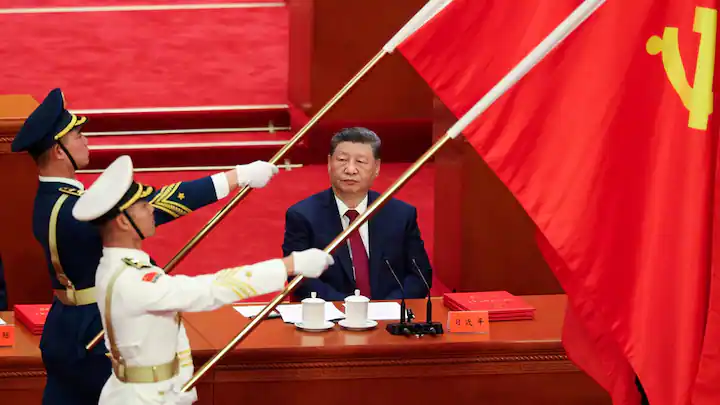
Beijing, being a past master of this nomenclature game, has always understood, and even weaponised, this exceptionally well. What’s heartening is that Delhi now appears to understand it too. The timing makes the message even more significant. Xi Jinping is expected to visit Delhi next month for the BRICS summit. The older Indian diplomatic instinct might have been to postpone anything remotely provocative. The usual Indian thinking would have been: why create unnecessary friction before such an important visit?
Not anymore.
There is a certain irony here because Beijing itself has repeatedly demonstrated that summitry does not require strategic restraint. Xi’s 2014 visit to Bharat coincided with a serious confrontation in the Chumar sector. Even as the Modi government rolled out the diplomatic carpet in September 17-19, 2014, troops of the People’s Liberation Army were confronting Indian forces along the Line of Actual Control (LAC).
China has, for years, mastered the art of what former Indian envoy to China Vijay Gokhale would, in his latest book, China’s Wars, call the Chinese “talk-and-take” strategy — “the selective application of force at the times of China’s choosing, while simultaneously forcing a desirable outcome through the negotiations”. Beijing has long understood that territorial disputes are fought not merely by soldiers but also by historians, diplomats, mapmakers, bureaucrats and propagandists. Repeat a claim often enough, publish it on enough maps, give places Chinese names, incorporate them into official documents, and wait for opportune moments to let these changes concretise.
Now, as the Arunachal Pradesh episode shows, Delhi too is responding to the Chinese challenge — soldier to soldier, diplomacy to diplomacy, maps to maps. It has realised that merely having civilisational, constitutional control over a territory is not enough. The country also needs to fight and win the narrative war.
The bigger challenge now is consistency. Beijing plays a long game. Delhi should be ready for that and resist the temptation to judge its China policy through individual summits, temporary border disengagements or carefully worded joint statements. It must cultivate strategic patience of its own.
For decades, Bharat’s China policy was haunted by the hope that one more gesture of goodwill might finally persuade Beijing of Delhi’s peaceful intentions. As Zhou Enlai’s story about Indira Gandhi shows, merely having good intentions is not enough. It is also paramount to send the right message.
This is where Delhi’s Arunachal Pradesh messaging is important. One hopes Beijing realises that the law of diminishing returns has set in. If it doesn’t and continues calling the Indian state “South Tibet”, then Bharat should be ready to send another message: “Dear Beijing, if Arunachal Pradesh is ‘South Tibet’, let’s then talk about Tibet.”
(The writer is the author of ‘Bharat Rising: Dharma, Democracy, Diplomacy’ and ‘Eminent Distorians: Twists and Truths in Bharat’s History’. Views expressed in the above piece are personal and solely those of the author. They do not necessarily reflect Firstpost’s views.)