HRW Report Says China’s Preschool Policy Undermines Tibetan Language
By Tenzin Chokyi
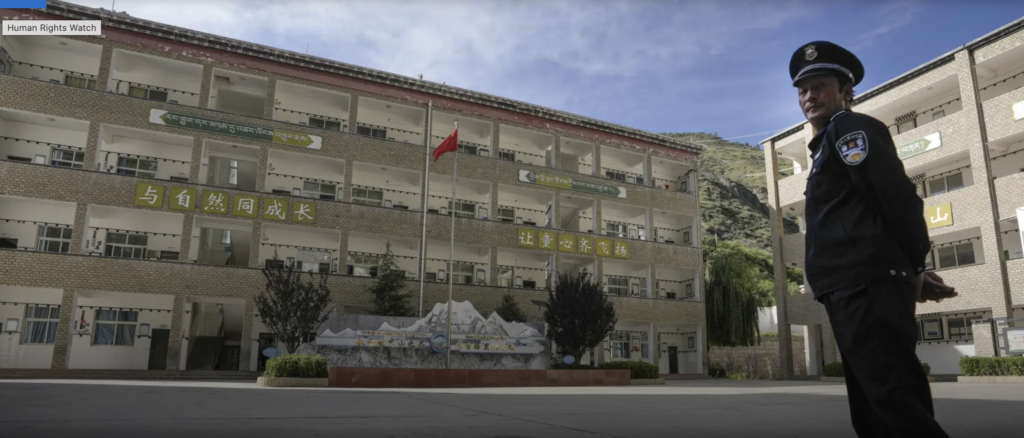
DHARAMSALA, 5 April: A new Human Rights Watch report titled Start with the Youngest Children: China Uses Preschools to “Integrate” Tibetans says China’s “Children’s Speech Harmonisation Plan,” introduced in 2021 by the Ministry of Education, has effectively eliminated the remaining legal and policy space for minority-language education in early childhood schooling.
Released on 4 April, reveals that while China’s 1984 Regional National Autonomy Law formally guarantees “minority communities” the right to use their own languages in education, this framework has been progressively eroded over four decades through successive reforms that have expanded the use of Mandarin Chinese in schools at increasingly earlier stages.
According to Human Rights Watch, the 2021 directive marked a decisive shift by mandating the use of standard Mandarin Chinese as the language of instruction and care in all preschools nationwide, including in areas inhabited by “minority populations” such as Tibetans, Uyghurs, and Mongols, among others.
Although supplementary minority-language teaching is not explicitly prohibited, the report states that references to “bilingual education” have disappeared from official policy documents, and in practice, local authorities no longer retain meaningful discretion to implement minority-language instruction at the preschool level.
The report describes this policy as the culmination of a transition that began in the 1980s, during which minority-language instruction was gradually reduced in primary and secondary education and replaced by Chinese-medium schooling. Kindergartens, which had remained the last institutional space where minority languages were widely used as the main medium of instruction, are now fully incorporated into this system.
Accounts cited in the report indicate that the effects of these policies are already becoming visible and appear to be intensifying. Tibetans with recent experience in the region describe very young children, sometimes as early as three or four, beginning to shift rapidly toward Mandarin after entering Chinese-language kindergartens, with Tibetan use declining noticeably within a short period of enrollment.
This shift in everyday language use is also associated with wider changes in social and family life, including reduced ease of communication between children and older relatives and disruptions in the transmission of cultural and religious knowledge. Some accounts further suggest that children increasingly associate Mandarin with higher social value, while Tibetan is seen as less useful or less important, which contributes over time to a sense of linguistic and cultural inferiority.
The report warns that post-2021 policies do not merely risk gradual language loss but are actively reshaping the linguistic, cultural, and social foundations of Tibetan society, placing the survival of Tibetan language and culture at risk within a single generation. Human Rights Watch says these developments raise serious concerns under international human rights law, including violations of children’s rights to language, culture, education, and family life, as well as protections afforded to minorities. It also notes that the policies appear to conflict with provisions of Chinese law relating to preschool education and minority autonomy.
The report calls on the government of the People’s Republic of China to ensure that the education of minority children respects their cultural identity, language, and values in line with the Convention on the Rights of the Child, and to end policies that contribute to forced assimilation. It further urges the government of the so-called Tibet Autonomous Region (TAR) to ensure Tibetan children can learn and use their language in kindergartens and throughout schooling.
Foreign governments, it adds, should press China to uphold its obligations under international law and its own constitutional guarantees on minority language rights.