Statement of the Tibetan Parliament-in-Exile on the Commemoration of the 66th Tibetan Democracy Day
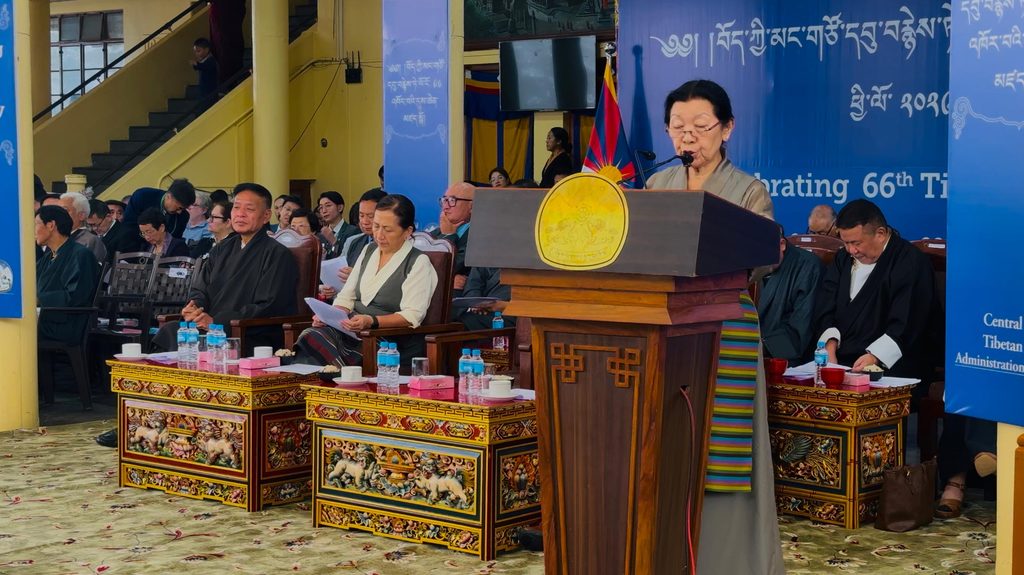
Today is a uniquely important day in the calendar of the exile Tibetan people: it is the 66th anniversary of the day on which His Holiness the Dalai Lama, the indispensable leader of the Tibetan people, out deep sense of thought and compassion, bestowed upon us the invaluable gift of the excellent of the democratic system of governance. With profound reverence, the Tibetan Parliament-in-Exile wishes to convey to His Holiness our utmost gratitude, while extending warm congratulations and greetings to the Tibetan people inside Tibet and in exile on this momentous occasion.
In this connection, it bears recalling the events on the 3rd of February in 1960, when lay and monastic people from all the exile Tibetan communities that had been set up throughout the subcontinent congregated at the sacred Buddhist site of Bodh Gaya and There, they offered a long-life ceremonial prayer to His Holiness the Dalai Lama and presented a solemn written oath of allegiance. On that occasion, His Holiness stated: “Unlike in the past, the government of Tibet must be based on a democracy informed by political and spiritual principles. We should establish a parliament whose deputies represent the broad Tibetan public, elected by majority vote. For the present, this parliament will consist of one deputy from each of the four major religious schools and three deputies from each of the three provinces of Tibet. Upon returning to your communities, you must submit lists of candidates chosen by learned, capable, patriotic, and selfless individuals who earn the trust of their constituencies.” In compliance with this directive, candidates were nominated across the exile settlements, comprising three representatives from each of the three provinces and one from each of the four major schools of Tibetan Buddhism. Appointed under the signature of His Holiness, they formed the first Tibetan Parliament-in-Exile. At 9:00 AM on September 2, 1960, these members took their oath of office before His Holiness the Dalai Lama, marking the official founding of the Tibetan people’s democratic government.
And so, the democratic system of government of the Tibetan people was not founded in the aftermath of a victory in a struggle for political power. Rather, it was established as a gift granted by the vision and foresight of His Holiness the Dalai Lama on the basis of trusting the potentiality of the Tibetan people. Hence, this is a day on which we, the people of the Snowland of Tibet, remember with great fondness the gratitude we owe to His Holiness the Dalai Lama, our destined protector and guide, by whose grace we are able to bask in the benefits of the democratic system of governance in exile. Along with it, our democratic system has continued to develop and progress, with each individual actively participating in our share of our respective responsibilities. Likewise, we must think in terms of being able to develop a foundation for democratic governance, peace, and mutual respect when the Tibetans in Tibet and those in exile will be reunited in future on the basis of lessons we had learnt while exercising our democratic freedoms in exile.
In this connection, a document outlining the salient features of a future democratic constitution of Tibet was announced in 1961. Then, in 1991, His Holiness the Dalai Lama acted to make the Tibetan parliament-in-exile a true lawmaking body in keeping with what its name suggested. Following it, on the 28th of June in 1991, His Holiness gave his assent to the Charter of Tibetans in Exile, which had been passed by the 11th Tibetan Parliament-in-Exile. Further on, in 2001, as desired by His Holiness the Dalai Lama in a move to complete the process of the building of Tibetan democracy, the Kalon Tripa – the executive head of the Tibetan administration in exile – was directly elected by the Tibetan public. This was a major leap forward in the development of Tibetan democracy.
In order that the Tibetan struggle would not need to depend on a single individual, as well as by taking into consideration a multitude of immediate and long-term concerns, His Holiness in 2011 transferred to the elected leaders of the Tibetan people the entirety of his political authority over the whole of Tibet that had been held for nearly four hundred years till then by his Gaden Phodrang institution. His Holiness thereby very graciously ensured that the entire framework of the Tibetan administrative setup became a fully functioning democracy in every respect. Apart from that, His Holiness has ensured that leaders of the Central Tibetan Administration in exile are elected entirely on the basis of their knowledge, capability, and experience without being encumbered by extraneous considerations based on one’s race or ancestry, state of wealth, power, and so forth. His Holiness has also ensured that the rule of law, not the power of an individual, prevails in all public affairs. These lend great value and dignity to the Tibetan democratic system in exile.
In stark contrast, for our Tibetan brethren living under Chinese rule in Tibet, enjoying the benefits of a democratic system remains entirely out of reach. The Chinese Communist government continues to deprive them of their most basic rights, denying fundamental freedoms of religion, movement, speech, and expression, as well as the right to preserve and transmit their linguistic heritage. Following its armed invasion in 1949 and full military occupation in 1959, Beijing has spared no effort to exploit Tibet’s mineral resources across all three traditional provinces. The rampant clearing of virgin forests, south-to-north river diversions, and widespread damming for massive hydroelectric power stations have inflicted devastating environmental destruction on Tibet’s fragile ecosystem.
Furthermore, China’s persistent campaign to erase Tibet’s unique religious, cultural, and linguistic identity has subjected the Tibetan people to grave atrocities, resulting in the loss of more than 1.2 million lives. Today, Tibetans inside Tibet remain deprived of basic freedoms and face constant threats of arrest, arbitrary detention, imprisonment, and execution. In response to this unrelenting oppression, peaceful protests calling for freedom and the return of His Holiness the Dalai Lama have continued unabated. Tragically, since 2009, a total of 157 Tibetans inside Tibet—driven by profound anguish—have set themselves on fire in protest, a fully verified figure representing the devastating reality on the ground.
On July 1, 2026, China began enforcing its “Law on Promoting Ethnic Unity and Progress”—a blatant stratagem designed to erase the ethnic identity of Tibetans and other non-Chinese peoples under the euphemism of “unity and progress.” Just a day later, on July 2, a brave Tibetan patriot named Rangzen Lobga set himself on fire in front of the United Nations Headquarters in New York City, protesting Chinese Communist rule and calling for the restoration of Tibetan independence. This tragic act filled us all with profound grief.
This oppressive law is a matter of grave concern not only for Tibetans, but for all other nationalities suffering under Chinese Communist rule. When a people’s distinct identity faces existential threat, the international community must investigate whether the policies driving it violate the foundational principles of international human rights. Furthermore, this legislation significantly heightens the threat of transnational repression posed by Beijing. Consequently, the Tibetan Parliament-in-Exile appeals for protection for all non-violent activists campaigning for Tibet’s freedom, as well as for support from democratic nations worldwide. Representatives across the Tibetan diaspora must honor the sacrifices of our martyrs by exposing the reality behind Beijing’s policies, actively raising awareness in their local communities to build sustained global support for Tibet.
In his last message before carrying out his self-immolation, the Tibetan independence martyr Rangzen Lobga said: “We, in all honesty, owe it enormously to His Holiness the Dalai Lama, the Bodhisattva Chenrezig, for having granted us a truly wholesome democratic system of government. Likewise, even though His Holiness the Dalai Lama has granted us democracy, without we having to bear any human and material costs for this purpose, we have kept on pleading to him to reject it, insisting that he simply take it back. Undaunted, His Holiness stood by his commitment on the implementation of a wholesome democracy in the Tibetan society. As regards the reason why His Holiness has granted us democracy, it is not at all so that we may fight among ourselves. Rather, it is for the sake of the Tibetan people, and with a hope to bring about progress to the Tibetan nation.” As thus stated, elections are held every five years in our democratic system, as we all know, which presents an occasion for the Tibetan people to change their political leaders. We should not consider the democracy we practice in exile as a personal privilege that can be taken for granted; rather, we should value it as a responsibility that must be cherished and protected. Hence, any implementation of our democracy should be accompanied by displays of mutual respect, tolerance, adherence to the law, and with a sense of responsibility and rectitude. Elections in an independent country are, no doubt, seen to involve political contests. We, on the other hand, are a people living in exile and this is what should define the practice of our democracy. So, everyone should bear in mind the fact that we need to sustain the fraternal unity of the Tibetan people and our democratic responsibility on a long-term basis.
Before concluding this statement, the Tibetan Parliament-in-Exile wishes to express heartfelt gratitude to the Government and people of India, as well as to all those who have supported the Tibetan cause and the development of Tibetan democracy, for their unwavering support during our years of living in exile.
And, in conclusion, we offer heartfelt prayers that His Holiness the Dalai Lama, the unparalleled friend of all beings even in the absence of prior personal connections, a champion of world peace, and the indispensable leader of all Tibetans in Tibet and in exile; that he may live for a hundred aeons, with all his noble wishes seen fulfilled with spontaneity; that the just cause of the Tibetan people may prevail to swiftly usher in an occasion for the reunion of all Tibetans living in exile and in Tibet.
The Tibetan Parliament-in-Exile
2 September 2026
. . . . . . . . . . . . . . . . . . . . . . . . . . . . . . . . . . . . . . . . . . . . . . . . . . . . . . . . . . . . . . . . . . . . . . . . . . . . . . . . . . . . . . . . . . . . . . . . . . . . . . . . . . . . . . . . . . . . . . . . . . . . . . . . . . . . . . . . . . . . . . . . . . . . . . . . . . . . . . . . . . . . . . . . . . . . . . . . . . . . . . . . . . . . . . . . . . . . . . . . . . . . . . . . . . . . .
* In case of any discrepancy between this English translation and its Tibetan original, the latter should be considered as authoritative and final for all purposes.