29 Countries Sign Up to China-Led AI Governance Body in Shanghai
By Tenzin Chokyi
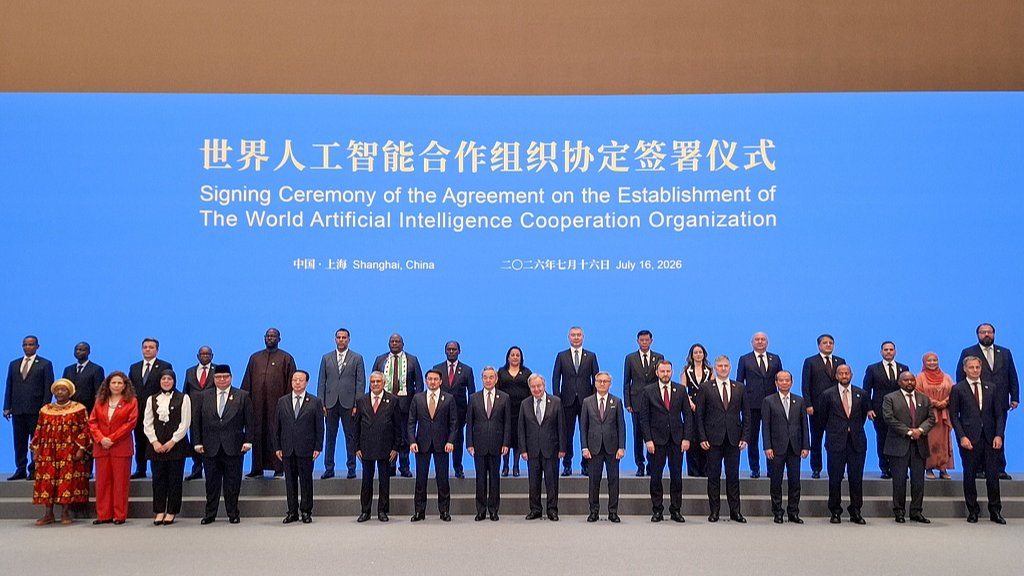
DHARAMSALA, 17 July: China has taken another step toward shaping global artificial intelligence governance after 29 countries signed an agreement in Shanghai on Thursday establishing the World Artificial Intelligence Cooperation Organisation (WAICO), an intergovernmental body headquartered in the Chinese financial hub.
The agreement was signed by representatives from countries including Russia, Pakistan, Kazakhstan, Laos and Indonesia, with Chinese Foreign Minister Wang Yi signing on behalf of Beijing. United Nations Secretary-General António Guterres attended the signing ceremony alongside representatives of participating countries and international organisations.
According to the agreement, WAICO will uphold the purposes and principles of the UN Charter, promote extensive consultation and shared benefit through a people-centered approach, and strengthen international cooperation on artificial intelligence while ensuring AI remains “beneficial, safe and fair.”
WAICO builds on a series of Chinese initiatives aimed at shaping global AI governance. Since 2023, Beijing has promoted its Global AI Governance Initiative, advocated for greater participation of developing countries in international AI rule-making through the United Nations, and introduced domestic regulations requiring generative AI services to align with socialist values and protect national unity.
At the same time, China has accelerated the development of homegrown AI models, including DeepSeek, Qwen, Ernie, Hunyuan and the Tibetan-language model DeepZang, reflecting its broader ambition to influence not only AI innovation but also the standards and governance frameworks that underpin its global development.
Despite its stated goals, the launch of WAICO has raised questions among researchers and human rights advocates about how China’s domestic AI governance model could influence international standards.
For Tibetans, Uyghurs, Southern Mongolians, Hong Kong democracy advocates and other communities living under what many activists describe as China’s colonial rule, the implications extend beyond technological cooperation.
Artificial intelligence has become an increasingly important tool in China’s governance of occupied Tibet and other regions through facial recognition, predictive policing, biometric databases and digital surveillance. Human rights groups argue these technologies strengthen state control while restricting privacy and freedom of expression.
The concerns also extend to AI-generated information. Chinese large language models, including DeepSeek and DeepZang—a Chinese-developed Tibetan-language AI model—have drawn attention for reproducing official Chinese government positions on politically sensitive issues while avoiding or refusing to answer certain questions.
On Tibet, for example, these systems typically describe Tibet as an “inalienable part of China,” use the official term “Xizang,” and reject or omit perspectives supporting Tibetan self-determination or independence.
Critics argue that if AI systems developed under such political constraints gain greater international influence through institutions like WAICO, they could normalize state-approved narratives within AI-generated information. Rather than traditional internet censorship, observers describe this as a form of algorithmic governance in which political narratives become embedded in AI systems that increasingly serve as sources of knowledge.
Supporters of WAICO, however, say the organization will provide a broader platform for international AI cooperation, particularly for developing countries seeking a greater role in shaping global AI governance. Whether WAICO becomes an inclusive multilateral institution or another avenue through which China projects its governance model remains to be seen.