Tibetan Youth Congress Concludes 25-Day ‘Black Hat’ March in Delhi, Appeals to UN and PMO Over Tibet Crackdown
By Tenzin Chokyi
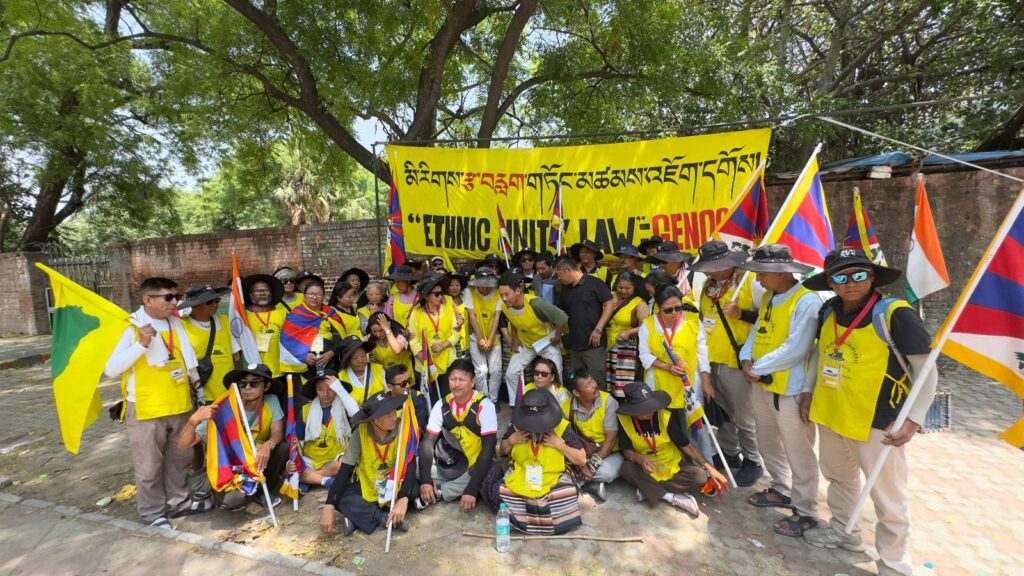
DHARAMSALA, 24 April: The Tibetan Youth Congress(TYC) today brought its 25-day “Black Hat” march to a close in Delhi, staging a protest at Jantar Mantar and appealing to the United Nations office and the Prime Minister’s Office to act against China’s controversial “Ethnic Unity and Progress” law, which the organisation describes as a deliberate attempt to accelerate the sinicisation and erasure of Tibetan identity under the guise of promoting unity.
According to Tashi Dhargyal, Vice President of the TYC, the concluding ceremony and related diplomatic engagements—originally scheduled for 25 April to coincide with the birth anniversary of the 11th Panchen Lama—were preponed by a day, as government offices in the capital remain closed on Saturdays.
The organisation submitted appeal letters to the United Nations office and the Prime Minister’s Office in Delhi, outlining its core demands, including the immediate repeal of China’s “Ethnic Unity” Law, which it says legitimises assimilation policies; the release of the 11th Panchen Lama and other Tibetan political prisoners; and recognition that Tibet is not a resource colony, while condemning ecological destruction in occupied Tibet carried out under the banner of development. The appeal also expresses gratitude to India for its longstanding support of the Tibetan movement.
Dhargyal said both offices expressed continued support for the Tibetan movement and the campaigns organised by the TYC, commending its sustained advocacy even amidst Delhi’s scorching summer heat, and assuring that they will extend support within their respective capacities.
Reflecting on the nearly month-long march that passed through four North Indian states, he said the campaign had largely achieved its core objective of raising awareness about the impact of China’s new “Ethnic Unity” law and the continuing repression faced by Tibetans inside occupied Tibet.
He acknowledged that it is not realistic to expect the organisation’s demands to be fulfilled immediately, stressing that meaningful change will take time. Rather than focusing on immediate results, he framed their activism as part of a broader, ongoing movement aimed at securing truth and justice in occupied Tibet. He emphasised that this struggle goes beyond short-term achievements, and that their efforts will continue despite any challenges, until that larger objective is ultimately realised.
“During the course of our march, which covered over 570 km, we faced several challenges—not major ones, but difficulties such as blisters and the extremes of heat and cold. Despite these hardships, we remained determined, mindful that from the outset we had committed ourselves to this cause for our Tibetan brothers and sisters who continue to face severe repression under Chinese rule”, said Dhargyal.
The “Black Hat” march, which began on 31 March from Dharamshala—the headquarters of the Tibetan government-in-exile and the residence of the 14th Dalai Lama—marks the largest grassroots movement against China’s new Ethnic Unity Law, passed on 12 March and set to take effect on 1 July.
The campaign condemns the heights of China’s aggressive nationalism and assimilation policies, which seek to eradicate Tibetan identity and its civilisation, and to silence its colonial dissent permanenttly.