The ROC’s Quiet Retreat: Tibet, the Mainland, and the Constitution
By Khedroob Thondup
When the Republic of China (ROC) government fled to Taiwan in 1949, it carried with it the constitutional claim to rule all of China—including Tibet and Mongolia. For decades, this claim was not only symbolic but institutionalised through agencies like the Mongolian and Tibetan Affairs Commission, which managed policies toward regions the ROC no longer controlled. Yet in 2017, Taipei dissolved that commission, a move that signalled the practical abandonment of its historic claims.
From Constitutional Fiction to Political Reality
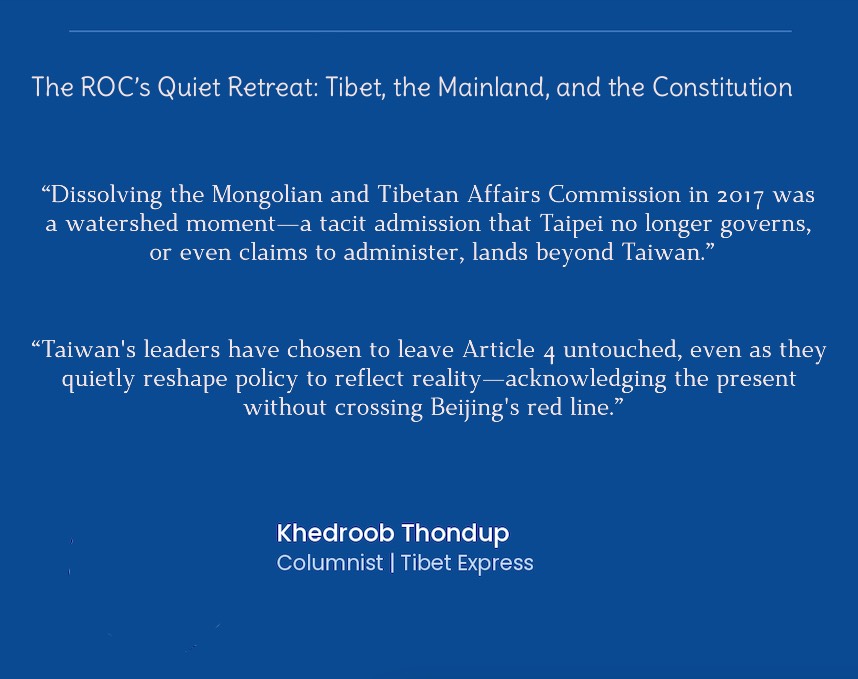
The ROC Constitution still contains Article 4, which defines the national territory as encompassing “the existing territory of the Republic of China.” In practice, this has long been interpreted to mean the whole of China, including Tibet. Dissolving the Mongolian and Tibetan Affairs Commission was a tacit admission that the ROC no longer actively governs or even administratively claims those regions. Yet the constitutional text remains untouched, preserving a legal fiction that Taiwan is the rightful government of all China.
Why Article 4 Remains Untouched: Changing Article 4 would require a constitutional amendment—a process heavily restricted under Taiwan’s political system. Any amendment redefining the ROC’s borders would be interpreted by Beijing as a formal declaration of Taiwanese independence. Such a move risks military escalation, diplomatic isolation, and economic retaliation. As a result, Taiwan’s leaders have chosen to leave the constitutional text intact, even as they quietly reshape policy to reflect reality.
The Practical Abandonment of Claims. The ROC’s retreat from its historic claims is evident in several ways: International diplomacy: Taiwan no longer asserts sovereignty over Tibet or the mainland in its foreign relations. Domestic governance: Policy focus is squarely on Taiwan itself, not on administering phantom provinces.
Symbolic institutions: The dissolution of the Mongolian and Tibetan Affairs Commission marked the end of an era in which the ROC maintained bureaucratic structures for lost territories.
The Strategic Ambiguity. Taiwan’s constitutional ambiguity serves a dual purpose: It avoids provoking Beijing by formally rewriting borders.
It allows Taiwan to continue functioning as a de facto independent state while maintaining the veneer of continuity with the ROC’s historic claims.
Conclusion. The ROC government has, in practice, abandoned its active claims over the Chinese mainland and Tibet. The dissolution of the Mongolian and Tibetan Affairs Commission in 2017 was a watershed moment, signalling that Taipei no longer pretends to govern lands beyond Taiwan. Yet the unaltered Article 4 remains a reminder of the delicate balance Taiwan must maintain: acknowledging reality without crossing Beijing’s red line.
Khedroob Thondup is a former Tibetan diplomat and parliamentarian and nephew of the 14th Dalai Lama. He is also the editor of the book ‘Dalai Lama, My Son and Tibet in Turmoil.’
The views expressed in this article are those of the author and should not be attributed to Tibet Express.