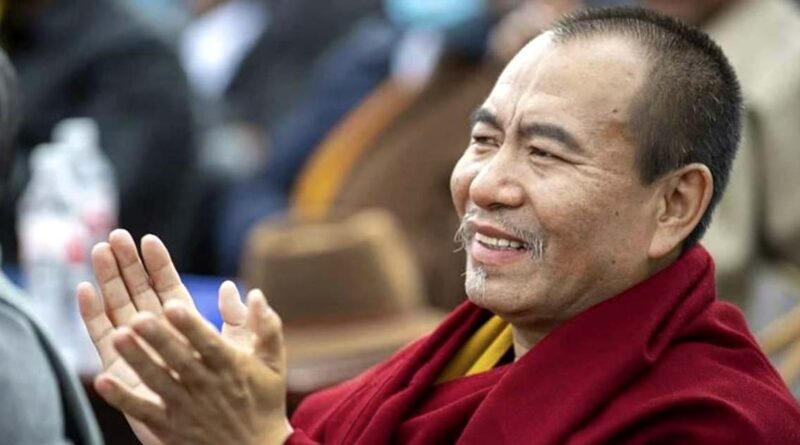
The Broken Promise: How Beijing Reversed Its Agreement on the 11th Panchen Lama
By Khedroob Thondup A Rare Moment of Consensus. In the mid‑1990s, an extraordinary moment of consensus emerged between Beijing and
Read moreBy Khedroob Thondup A Rare Moment of Consensus. In the mid‑1990s, an extraordinary moment of consensus emerged between Beijing and
Read moreBy Tenzin Chokyi
DHARAMSALA, 12 August: A bipartisan group of US senators has introduced legislation aimed at ensuring American support for Tibet continues beyond the lifetime of the 14th Dalai Lama, by strengthening Washington’s relationship with the Central Tibetan Administration (CTA) and its democratically elected leadership.
Read moreBy Khedroob Thondup
The question of whether Tibetan lamas in exile should visit Tibet if permitted by Beijing is not simply a matter of travel. It is a profound test of spiritual fidelity, political calculation, and communal unity. On the surface, such visits promise a long-awaited homecoming, a chance to reconnect with sacred landscapes and ease tensions. Yet beneath that promise lies the risk of exploitation, division, and propaganda.
By Utpal Kumar | Firstpost | 10 August 2026
Former Foreign Secretary Shyam Saran, in his book How China Sees India, recounts an extraordinary conversation between Chinese Premier Zhou Enlai and US Secretary of State Henry Kissinger in 1972.
By Khedroob Thondup
I am one of six million Tibetans who wholeheartedly support His Holiness the Dalai Lama’s roadmap for his next reincarnation. This is not merely a matter of faith, nor simply a question of tradition. It is the assertion of a people’s right to determine their spiritual destiny, free from external interference, and to safeguard the continuity of our culture and identity.
Read moreBy Khedroob Thondup
The sweep of history reminds us of a simple truth: no empire, however mighty, is permanent. Rome, the Ottomans, the British Raj—all believed their dominion eternal, only to discover that power is cyclical, not absolute. Today, the Chinese Communist Party (CCP) exercises seemingly unassailable control over the Tibetan Plateau, integrating it through modernization, surveillance, and demographic engineering. Yet the long arc of history suggests that rigid, coercive assimilation strategies ultimately face systemic limits.
By Tenzin Chokyi
DHARAMSALA, 7 August: Human rights watchdog Amnesty International has demanded the immediate and unconditional release of prominent Chinese pro-democracy activist Zhang Yi, following his formal arrest in occupied Tibet for displaying a photograph of the Dalai Lama.
Read moreBy Khedroob Thondup
For sixty-seven years, Tibet has remained under Chinese occupation—a reality that has reshaped the Himalayan plateau and reverberated across the world. To imagine Beijing voluntarily loosening its grip on Tibet without seismic shifts inside China itself is to misunderstand both the strategic calculus of the Chinese state and the symbolic weight Tibet carries in the Chinese Communist Party’s narrative.
By Tenzin Chokyi
DHARAMSALA, 6 August: A Tibetan couple from Miao Tibetan Settlement in Arunachal Pradesh arrived in Dharamshala on Wednesday after completing a 15-day, more than 2,000~ kilometre peace ride across India to honor the late Tibetan activist Pawo (Martyr) Lobga Rangzen and raise awareness about Tibet’s freedom struggle
By Tenzin Chokyi
DHARAMSALA, 6 August: The Government of Nepal has called off the 17th Seminar of the International Association for Tibetan Studies (IATS), an international academic gathering that was scheduled to take place in Kathmandu from 23 to 29 August 2026. The sudden decision halted nearly four years of preparation for what was slated to be one of the largest gatherings of global Tibetology scholars, coming on the heels of sustained diplomatic pressure from Beijing.
Read more