China, Russia and US Issue Joint Declaration After Trilateral Summit
By Tenzin Chokyi
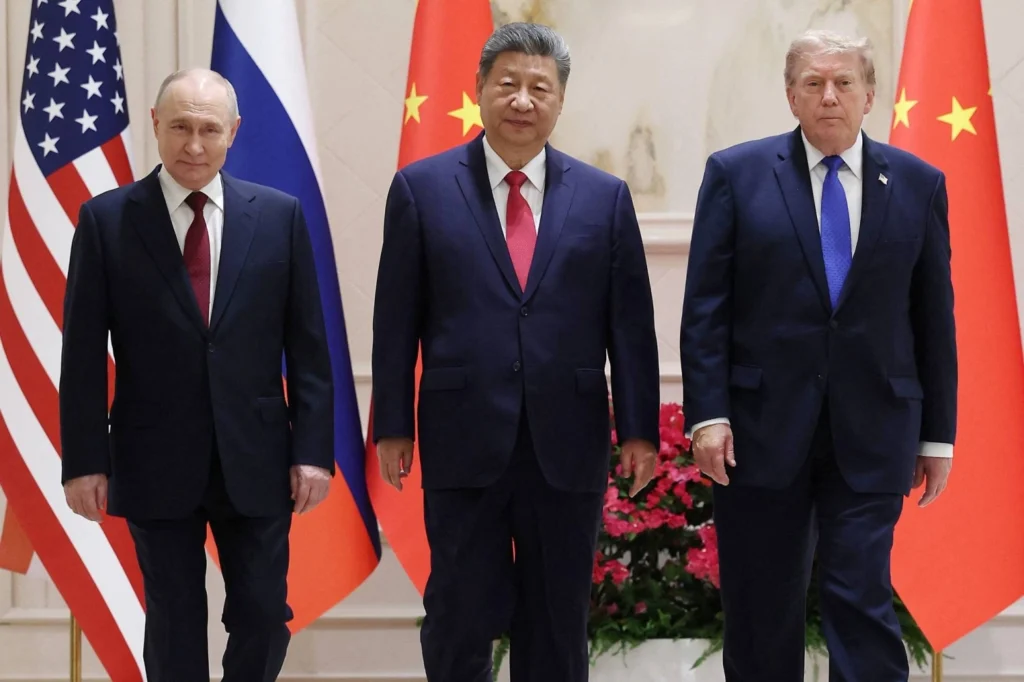
DHARAMSALA, 20 Nov: The leaders of China, Russia and the US issued a joint peace declaration after an unprecedented trilateral meeting on the sidelines of the Asia-Pacific Economic Cooperation (APEC) summit in Shenzhen on Thursday. The meeting brought together three of the world’s most powerful countries amid growing geopolitical tensions.
US President Donald Trump, Chinese President Xi Jinping, and Russian President Vladimir Putin held a more-than-an-hour discussion on nuclear security, international conflicts, and global governance. Trump described the gathering as an opportunity to “make history”, saying the three countries were uniquely positioned to discuss reducing nuclear stockpiles and lowering the risks of nuclear weapons being used.
The resulting declaration affirmed that “a nuclear war cannot be won and must not be fought”, while outlining priorities including reforming the United Nations, increasing oil supplies and protecting the immunity of state officials. However, despite discussions reportedly touching on the wars in Ukraine and Iran, the joint declaration made no specific reference to either conflict.
A particularly significant provision of the declaration concerned international judicial institutions, recognising the importance of state consent and the immunity of state officials. It stated that the International Criminal Court (ICC) and similar institutions “must not abuse their jurisdiction”. This comes as Putin remains subject to an ICC arrest warrant issued in March 2023 over alleged war crimes involving the unlawful deportation and transfer of Ukrainian children.
The declaration’s implications also extend to wider questions of accountability for alleged human rights violations under Xi’s leadership. Tibetan groups and human rights organisations have accused Chinese authorities, under Xi’s leadership, of serious human rights violations in occupied Tibet, including religious repression, forced assimilation and restrictions on fundamental freedoms.
Following the summit, Xi called on major powers to respect one another’s sovereignty and territorial integrity, political systems and development paths, and to refrain from interfering in each other’s “internal affairs”. He also urged the three countries to uphold mutual respect, peaceful coexistence, cooperation and dialogue, while cautioning against challenging one another’s “red lines”. His remarks are particularly relevant to occupied Tibet. Beijing considers it an integral part of China and has repeatedly rejected international criticism of its policies, describing such scrutiny as interference in its sovereignty.
The summit also marked a significant diplomatic moment for Xi, who hosted the gathering and presented China as a key actor in facilitating dialogue among major global powers. Chinese Foreign Minister Wang Yi described the meeting as a “peace summit”, saying it had created a new model of interaction among the three leaders. China’s growing role in shaping discussions on international governance, sovereignty and non-interference has implications for Tibet, where Beijing has repeatedly invoked these principles to reject international criticism of its occupation and policies.