
Sikyong Endorses Ban, EC Remains Silent: Where Is Tibetan Democracy Headed
In January 2026, the CTA’s Election Commission declared that barring teachers from running violates Article 11 of the Tibetan Charter. Months later, when Gelug monks face expulsion for the same right, the Sikyong applauds the ban- and the EC shuts its door.
By Lobsang Tenchoe
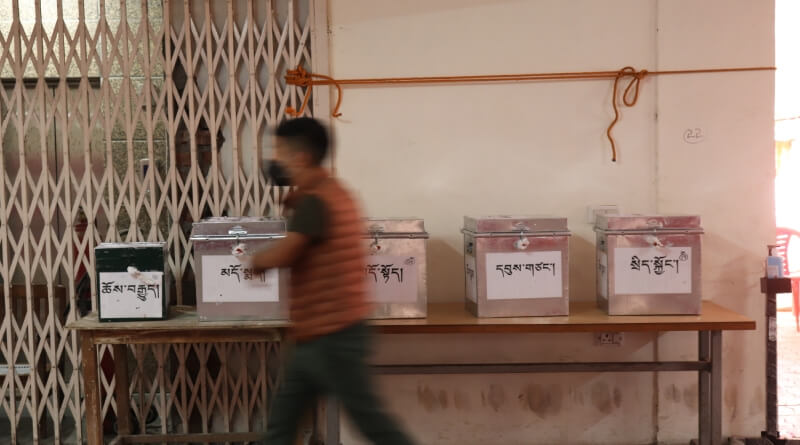
On 28 January 2026, the Chief Election Commissioner (EC) told a press conference that barring teachers from contesting elections violates Article 11 of the Charter of the Tibetans in Exile. He called the matter a concern that threatens the fundamental unity of the Tibetan people in exile and harms the Tibetan struggle.
Article 11 of the Charter of Tibetans in Exile guarantees that all Tibetan citizens have equal rights to vote and stand for election. Both Tibetan Children’s Villages (TCV) and Sambhota Tibetan Schools Society (STSS) have bylaws barring teachers from running for political office.
In October 2026, the Gelug International Foundation, the highest organisational and administrative body of the Gelug sect of Tibetan Buddhism, unanimously passed a resolution barring Gelug monks from its affiliated monasteries and monastic colleges from running in elections for the President of the Central Tibetan Administration (CTA) and the Tibetan Parliament-in-Exile. Monks who defy the ban face expulsion from their monasteries. Unlike in the teacher’s case, the EC has remained silent.
During a public address to the Minnesota Tibetan Community on 15 November, Sikyong Penpa Tsering, the elected head of the CTA, asked, “Do you want to be a true follower of the Buddha, or is politics more important? Each person must decide for themselves.”
By framing the choice as one between being a “true follower of the Buddha” and “a politician,” he effectively endorsed the Gelug International Foundation’s position. His remarks not only undermined monks’ equal citizenship rights but also conflicted with the Charter’s guarantees.
Article 11 of the Charter guarantees every Tibetan the equal right to stand and vote in elections. Article 37 provides for religious representation in the Tibetan Parliament-in-Exile: two from each of the four schools of Tibetan Buddhism and the pre-Buddhist Bon religion. Monastic participation is therefore built into the democratic system established by His Holiness the Dalai Lama.
Do Sikyong’s remarks imply that elected religious representatives are not genuine practitioners? The history of the political leadership of the Dalai Lama and Samdhong Rinpoche also challenges the supposed divide between religious practice and public service.
Every Tibetan is entitled to hold personal opinions, but the Sikyong has sworn to uphold the Charter. By endorsing an external organisation’s ban, he appears to place the Gelug International Foundation’s private bylaws above the Charter.
While the Sikyong remains abroad on tour, the Kashag (Cabinet) Secretariat declined to comment, saying there was “no precedent” for it to speak on the Sikyong’s behalf.
His support for restricting monks’ right to vote and stand for election raises questions about his oath to uphold the Charter, the rule of law and the EC’s authority.
The EC also declined to address the issue. When reminded of its 28 January precedent on schoolteachers, it said the election was over, and the matter was “beyond its office now,” and that “whoever is the next EC” would deal with it during the next cycle. Yet the Charter tasks the EC with protecting electoral integrity on an ongoing basis. The EC’s role doesn’t end between elections.
Why, then, won’t the EC consider the repercussions? The threat of expulsion remains unchallenged. With the Sikyong backing the ban and the EC remaining silent, Gelug monks may be deterred from running years before nominations open. The damage may already be done by the time the next EC takes office,
The two Additional Election Commissioners serve only from the announcement of an election until the final results are declared. By contrast, Article 99, Clause 1 of the Charter sets the CE’s term at five years or until they reach 65, whichever comes first, unless Parliament removes them by a two-thirds vote.
The executive branch has publicly backed a restriction on who may run for office, while the EC—the very body tasked with deciding candidate eligibility—has become a silent referee.
Although the ban is not legally binding, the Sikyong’s endorsement could set a dangerous precedent. Democracies rarely collapse all at once. They weaken gradually, through small steps. Without pushback, restrictions on one group may invite restrictions on others. Over time, this could make constitutional rights conditional rather than guaranteed.
Tibetan democracy now sits at a crossroads between constitutional supremacy and institutional convenience. When those entrusted with protecting the Charter choose silence or overreach, Parliament, the judiciary and the Tibetan public must affirm that the Charter is supreme and binds every organisation, secretariat and leader.


