CTA launches Tibetan National Identity Preservation Week
By Tenzin Chokyi
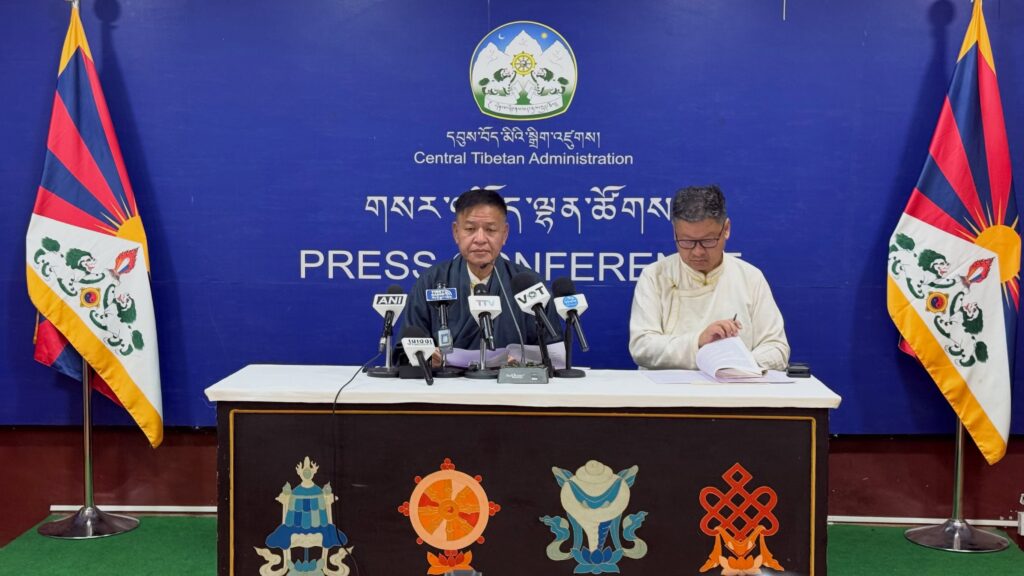
DHARAMSALA, 23 Sept: The Central Tibetan Administration (CTA) on Wednesday launched the first observance of Tibetan National Identity Preservation Week, an initiative established in response to China’s Law on Promoting Ethnic Unity and Progress, which came into effect on 1 July.
Sikyong (President) Penpa Tsering announced the initiative at a press conference at the Lhakpa Tsering Memorial Hall of the CTA’s Department of Information and International Relations (DIIR).
The initiative originated from a seven-point resolution unanimously adopted by the 17th Tibetan Parliament-in-Exile on 25 March, following the passage of China’s ethnic unity law. The resolution called on Tibetan organisations and individuals in free countries to organise activities during the fourth week of September each year to preserve and celebrate Tibetan national identity.
The CTA subsequently designated the fourth week of September every year as Tibetan National Identity Preservation Week, with this year’s observance running from 20 to 30 September.
The initiative is particularly focused on what the CTA describes as the Chinese government’s efforts to undermine the Tibetan language, culture, religion and national identity through its “ethnic unity policies”.
Launching the week-long initiative, Sikyong Tsering announced the “Principles and Guidelines for the Preservation of Tibetan Language,” outlining responsibilities for Tibetan families, schools, communities and the CTA.
The guidelines call for greater use of Tibetan at home and in schools, including Tibetan as the primary medium of instruction in primary education. They also encourage weekend language classes, immersion programmes, greater use of Tibetan in public spaces and cultural activities, and increased use of the language on social media.
The CTA’s Department of Education is tasked with supporting Tibetan-language teacher training, scholarships, higher education and the development of modern Tibetan terminology and digital resources.
The guidelines also call for technological development in areas including machine translation, speech recognition, artificial intelligence and optical character recognition.
The guideline proposes establishing a Tibetan Language Preservation Committee of 3 to 5 experts to assess the implementation of the language policy and publish an annual report.
As part of the week’s programme, the Tibet Museum under DIIR organised a screening of the animated film Man of Peace at Maximus Mall in Dharamsala. The film was screened in Hindi and English and portrays the life and message of the 14th Dalai Lama. The Tibetan Institute of Performing Arts (TIPA) is also scheduled to stage a play as part of the observance, depicting the impacts of Chinese government policies on Tibetans.
The Sikyong concluded by saying that the observance should not be viewed merely as a one-week campaign but as an enduring commitment to preserving Tibetan national identity.