Nepal Cancels International Tibetan Studies Conference Following Reported Chinese Pressure
By Tenzin Chokyi
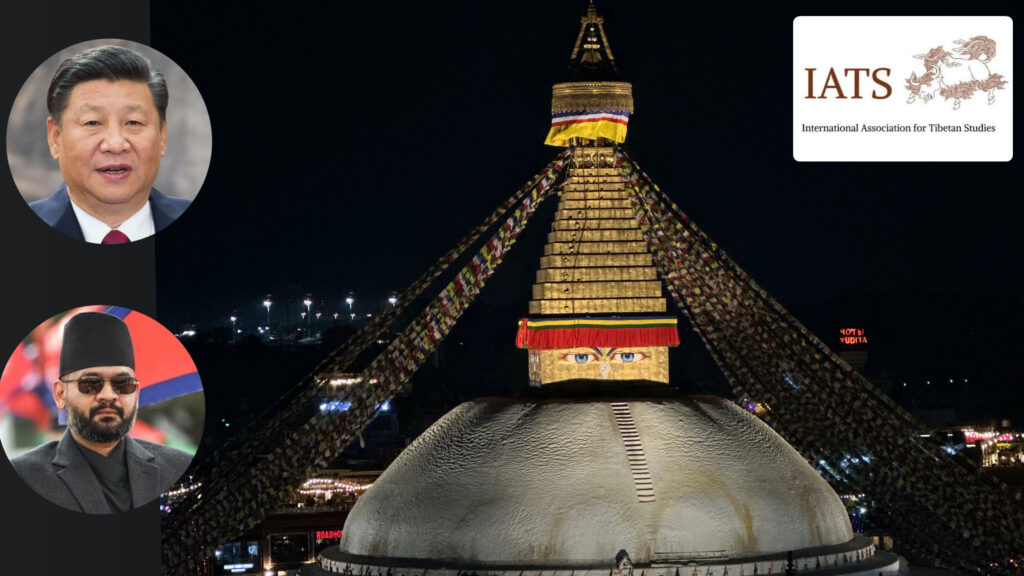
DHARAMSALA, 6 August: The Government of Nepal has called off the 17th Seminar of the International Association for Tibetan Studies (IATS), an international academic gathering that was scheduled to take place in Kathmandu from 23 to 29 August 2026. The sudden decision halted nearly four years of preparation for what was slated to be one of the largest gatherings of global Tibetology scholars, coming on the heels of sustained diplomatic pressure from Beijing.
The executive action stands out because Nepal’s own intelligence and security agencies had evaluated the event, found no security threat, and recommended that the seminar be allowed to proceed under standard monitoring.
Internal Bureaucratic Reversal and Lack of Cabinet Review
According to reporting by the Kathmandu Post, the directive originated from Chief Secretary Govinda Bahadur Karkee following consultations with Foreign Secretary Amrit Bahadur Rai. Karkee directly communicated instructions to the senior administration at Kathmandu University (KU)—which was co-hosting the event through its Himalaya Centre for Asian Studies (KU HiCAS), the Centre for Buddhist Studies (KU-CBS), and the Rangjung Yeshe Institute—to halt all plans for hosting the event.
Nepalese government officials indicated that the decision was finalized without Cabinet approval or formal executive review, despite its clear foreign policy weight. The instruction marks a direct reversal of public commitments made days prior by Home Minister Sudan Gurung, who had confirmed that the event would move forward subject only to routine participant security vetting.
Pressure Campaign from Chinese Officials
Beijing’s diplomatic outreach intensified after registration closed in June. On July 21, Chinese Ambassador Zhang Maoming held talks with Foreign Secretary Rai, urging Nepalese authorities to remain vigilant regarding potential pro-Tibet statements or discussions surrounding His Holiness the Dalai Lama.
Pressure mounted further on July 29 when the Venerable Master Yinshun—a member of the Chinese People’s Political Consultative Conference (CPPCC) and former vice president of the Buddhist Association of China—arrived in Kathmandu for meetings with state officials.
A Tibetan researcher said the proposed venue, Hotel Soaltee in Kathmandu, also heightened concerns among some participants because it regularly hosts visiting Chinese diplomatic delegations, including Chinese President Xi Jinping during his 2019 state visit to Nepal.
The researcher added that some Tibetan scholars, particularly those with family members still living in Tibet, feared that staying at the hotel could expose them to surveillance or scrutiny.
Academic Disparity and CTA Delegation Clarifications
While exile researchers felt increasingly marginalised as diplomatic friction grew, state-backed institutions from China—including Peking University and the China Tibetology Research Centre—had successfully registered approximately 100 delegates. Independent analysts viewed this substantial delegation as an effort by Beijing to steer academic discussions on Tibet.
Addressing prior media claims that a five-member delegation from the Central Tibetan Administration’s (CTA) Tibet Policy Institute (TPI) had officially withdrawn under Chinese pressure, TPI Director Tenzin Lekshey clarified to Tibet Express that no such delegation existed:
“There is no precedent for the CTA sending an official delegation to IATS seminars,” Lekshey said. “To maintain the conference’s purely academic purpose, researchers apply strictly in their individual capacities as independent scholars.”
Lekshey said the Tibet Policy Institute may provide financial assistance to researchers who require support to attend the conference, but it does not determine or influence the content of their research, which remains the responsibility of the individual scholars.
A researcher from the TPI told Tibet Express that former TPI director Bari Dawa Tsering, who was identified in earlier reports as leading a delegation, had never applied to attend the conference. When contacted, Dawa Tsering confirmed that he had not submitted an application.
The researcher also said that four current TPI researchers had applied individually to participate in the conference. Of those, only one had completed the registration payment. The remaining three had not finalized their registration before Chinese Ambassador Zhang Maoming raised concerns about the seminar with Nepal’s Foreign Secretary on July 21.
Current Status
Organizers and academics have voiced deep frustration over the cancellation, pointing out that IATS is a purely scholarly body focused on research in history, language, philosophy, religion, and culture. KU spokespersons confirmed that organizers had repeatedly reassured the government that political activism or statements would be prohibited at the venue.
Tibetan scholars and rights analysts argue that Beijing’s pressure is part of a calculated strategy to monopolize academic forums that play a pivotal role in shaping global narratives on Tibet. They contextualize the cancellation within China’s recently enacted “Ethnic Unity and Progress Law,” which codifies forced ideological compliance and seeks to reshape international discourse on Tibetan identity. Furthermore, observers warn that Nepal is increasingly becoming a testing ground for Beijing’s expanding transnational repression—leveraging extraterritorial clauses in the new law designed to penalize individuals and silence dissent beyond China’s borders.
With Kathmandu University officially stepping down as convener, responsibility now shifts to the IATS Executive Committee to determine whether the 17th Seminar can be relocated to a different host country. Meanwhile, scheduled visits by high-level Chinese state officials linked to the seminar are still expected to proceed in Kathmandu later this month, led by Jiang Jianguo, vice director of the CPPCC Ethnic and Religious Committee.