Rules for Thee but Not for Me: The Sorry State of the Tibetan Parliament
By Lobsang Tenchoe
An extraordinary display of political amnesia- that was my immediate thought while watching the house stretch, pull and twist Article 56 of the Charter of the Tibetans in exile on 18th September. The episode followed the Sikyong (President) of the Central Tibetan Administration’s (CTA) point of order against a private member’s bill calling for the continuation of the Tibetan independence struggle. The bill was introduced by Parliamentarian Sangay Dorjee and supported by Parliamentarian Gagya Gyaltsen Choekyi, while the Speaker, Dolma Tsering Teykhang, duly accepted the point of order.
What transpired in the second session of the 18th Tibetan Parliament-in-Exile (TPiE) was not merely a matter of parliamentary procedure. It raised broader questions about consistency, precedent and the interpretation of Article 56 by the two most senior political figures in the House.
“If the CTA’s policy needs to be changed, it must go through Article 56 of the charter,” Sikyong Penpa Tsering said in the House, adding that “otherwise, if a policy is changed merely in the form of a resolution or motion, I cannot say for certain that it would be genuinely consistent with the House’s procedures and the framework of theof the charter. This is also how the Kashag (cabinet) views it.
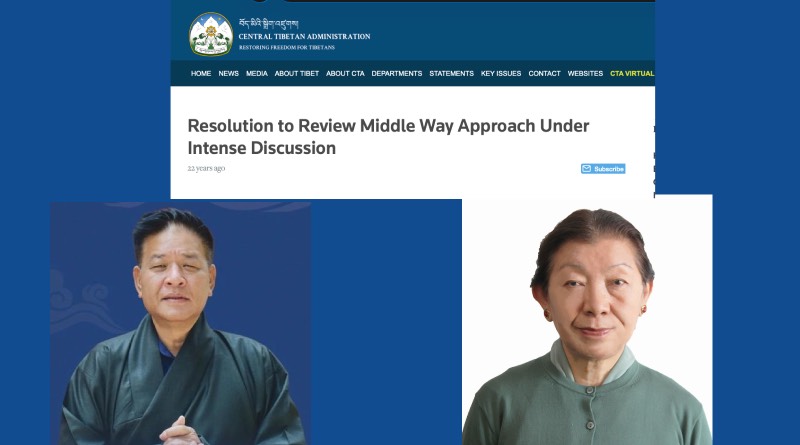
Twenty-two years ago, as members of the 13th ATPD, the Sikyong and the Speaker were present when the House passed the resolution (document no. 13) to review the exile administration’s policy of the Middle Way Approach if no positive response from China comes by March 2005. The resolution was introduced by late MP Karma Choephel.
Though the resolution was passed by the House, it was short-lived, as the House later passed Resolution No. 14, proposed by MP Hortsang Jigmey, calling for the termination of Document no.13. What led to the demise of the resolution was that “The regional associations of Domed and Utsang have earlier resolved to resign from the assembly if the resolution is not withdrawn. It is said that the ATPD has received several letters from various Tibetan individuals and communities expressing their resentment against the resolution and even threatening to sit on hunger strikes if the resolution is not withdrawn,” as reported by tibet.net, the official website of the CTA.
The current MPs who were also members of the 13th ATPD include U-Tsang MP Dawa Tsering and Dho-Toe MP Juchen Kunchok Choedon.
Irrespective of whether the contents of MP Sangay Dorjee’s resolution calling for the continuation of the Tibetan independence struggle was directly connected to the official political policy of the CTA or not, as argued by the Sikyong, does Article 56 of the Charter of the Tibetans in Exile restrict such discussion or parliamentary procedures?
If Article 56 is read closely, it does not prohibit private members from introducing bills to review or change the policy of the CTA. The passage of Document No. 13 22 years ago supports this interpretation.
“For the purpose of taking a decision on an important policy matter pertaining to the fundamental interests of Tibet or of the Tibetan people, a popular referendum may be initiated through the Central Tibetan Election Commission if a call for such a recourse is made by at least two-thirds majority of the total strength of the Tibetan Parliament or at least three-fourths of the combined strength of the Kashag and the Standing Committee of the Tibetan Parliament. With regard to the outcome of such referendum, the Sikyong shall, within 14 working days, make an announcement, setting out his or her recognition of the majority decision and signing his or her name thereon,” reads the English translation of the Tibetan Charter on tibet.net.
The question, therefore, is not simply why the Sikyong raised the point of order, but whether the objection was consistent with the charter or parliamentary precedent. More importantly, why did the Speaker entertain the objection? In other words, why the double standard that misled the House and the Tibetan public watching the proceedings?
While many may argue that rule manipulation occurs in parliaments across the world when the ruling government tries to block a bill from being debated at all, what problem does a partyless exile Tibetan government have with the resolution that calls for the continuation of the Tibetan independence struggle?
Given the CTA’s political position, the Middle Way Approach seeks genuine autonomy within the framework of the People’s Republic of China. And the fact that China experts, rights groups like Amnesty and the UN argue that Beijing’s so-called Law on Promoting Ethnic Unity and Progress, passed by China’s National People’s Congress on 12 March 2026, which took effect from 1 July 2026, legally supersedes and hollows out the autonomy the Middle Way depends on.
As such, even if the resolution does seek to change the official stance of the CTA from Middle Way to complete independence, why such scrutiny and hostility? Isn’t that like a timely rain?
The Sikyong and the Speaker, having witnessed the passage of the Resolution to Review Middle Way during their tenure as members of the 13th ATPD, now appear to be applying a different procedural standard. This raises an uncomfortable comparison with George Orwell’s Animal Farm, where the rules of engagement change depending on who holds the gavel.
The central question is whether the Tibetan Parliament can preserve its independence when the Speaker so easily folds under the Sikyong’s point of order, as if suffering from amnesia, without upholding the line of historical precedent. What is to prevent the same from happening again?