Why Frank Aiken’s 1981 Remark About Tibet Still Matters
By Khedroob Thondup
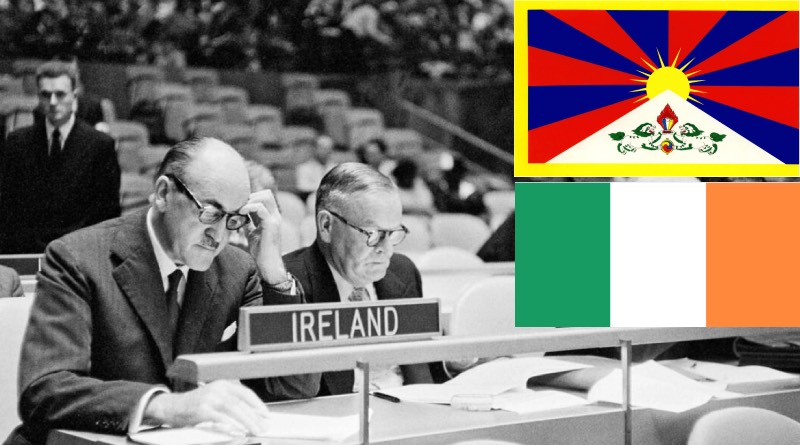
In 1981, I had a conversation with Frank Aiken, the former Irish Minister for External Affairs, that has remained with me for decades. During that discussion, he expressed the view that the United States had not given its full support to United Nations resolutions concerning Tibet. Whether one agrees entirely with his assessment or not, the observation raises important questions about the gap that can exist between public declarations of principle and diplomatic action.
Aiken was not an ordinary commentator. As one of Ireland’s most influential foreign ministers and a long-standing advocate of the role of the United Nations in international affairs, he understood the realities of diplomacy. His perspective was shaped by decades spent observing how major powers behaved when moral questions collided with strategic interests.
The Tibet issue was one such test.
Throughout the second half of the twentieth century, Tibet occupied a unique place in international politics. Concerns over the preservation of Tibetan culture, religion, and self-determination generated sympathy in many countries and led to discussions and resolutions within the United Nations. Yet sympathy did not always translate into sustained political commitment.
According to Aiken’s assessment, the United States did not fully back the spirit or objectives of those UN resolutions. His argument, as I understood it, was not that Washington openly opposed concern for Tibet. Rather, it was that American support stopped short of the level of diplomatic engagement that would have been necessary to make those resolutions truly effective.
Why would this have been the case?
The answer lies in the realities of Cold War geopolitics. By the 1970s and early 1980s, the strategic relationship between the United States and the People’s Republic of China had become increasingly important. Following President Nixon’s opening to China in 1972, Washington viewed Beijing as a critical counterweight to Soviet influence. In such an environment, Tibet became a sensitive subject. Strong advocacy for Tibetan self-determination risked creating tensions with a government whose cooperation was considered strategically valuable.
Aiken’s point was therefore about priorities. Great powers frequently proclaim support for universal principles, but they also pursue national interests. When these goals collide, interests often prevail. In his view, Tibet was an example of that reality.
This observation remains relevant today because it highlights a broader truth about international relations. The effectiveness of United Nations resolutions depends largely on whether influential states are willing to invest political capital in their implementation. Resolutions can express global concern, but without determined backing from major powers, they often remain statements of intent rather than instruments of change.
What struck me most about Aiken’s remark was not its criticism of any particular country. It was his skepticism about the willingness of powerful nations to place principle above strategic calculation. Coming from a statesman who had spent much of his career advocating international cooperation and the rule of law, the comment carried particular weight.
More than four decades later, his observation continues to resonate. Tibet remains a reminder that international support for a cause is not measured solely by speeches, votes, or carefully worded statements. It is measured by the extent to which governments are prepared to act when doing so carries political or diplomatic costs.
That, I believe, was the essence of what Frank Aiken was telling me in 1981. His message was that genuine support is demonstrated not by expressions of concern alone, but by the willingness to stand behind those concerns when the consequences become inconvenient. In the case of Tibet, he believed the United States had not gone that far. Whether history ultimately vindicates that judgment is open to debate, but the question he raised remains as relevant now as it was then.
Khedroob Thondup is a former Tibetan diplomat and parliamentarian and nephew of the 14th Dalai Lama. He is also the editor of the book, ‘Dalai Lama, My Son and Tibet in Turmoil.’
The views expressed in this article are those of the author and should not be attributed to Tibet Express.