18th Tibetan Parliament-in-Exile Opens Second Session
By Tenzin Chokyi
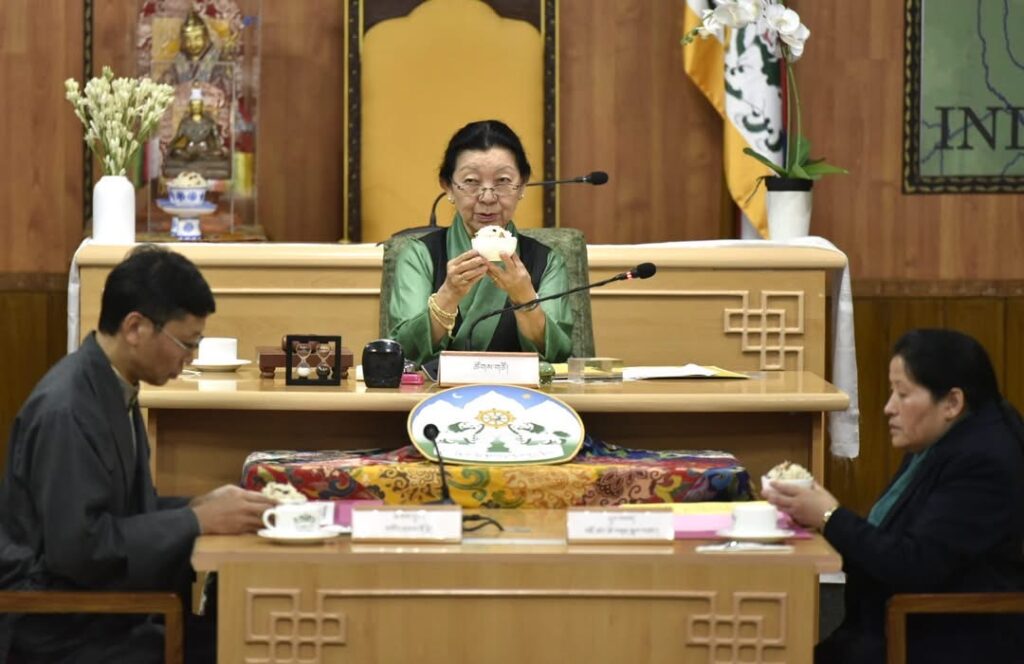
DHARAMSALA, 16 Sept: The second session of the 18th Tibetan Parliament-in-Exile (TPiE) opened in Dharamshala on Wednesday, launching nine days of departmental oversight and deliberations on Beijing’s escalating assimilation policies in occupied Tibet. Scheduled to run through 25 September, the assembly will review the Central Tibetan Administration’s (CTA) administrative and financial performance for the 2025–2026 fiscal year.
Opening the session with a solemn tribute to Pawo (Martyr) Lobga Rangzen, who died after self-immolating in protest against China’s colonial rule and in support of an independent Tibet, Speaker Dolma Tsering Teykhang urged both the Tibetan leadership and the public to honour Pawo Lobga’s call for unity and coexistence. She noted that parliamentary appeals sent to international legislative bodies and think tanks after Lobga’s death have begun to yield responses, including early diplomatic engagement from Switzerland, Germany, and Taiwan.
The Speaker delivered a comprehensive critique of Beijing’s recently enacted “Ethnic Unity and Progress Promotion Law”, framing it as the culmination of a decades-long drive to dismantle the distinct identity of recognised “national minorities.” She highlighted China’s systematic language shift from “national minorities”—which acknowledges distinct historical rights—to the generic term “ethnic minorities.” Tracing this historical trajectory, she explained that efforts to eliminate non-Han national identities date back to the founding period of the Republic of China and intensified around 2002, when Beijing tasked state scholars with solving the “minority problem,” leading directly to the mass urban relocation of Tibetan nomads away from ancestral lands.
Describing the 2008 Tibetan uprising as a turning point after which China concluded that force was its most effective instrument, Speaker Dolma Tsering outlined how coercive measures were rolled out in Dechen Tibetan Autonomous Prefecture before expanding into Kardze, Marlo, Tsojang, Tsolho, and Yulshul. She cited 2012 research by officials from the United Front Work Department (UFWD)—a key agency of the Chinese Communist Party (CCP) that coordinates influence operations to co-opt and neutralise potential opposition groups both inside and outside China— who argued that minority populations living collectively foster a shared identity that could develop into separatism and pose a threat to state security. This doctrine directly shaped subsequent state actions, including closing local Tibetan schools and expanding colonial boarding schools.
The Speaker linked this framework to the “second-generation ethnic unity” policy introduced around 2018–2019 in the Tibetan Autonomous Region, which drew criticism from the US Congress, including from Senator Marco Rubio, and argued that the recent rapid passage of the Ethnic Unity Law reflects internal power struggles to consolidate Xi Jinping’s authority.
Turning to exile affairs, Speaker Tsering stated that as Beijing actively aims to destroy the shared identity and collective oneness of the Tibetan people, internal unity and coexistence become indispensable defences against China’s aggressive policies. She maintained that unity does not mean uniformity, emphasising that every individual is entitled to their own political views and opinions. However, she made clear that the political leadership and anyone carrying political responsibility are bound to work toward resolving the Tibetan issue through the established Middle Way policy. She also acknowledged public feedback regarding parliamentary conduct, reassuring the public that MPs adhere to established ethical codes and orientation training.