China Confirms Demolition of Historic Gyalrong Fortress, Calls It a “Replica”
By Tenzin Chokyi
DHARAMSALA, 30 July: Chinese state media has confirmed that a historic stone fortress in Tibet’s eastern Gyalrong region was demolished by authorities, attributing the destruction to an expressway construction project. The official admission comes weeks after footage of a bulldozer tearing down the structure circulated online around 14 July, triggering widespread grief inside occupied Tibet and condemnation from Tibetan exile communities.
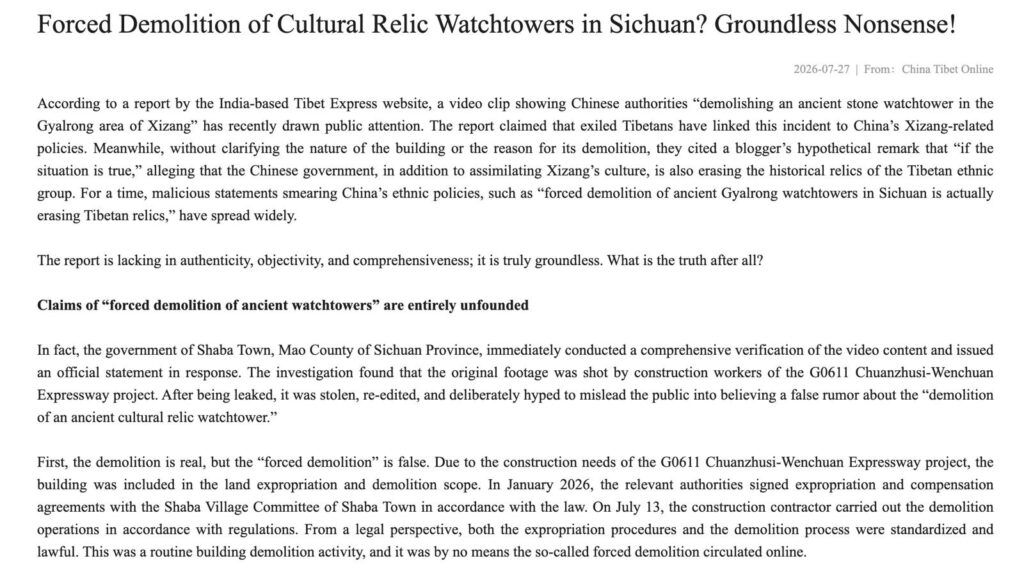
In an article published on 27 July, state-run China Tibet Online named this website directly, citing Tibet Express’ earlier report on the demolition while attempting to dismiss it as unfounded.
The Chinese state outlet acknowledged that the structure was in fact dismantled on 13 July but rejected reports by Tibet Express’ characterisation of it as an ancient relic.
Instead, it claimed the structure was a “folk-style replica” built in 2010, and it said the demolition was carried out in accordance with Chinese law as part of land acquisition for the G0611 Chuanzhusi–Wenchuan Expressway project, following a compensation agreement signed with the local village committee in January 2026.
The China Tibet Online report marks the first official acknowledgement by Chinese authorities that they had deliberately demolished the structure, ending weeks of official silence after the footage spread widely online. The site forms part of Gyalrong’s historic network of stone fortresses (khar), which date from the 6th to 9th centuries during the Tibetan Empire.
According to the article, the original footage was filmed by construction workers before being “leaked”, after which it was allegedly “stolen, re-edited and deliberately hyped” to “mislead the public,” — a claim that notably does not dispute the authenticity of the demolition itself, only how the footage came to light.
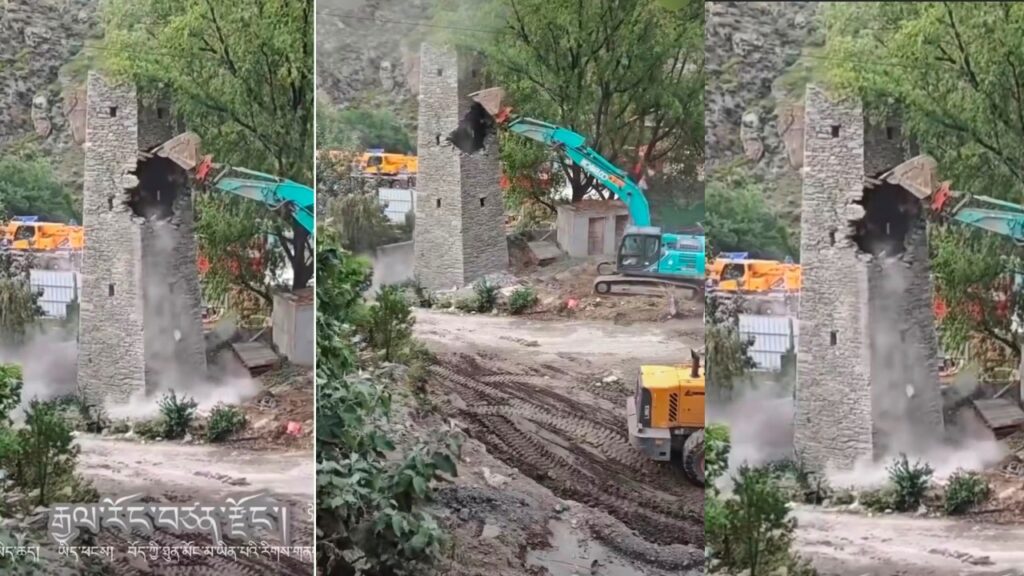
This raises a question: if the demolition was, as the Chinese state media insists, a lawful and routine part of an approved infrastructure project, it remains unclear why footage of it would be treated as leaked material never meant for public release, or why the video was swiftly removed from Chinese social media platforms.
Responding to the Chinese state media account, Tenzin Lekshey, Director of the Tibet Policy Institute (TPI) under the Central Tibetan Administration, rejected Beijing’s assertion that the demolished structure was a modern replica, arguing that such a claim defies logic in a region where authentic centuries-old stone fortresses remain part of the historic landscape.
“If the demolition was conducted in accordance with the law, why was the video censored across social media platforms so rapidly?” Lekshey asked, arguing that the swift removal of the footage undermines official claims of transparency and legality.
He also questioned why authorities chose to route the expressway through a historic cultural site when alternative alignments could have been adopted, warning that similar infrastructure projects must not be allowed to threaten Gyalrong’s remaining stone towers.
Further challenging Beijing’s legal justification, Lekshey asked, “Is China a country governed by the rule of law, or rule by law?” He argued that, in this case, legal procedures were being used to legitimise the destruction of Tibetan cultural heritage rather than to protect it.
The demolition has renewed broader concerns over Beijing’s infrastructure expansion across occupied Tibet. While Chinese authorities portray highways and other large-scale development projects as drivers of economic growth and connectivity, Tibetan scholars and rights advocates argue that such projects increasingly facilitate state control, demographic transformation and the erosion of Tibet’s historical and cultural landscape. They contend that the destruction of the Gyalrong fortress reflects a broader pattern in which development is used to justify the loss of irreplaceable Tibetan cultural heritage.